Page 54 - TLU magazine - The Way to The Top
P. 54
a new look at
SCIENTIFIC
COMMUNICATION
An acquaintance shares an article on Facebook about vaccines, a politi- cian talks about the safety of electronic elections on a news show, young people organise a picket at Toompea on the subject of environmental change. These are examples on how topics related to science spread in the public domain without a lab professor in a white coat.
On one hand, scientific communication has wished for a wider spread of scientific knowl- edge and research results in society so that the information reaches everyone. On the other hand, a common concern is that if everyone has the ability to spread information, false
or distorted information can be ac- cessed much more easily.
This is how topics with great social influence are discussed. For instance, climate change and vac- cinating, where it is im- portant that up-to-date and scientific informa- tion is accessible to us in the public space.
Calls for more and better
scientific communication are
becoming more frequent when
stupidity is spreading somewhere.
The problem is that we lack a common understanding of what can be understood as the quality of scientific communication.
This is the task set for Tallinn University in
the project QUEST, funded by the Horizon 2020 programme. We wish to understand how scientific communication parties interpret quality and wish to provide a framework based on the interpretation on which both scientists and journalists would agree. This would help both posters on social media and supervisors of research centres.
Across Europe, including in Estonia, there were six workshops that brought together journalists,
scientists, scientific communication special- ists and science enthusiasts and presented them with a question: Which elements make up the quality of scientific communication for you? While analysing keyword charts, we have
formulated 12 initial indicators based on which the content of scien-
tific communication can be assessed and perhaps even
measured with.
Further elaboration of the results still needs to be done, but it is
already clear that the indicators fall into
three groups which relate to the scientific
nature of the sources used and their reliability,
the presentation of the content and the social role of scientific communication. Based
on the indicators, we will formulate guidelines for the specialists on different fields of scientific communication with which they can assess the quality of the content created.
Project QUEST ”QUality and Effectiveness in Science and Technology communication” takes place from 1 February 2019 to 31 January 2021. Funded by the Commission of the European Communities under the Horizon 2020 programme. The budget is €74,812.50.
Principal Investigator: Lecturer of BFM scientific communi- cation at Tallinn University Arko Olesk. Follow the project at questproject.eu
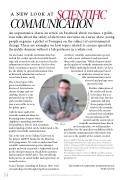
Lecturer of scientific communication Arko Olesk
 54
TALLINN UNIVERSITY MAGAZINE / NO. 14 / SPRING 2020
i
n
ä
R
t
e
r
i
P
:
y
b
o
t
o
h
P
k
s
A
r
k
o
O
l
e