Page 26 - TLU magazine - The Way to The Top
P. 26
RURALCHANGE INAN URBANISING WORLD
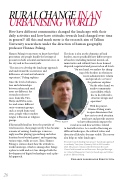
How have different communities changed the landscape with their daily activities and how have attitudes towards land changed over time in general? All this and much more is the research aim of Tallinn University researchers under the direction of human geography professor Hannes Palang.
Hannes Palang’s team wants to know how third generation city people handle the heritage of peasants in both a mental and material sense, in the city and in the countryside.
“The aim is to develop the landscape approach and understand the coexistence and differences of rural and urbanistic experience,” Palang explains.
Since the level of urbanisa- tion and relationships between urban and rural areas are different, the researchers observe
cases from Ida-Viru,
Harju and Põlva coun-
ties and across different socio-economic groups,
such as youth from rural areas, people whose mother tongue is Russian or religious groups.
If historically land has been the provider of
vital resources, then progressively it has become a means of earning. Landscape is increas-
ingly used for playing (geocaching and other location-based virtual games) and organising various trips, walks or races. Thus, Hannes Palang is curious about how the attitude to- wards landscape, which is among other things
a place to walk and rest, has changed with the development of digital technologies and a play- ful approach.
The focus is also on the dynamics of land borders, more specifically how different types of borders (including material, mental, ad- ministrative and cultural) have been formed, disputed, negotiated and preserved on all levels.
“On one hand, we analyse the chang- ing of the borders in relation to
recent administrative reform and spread of e-services,”
the professor explains. “On the other hand, we
analyse community accessibility, which
has to do with infra- structure design and
operation.”
With his project, Hannes Palang wants
to open dimensions that have not received attention
until now and provide answers to how urbanisation impacts the
rural areas and how activities related
to land affect cities. As a result of focusing on different landscapes, the cultural values and diversity of lifestyles become visible. The survey also helps us value landscapes.
Personal research funding team project “Landscape approach to rurbanity” lasts from 1 January 2019 to 31 December 2023. The project is financed by the Estonian Research Council with around one million euros. Principal Investiga- tor: School of Humanities Centre for Landscape and Culture professor Hannes Palang.
Research coordinator Kerstin Liiva
 26
TALLINN UNIVERSITY MAGAZINE / NO. 14 / SPRING 2020
i
n
ä
R
t
e
r
i
P
:
o
t
o
h
P
g
n
a
l
a
H
a
n
n
e
s
P