Page 28 - TLU magazine - The Way to The Top
P. 28
 28
TALLINN UNIVERSITY MAGAZINE / NO. 14 / SPRING 2020
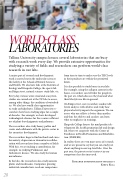
Molecular Sciences lab. Photo: Lauri Veerde
WORLD-CLASS
LABORATORIES
Tallinn University campus houses several laboratories that are busy with research work every day. We provide extensive opportunities for studying a variety of fields and researchers can perform world-class research in our labs.
A major part of research and development work is carried out in the molecular sciences lab facility at the School of Natural Sciences and Health. We also have labs at the Institute of Ecology and Haapsalu College, the sports lab on Räägu street, natural sciences study labs, etc.
Every day, various water, mud and ecosystem studies are carried out at the TU labs to assess, among other things, the condition of waterbod- ies. We also have world-class opportunities
to study carbohydrates. Tallinn University re- searchers have been studying algae for a couple of decades. For example, we have developed technological schemes for the resource efficient use of plant-based pigments and polymers.
The researchers also study honey, pollen and scents and collaborate with the private sector in the cosmetics development.
The researchers hope to find methods and cures for anxiety, depression or dementia in collabo- ration with researchers from a number of fields. With this, we are making a contribution, for example, in studying Parkinson’s and Alzheimer’s disease. We also study the human microbiome.
In the labs, the researchers also study narcotic plants and mushrooms. Companies growing industrial cannabis have used our competence
from time to time to make sure the THC levels in their products are within the permitted limits.
It is also possible to study bones in our labs. For example, using the collagen content in the bones, researchers can tell what the people in the past ate, which diseases they had and what their lifestyle was like in general.
On Räägu street, our researchers conduct dif- ferent analyses with athletes and study how physical activity impacts the organism. We can assess why one athlete is better than another and thus the athletes and coaches can learn what to emphasise in trainings.
Haapsalu College houses the mud product de- velopment lab, health promotion lab and design lab, where we cooperate with the Centre of Excellence in Health Promotion and Rehabilita- tion (TERE KK).
In reality, there are even more areas of research and we are proud to say that you can study just about anything in our top-level labs. Over the past year, the private sector’s interest in our competence has also increased.
Research communication specialist Kertu Kula