Page 30 - TLU magazine - The Way to The Top
P. 30
Use of crustacea in healing wounds –
FUTURE OF MEDICINE?
Tallinn University School of Natural Sciences and Health research track associate professor Rando Tuvikene spent three years with partners from Norway, Romania and Greece studying how the industrial residue of crustacea could be used better and more effectively. For example, in medicine, for boosting the treatment of burns.
In one year, 6-8 million tonnes of shrimp and crab shells are produced as waste in the world, which take a long time to decompose in nature. Currently, there is no good use for them, which is why the shells must be recycled. It is
possible to extract chitin from the shells of crustacea, but it has little use because it is water-insoluble. However,
as a result of chemical treatment, it is possible to produce chitosan from chitin, which
is water-soluble and mostly has antibacte- rial properties.
Making a bandage
The leading partner of
project CHITOWOUND,
Norwegian University of Science and Technology (NTNU), has historically studied several marine biomasses, including chitosan. Crustacea have not been studied in depth at TU before; however, we have worked on identifying the chemical composition of marine algae.
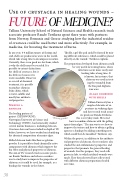
Milled chitosan looks like flour or gelatine powder. It is possible to bind chemically active components with chitosan which improve the bio effect and physical properties of chitosan. The aim of TU research track associate profes- sor Rando Tuvikene and other researchers was to study how to improve the properties of chitosan so it could be used, for example, as a bandage for wounds in the future.
“Ideally, a gel-like pad could be formed by mix- ing different substances, which could be placed directly on the wound,” Tuvikene explains.
The preparation developed from chitosan could be very useful in treating burns, where
infections occur more easily and healing takes a long time. It
is known, for instance, that chitosan was used in treat-
ing the wounded from the Iraq and Afghani-
stan wars.
Algae combined with shells
Tallinn University has a couple of decades of ex-
perience in studying algae and for research track associ-
ate professor Rando Tuvikene, this is everyday work. He tested
how to combine chitosan with the gelling agents from algae. “The aim was to see how to improve the texture and how to obtain a gelling agent or a bandage by adding something new, which could then be moulded,” Tuvikene says.
Within the project, in addition to the antibacte- rial properties of chitosan, the researchers also studied the anti-inflammatory properties and properties that promote the general healing
of wounds. For this purpose, they used cells grown in labs, to which artificial wounds were made. They then observed how cells treated with different chitosan preparations healed over time.
 30
TALLINN UNIVERSITY MAGAZINE / NO. 14 / SPRING 2020
i
n
ä
R
t
e
r
i
P
:
o
t
o
h
P
r
e
d
w
o
p
C
h
i
t
o
s
a
n