Page 34 - TLU magazine - The Way to The Top
P. 34
34
The project "Schoolchildren's hearing acuity study" is funded by non-government
organisation MTÜ Audiere. It is a collaboration between the Estonian Society of Audiologists, Tallinn University and the University of Tartu Clinic's ear clinic. The project began in November 2019 and will run until September 2020. In South Estonian schools, the study is conducted by Sandra Vill, an audiologist at the UT Clinic's ear clinic, in North Estonian schools the study is conducted by Avo-Rein Tereping, Project Manager of the Experimental Psychology Laboratory at the Tallinn University's School of Natural Sciences and Health.
Science communication specialist Kertu Kula,
communication specialist Signe Pikk
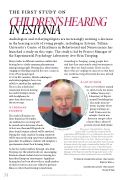
the first study on
CHILDREN’SHEARING
IN ESTONIA
Audiologists and otolaryngologists are increasingly noticing a decrease in the hearing acuity of young people, including in Estonia. Tallinn University's Centre of Excellence in Behavioural and Neuroscience has launched a study on this topic. The study is led by Project Manager of the Experimental Psychology Laboratory Avo-Rein Tereping.
Many studies in different countries confirm that hearing loss is a fairly common phenomenon among young people. Hearing loss, often tinnitus (ringing or whistling sound in the ears), occurs in 10 to 13% of people aged
12-35 in EU countries. British audiologists and otolaryngologists have even
called it a modern day epidemic.
There is also a fairly close
connection between hearing loss and listening to music with headphones for
more than three hours a
day on average.
A thousand students
The study of Estonian stu-
dents began last November.
An audiometric screening will
be carried out in Estonian schools.
At least one thousand 9th grade stu-
dents from Estonian schools will be involved. During the study, students' hearing sensitivity will be measured using a pure tone audiometric procedure. In addition, students will complete a questionnaire about their listening habits.
So far, the study is halfway through. Avo-Rein Tereping says the initial results are encouraging. Estonian school students have less hearing loss than their European counterparts. Significant hearing loss has been observed in a small number of subjects, but its causes are related to previous illnesses rather than listening to loud music.
According to Tereping, young people have
said that they consciously avoid environments where there are loud sounds. There are also those who use earplugs at concerts so that their ears would not ring afterwards because of loud
music.
 TALLINN UNIVERSITY MAGAZINE / NO. 14 / SPRING 2020
A lot of noise
Noise is everywhere around us, often we do not notice
it. Tallinn University's Laboratory of Experi-
mental Psychology has also made measure- ments in gyms where group trainings are
held. It turns out, for example, that in one
hour you can get a dose of noise that is about 85
percent of your daily intake.
n
o
i
t
c
e
l
l
o
c
e
t
a
v
i
r
P
:
o
t
o
h
P
g
n
i
p
e
r
e
T
n
A
a
v
o
-
R
e
i