Page 32 - TLU magazine - The Way to The Top
P. 32
  DIVERSIFY
URBANSPACE
Tallinn University is contributing to an international project with the aim of making European cities the ambassadors of sustainability.
74.5 per cent of European residents live in urban areas. By 2040 this percentage will be 80 and
by 2050, 85. Thus, we are facing social, health, environmental and economical challenges.
In order to further stress the interaction of people and nature as the main determiner of the physical and mental health and wellbeing of a citizen, the international Go Green Routes proj- ect was developed, which in Estonia is
lead by the TU School of Natural
Sciences and Health environ-
mental behaviour research
group “Human-nature
interactions in the city”
in collaboration with the
city of Tallinn. The re-
search group was estab-
lished at the beginning
of 2018 with the aim to
combine TU’s environ-
mental knowledge across
subjects under the guid-
ance of School of Natural
Sciences and Health professor
and sustainable development vice-
rector Helen Sooväli-Sepping. Tiiu Koff, environmental sociology research fellow Bianka Plüschke-Altof, environmental anthropology and environmental organisation lecturers Joonas Plaan and Piret Vacht and junior research fellow Anni Müüripeal.
Together, they are paving the way towards
a unique approach in urban planning that adheres to the aim of promoting the good re- lationship between people and nature, reviving the natural ties and increasing the involvement of citizens. Among other things, the focus is on establishing green corridors to connect public spaces in the urban environment with linear parks, walkways and bicycle roads.
Tallinn University researchers observe the so- cial, health and environmental impacts and get involved, if necessary. Thanks to the interdisci- plinary aspect of the research group, a holistic approach can be applied when measuring the impact of landscaped areas.
Interdisciplinary cooperation is also important. Relying on the competences of different fields,
the researchers can follow and map environmental indicators. Social,
health and wellbeing indica- tors are also measured
(access to landscaped areas, their recreational,
wellbeing and health impact, visitor satisfac-
tion and preferences, incl. sense of secu-
rity, visiting habits and environmental behav-
iour).
Recently, School of Natural Sciences and Health scien- tists in their SportEST cluster
“Health for active life innovations” have also highlighted the lack of physical ac-
tivity and time spent outdoors among Estonian children, which is also one focus for Go Green Routes. The green area in Tallinn city centre will obtain a new appearance and function, with resting areas and playgrounds, but also multifunctional landscapes.
Project Go Green Routes is financed by Horizon 2020 (Call H2020-SC5-2018-2019-2020, Greening the economy in line with the sustainable development goals). The project lasts for four years, until June 2023. Tallinn University and the city of Tallinn are among the almost 40 partners.
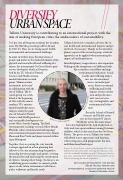
Sustainable development vice-rector Helen Sooväli-Sepping and environmental sociology research fellow Bianka Plüschke-Altof
 32
TALLINN UNIVERSITY MAGAZINE / NO. 14 / SPRING 2020
32
i
n
ä
R
t
e
r
i
P
:
o
t
o
h
P
g
n
i
H
p
p
e
S
-
e
l
e
n
S
o
o
v
ä
l
i