Page 33 - TLU magazine - The Way to The Top
P. 33
  WATER AND
BIODIVERSITY
The basic research of Tallinn University Institute of Ecology goes hand in hand with the applicability and development of water policies. This leads us towards better preserved water resources and an ecosystem rich in biodiversity.
Although the Institute of Ecology has worked with water ecosystem studies throughout its nearly 30-year history, the term ecohydrol- ogy has become prominent only in the past decade. The ecohydrological approach * helps put together the pieces of the puzzle of differ- ent research fields: water movement below or above the ground or even within one
living organism is all a part of one circulation. All of these must be observed simultaneously and human impact must be considered additionally.
Even here in Estonia, we have no waterbodies
left that people would not have impacted with their ditches, water extraction or pollution.
The narrower field under
ecohydrology – investigat-
ing the connections between
the ecosystems dependent on
groundwater and groundwater and
surface water – has gained momentum
at the Institute of Ecology thanks to several surveys conducted for the state (developing the methodology and expert assessments) as well as research projects. The environmental problems of the Kurtna Lakeland in Ida-Viru County are handled both in the form of a research proj-
ect within the KESTA programme and in the form of applied research for the Environmental Board and Enefit Kaevanduste AS.
In recent years, international cooperation in the Interreg ESTLAT programme has been added, project GroundEco of which is coming to an end, but the next one (WaterAct) will soon
start and involves in addition to universities the
ministries of environment and geology agencies in both Estonia and Latvia. The latter mainly deal with the topics of groundwater-dependant terrestrial ecosystems (such as extremely rare and valuable spring marshes) and springs. Ex- pert opinions have also led us to deal with karst systems and springs.
In cooperation projects, the relations with neighbouring countries in
jointly managing the ground- water bodies are very
important since water does not acknowledge
state borders. In addi- tion, there is an agreed water policy and rea- sonable usage of water monitoring in terms of
resource saving.
Students have not been left out of the study of the relationship between ground-
water and surface water. In addi- tion to many Bachelor's and Master's
theses, there is one doctoral thesis on the subject of Lake Kurtna. Another focusing on the karst hydrology topic will be finished soon. Thus, ecohydrology has high potential and is an ever-evolving and thriving field of research.
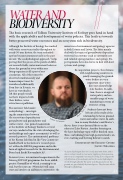
Director of the Ecology Centre Jaanus Terasmaa
*A classic hydrologist does not usually deal with biota, and a classic ecologist tends to treat water simply as a living environ- ment or as a compound necessary for living. If we compare the self-definition of groundwater and surface water hydrologists strictly through whether the water is in the ground or on the ground, we get relatively disjointed pieces. They become whole through ecohydrology.
 TALLINN UNIVERSITY MAGAZINE / NO. 14 / SPRING 2020
33
33
i
n
ä
R
t
e
r
i
P
:
o
t
o
h
P
J
a
a
a
a
n
u
s
T
e
r
a
s
m