Page 48 - TLU magazine - The Way to The Top
P. 48
 48
TALLINN UNIVERSITY MAGAZINE / NO. 14 / SPRING 2020
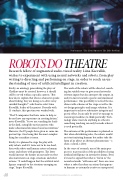
Performance “The Cloud Opera or The Dido Problem”.
ROBOTS DO THEATRE
Research fellow of augmented audio-visual reality Liina Keevallik, wishes to experiment with using neural networks and robots, from play writing to directing and performing on stage, in order to reach an un- derstanding of uses of artificial intelligent in creation.
Firstly, an ontology generalizing the plays of Chekhov must be created; however, it should still be served within a specific context. “But how do we explain that when a character speaks about fishing, they are doing so to drive away suicidal thoughts?” asks theatre artist Liina Keevallik, leader of the project. Recently with 13 students, this question was worked with.
“The IT companies that have come to help us do not have any experience in creating fiction,” notes Keevallik. “So we are searching for leads in the dark, acting like novice parents who make educational decisions based on intuition.” However, the IT people have given us some im- portant tips. One being that the most complex thing for a machine is irony.
Firstly, it is planned to stage the play with
only robots, and if it turns out to be too hard, then with robots and human actors or human actors and robots with prompters. The latter would instruct the former on not only text but also movements on stage, emotions and other actions. “It could happen that the artificial intel- ligence responds to the situation emerging on stage,” hopes Keevallik.
The work of the robots will be directed, search- ing for suitable ways to give neural networks relevant inputs but also interpret the output, in order to move towards a poetic and emotional performance. One possibility is to feed the ma- chines with schemes of the stage as well as the set design principles and image solutions. It is important to achieve substantive integrity and poetic effect. It can only be art if we manage to encourage machines to think poetically. Tech- nology alone won’t do anything in a theatre; something touching can only be made when it is used poetically.
The outcome of the performance is planned so that when distributing roles, the robots would not start imitating humans but rather take the form of an object or abstract phenomenon – a chair, a cloud, a deity.
In the sense of research, one of the main pur- poses is to get an idea of the possibility of using artificial intelligence in interactive drama. Even if it can be argued that what is “fed in to” the neural networks “will come out”, there are cases where a robot has done an action that appears to humans as extremely creative or unexpected.