Page 31 - TLU magazine - The Way to The Top
P. 31
    The aim of the researchers was to study how to improve the properties of chitosan so it could be used, for example, as a bandage for wounds in the future.
“Chitosan can quicken this process many times,” Rando Tuvikene confirms. “Especially if a bacterial infection occurs and the wound takes longer to heal.”
Tuvikene admits that during the project, there were many setbacks when mixing together different substances – some residue settled or there were clumps in the mixture. “We wanted a homogenous texture, without clumps,” the pro- fessor says. “At last, we obtained a material with improved properties, but it is far from perfect.”
Improving the properties
A product has not been launched during the project because bringing a new medicinal product to the market is a lengthy process. It requires years of testing.
But of course, there is always hope that the hard work will yield a product that will actu- ally reach the market. However, Tuvikene admits that their main aim was not to produce anything, but to show that the texture and biological activity of chitosan can be improved in several ways. This was successful and this
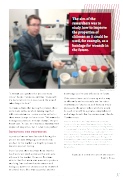
Rando Tuvikene
knowledge can be used efficiently in future.
If the researchers could come up with a way
to efficiently and sustainably use the indus- trial residue of crustacea, and demand would increase to the extent where all shells would
be used, it would be a great accomplishment and a huge benefit for the environment, Rando Tuvikene says.
Project CHITOWOUND “Implementation of biotechno- logical tools for new wound healing applications based on by-products from the crustacean seafood processing industry” is international. It involved Tallinn University, the Norwegian University of Science and Technology (leading partner), the West University of Timișoara in Romania, the University of Crete and the FORTH Institute of Molecular Biology and Biotechnology. Additionally, industrial partners Seagarden, Sintef and AlgiPharma from Norway were involved. TU’s participation in the project was financed by the Ministry of Rural Affairs.
Research communication specialist Kertu Kula
TALLINN UNIVERSITY MAGAZINE / NO. 14 / SPRING 2020
31
Photo: Piret Räni