
Designing trust in AI: Wise Pathfinders win second place at Wise Hackathon 2026
In November 2026, four Master's students from Tallinn University's Human-Computer Interaction (HCI) programme – Ksenija Meier-Kozlova, Anna Zhukova, Martin Türnpuu, and Hatim Lachyab – secured second place at the Wise Hackathon in Tallinn as the team Wise Pathfinders.
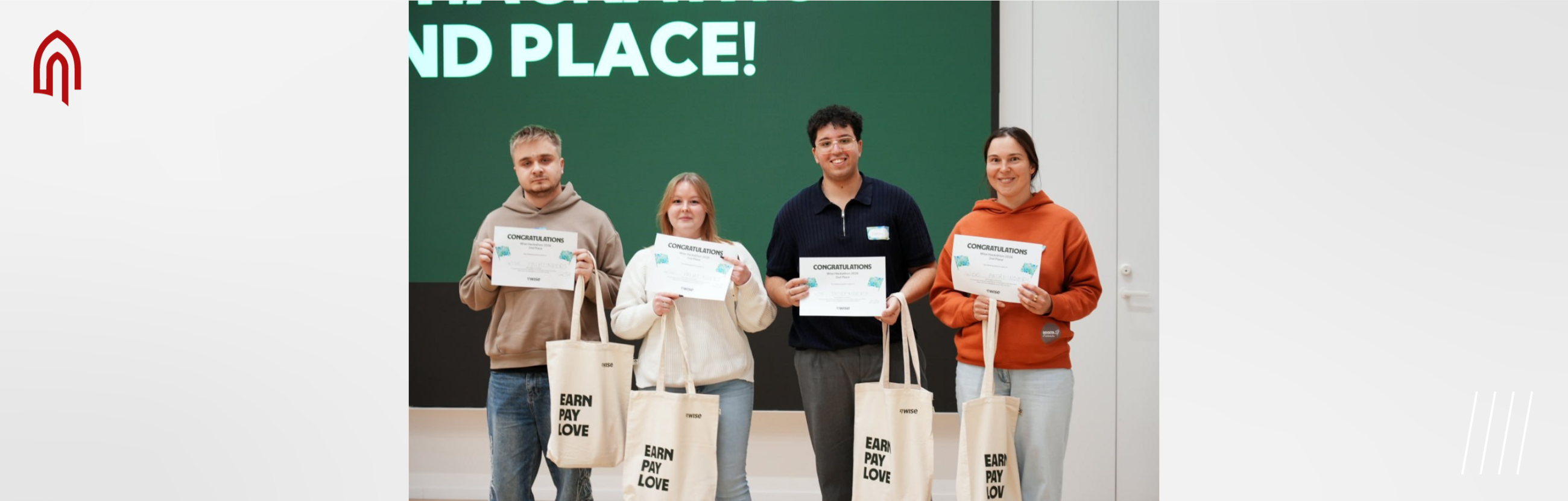
Returning for a second consecutive year, the team put what they had learned into practice and reflected on how much they had grown since their first hackathon in 2025.
Designing for trust and user control
This year's hackathon theme, "Max Ease", challenged participants to explore ways of reducing friction in everyday experiences. Drawing on their knowledge of human-centred design and trust in technology, the team addressed a timely challenge at the intersection of artificial intelligence, financial technology, and human-computer interaction: how can AI assistants perform financial tasks while ensuring that users remain in control of their money?
Their project, Wise Agent Pass, proposed a permission-based system that enables AI assistants to initiate financial transactions within user-defined boundaries. Guided by the principle "Let AI do the work. You stay in control", the solution allows users to set spending limits, manage trusted recipients, and approve transactions that fall outside their predefined rules. A central principle of the concept is that security rules are enforced by Wise rather than the AI assistant itself. This approach reflects the importance of designing for appropriate trust, transparency, accountability, and user control — concepts explored within the HCI programme.
Putting HCI knowledge into practice
Throughout the hackathon, the team applied methods and approaches developed during their studies, combining user research, interaction design, product thinking, rapid prototyping, and software development. They explored existing technological capabilities, conducted a user interview, developed a persona, and used research findings to inform their design decisions. The team also experimented with an AI-assisted design workflow, incorporating Claude and a design system into their process. The result was a functional prototype demonstrated live with Claude, showcasing three scenarios: an automatically approved payment, a transaction requiring user confirmation, and a blocked payment due to changed recipient bank details.
A year of learning and professional growth
For Wise Pathfinders, this year's achievement was about more than securing second place. Returning to the hackathon allowed the team to recognise how much their skills, confidence, and approach to problem-solving had evolved over the past year. The knowledge and practical experience gained through the HCI programme helped them approach the challenge more systematically, ask better research questions, make more informed design decisions, and transform a complex idea into a functional prototype within a limited timeframe. Their experience demonstrates the value of the HCI programme in bridging academic learning and real-world practice, equipping students with the skills to critically evaluate emerging technologies, collaborate across disciplines, and design solutions that address genuine human needs.