

Digital Learning Games
Digital Learning Games is an interdisciplinary programme that combines game design with educational sciences and psychology. In DLG, we recognise that video games are more than entertainment: they also offer unique ways of tackling educational and societal issues. We welcome educators, designers, developers, artists, and everyone else interested in creating innovative games that can help make the world a better place.
What do we offer?
At its core, DLG is a game design programme. What makes us different from other programmes is that we focus on learning games and so-called serious games: games that can be used in education and training, raise awareness about social issues, improve players’ physical and mental health, and so on.
The programme’s main strengths are:
- Unique focus: in DLG, you will learn not only how to design games, but how to maximise their learning potential and societal impact.
- Interdisciplinary curriculum: DLG integrates game design with education sciences, psychology, and broader game studies, offering a uniquely multifaceted approach to digital games. The curriculum also covers other core skills necessary for game production: programming, art, project management, etc.
- Project-based learning: we believe that the best way to learn is by doing. This is why many courses in Digital Learning Games are structured as interdisciplinary team projects focused on producing a tangible outcome, which helps students build up their portfolios.
- International community: with students from 45+ countries, DLG offers an enriching intercultural experience and provides a foundation for building international networks.
- Innovation-centred environment: Estonia is one of Europe’s innovation hubs: it has the most start-ups per capita and was the world’s first nation to introduce e-government. You will be able to take part in hackathons, game jams, and ICT events both at and outside of Tallinn University.
Who are we looking for?
Digital Learning Games is a programme for those who want to design meaningful and impactful games: designers and educators interested in exploring games’ transformative potential, developers and artists expanding into game creation, and career-changers from other fields. Game creation requires different skills and is usually a team effort involving people from diverse fields.
We welcome applicants from all backgrounds, including but not limited to.
- Programming: software development, using game engines
- Visual art: 2D or 3D art, animation
- Audio: sound design, music composition, and production
- Education: instructional design, educational technology, teaching
- Research: psychology, sociology of education, design theory, etc.
We do not require prior programming knowledge or familiarity with game engines. If you wish to learn these skills, the programme will provide a supportive environment to do so. If you already have them, you will certainly be able to put them into practice. And if you would like to focus on other aspects of game creation (design, asset creation, etc.), you are welcome to do so.
Start your application
Local candidates – Estonian citizens and holders of a long-term residence permit in Estonia:
Apply via SAIS
International candidates – candidates who do not hold Estonian citizenship or a long-term residence permit in Estonia:
Apply via DreamApply
Career opportunities
DLG alumni pursue careers in a wide range of fields where games, learning, and design intersect. Common career paths include:
- Game industry: DLG alumni work as designers, developers, and in other roles in game studios in Estonia and beyond.
- Education: many of our graduates work as educational technologists, teachers, and instructional designers in both formal and non-formal education.
- Academia: completing the programme opens up a pathway to pursue a doctoral degree in educational technology, game studies, and other relevant fields.
- ICT: DLG alumni have used their skills to help integrate gamification and improve the user experience in various software companies and tech startups.
How is this programme structured?
Digital Learning Games is a two-year programme taught in English. At the core of the programme is the Game Design, which includes the following courses:
- Introduction to Digital Learning Games and Game Studies.
- Fundamentals of Game Design.
- Learning Game Development.
- Games for Learning and Teaching.
Students can also choose from a variety of elective courses that support specialisation in game development, educational psychology, game art, or industry."
At the end of their studies, students will produce a research-based Master’s thesis, which may focus on designing and testing a digital game or gamified tool; using game-based approaches in educational and work settings; and other relevant topics.
Digital Learning Games curriculum
(Note that the programme is subject to change.)
Admissions
Please adhere to the Academic Affairs Office guidelines when filling in the section about Admissions and Admission Exams.
Application dates
- international applicants: 1 November 2026 - 1 March 2027
- local and eligible applicants 1 November 2026 - 29 June 2027
View detailed admission requirements and timelines for the applicants.
General requirements
- Completed Bachelor’s degree or the equivalent
- Proof of English Proficiency
Please see the complete overview of admission and application requirements for Master's level applicants.
Application documents:
- Curriculum vitae (CV)
- Motivation letter (maximum 700 words)
- Portfolio
Entrance exams
The entrance examination consists of two components:
- Assesment of submitted documents (50%) – evaluation of the motivation letter and portfolio.
- Admission interview (50%) – assessment of the applicant's motivation, communication skills and ability to present an original learning game or research idea.
Assessement
The entrance examination consists of an assessment of the motivation letter and portfolio (50 points) and an interview (50 points), with applicants required to score at least 35 points in each component to pass.
1. Assessment of submitted documents (50 points)
Motivation letter
The aim of the motivation letter is to introduce the applicant’s background and articulate their interest in the fields of game design and game-based learning. The motivation letter should provide an overview of how the applicant’s personal and professional background connects to their interest in the programme and discuss how the study of game design and game-based learning is relevant to their future career. Whenever relevant, applicants are encouraged to highlight specific games, academic publications, as well as personal and professional experiences that connect to their discussion. The motivation letter should be up to 700 words long.
Portfolio
The portfolio may be submitted as a PDF file or as a URL (e.g., the applicant’s personal page, Github repository, Itch.io or Artstation page, etc.). The contents of the portfolio depend on the applicant’s background and will be evaluated relative to their professional experience.
- Applicants with a background in education: course syllabi, lesson plans, any teaching materials developed. A short annotation introducing the materials’ context of use should be included.
- Applicants with a design background: digital or non-digital games, apps, or prototypes, design and concept documents, etc. Games may range from game jam entries and school projects to published work. For group projects, a description of the applicant’s role and contribution should be included.
- Applicants with a background in visual art, graphic design, music, creative writing, etc.: a selection of creative works with brief annotations explaining the context.
- Applicants with a background in computer science and software engineering: examples of previous work, preferably in the form of code repositories, and a short description of each included project’s background and functionality.
- Applicants with a research background: one or several publications, including bibliographies. For work with multiple authors, the applicant’s specific contribution should be stated.
- Applicants with other backgrounds: a selection of practical work that demonstrates their specific skill set and a brief description of the context behind it.
- A recent graduate may submit their final thesis or project, or any relevant work completed during their undergraduate studies.
2. Admission interview (50 points)
During the admission interview, the applicant will be asked a series of questions based on their motivation letter and portfolio, as well as invited to briefly present an original idea for a learning game that relates to their interests and expertise, or an idea for a research project related to game-based learning or game design.
Assessment criteria
The application is evaluated based on:
- how specific its content is to the study programme
- how clearly written and structured it is
- how clearly it articulates the programme’s relevance to the applicant’s educational and professional background, as well as their career vision
- to what extent it demonstrates familiarity with the field
- to what extent the skills and outputs presented in the portfolio are relevant to the study programme
The admission interview is scored based on:
- the applicant’s language fluency and communication skills
- the applicant’s ability to offer meaningful and specific responses to the interviewers’ questions
- the applicant’s ability to present a learning game idea or a research idea that is clear, meaningful, and does not merely replicate existing work
To pass the entrance examination, applicants must score at least 35 out of a maximum 50 points in each category.
Students and alumni stories
Watch videos with our students and alumni:
Read Interviews with our alumni:
DLG Games
Below are some of the educational games DLG staff and students have worked on.
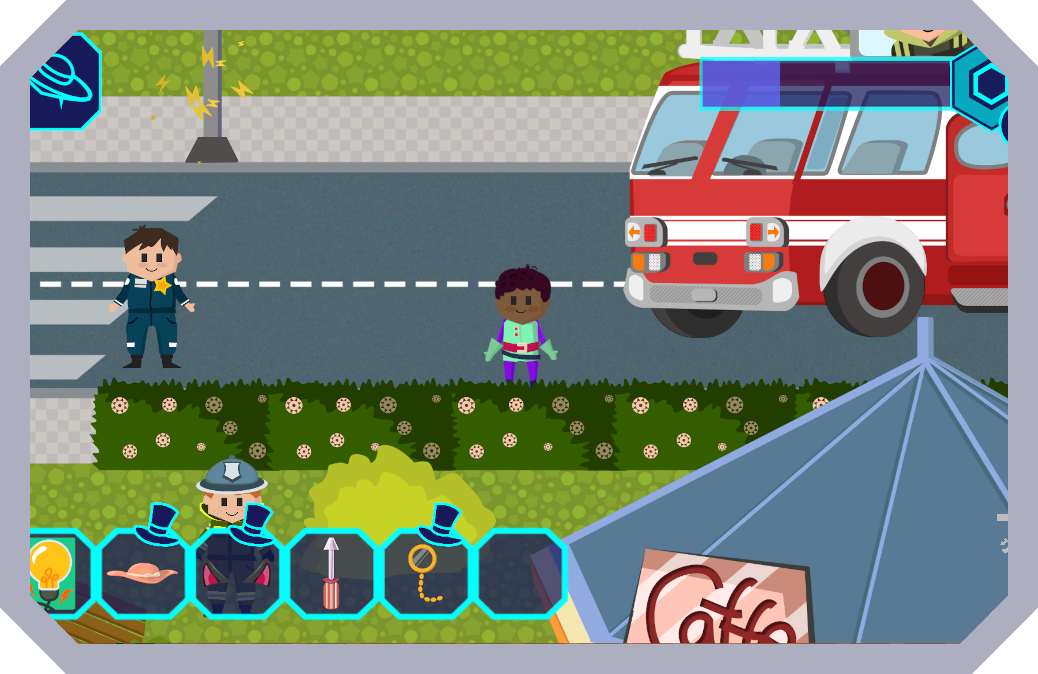
Spoofy is a game introducing the basics of Internet safety and cybersecurity to primary schoolers. In the game, you play as an interstellar traveller visiting five different worlds and helping their inhabitants solve their cyber-issues. Spoofy was created by CGI Inc. in collaboration with Tallinn University, whose team was responsible for expanding the game by designing the fifth world.
Find more information about the game and play
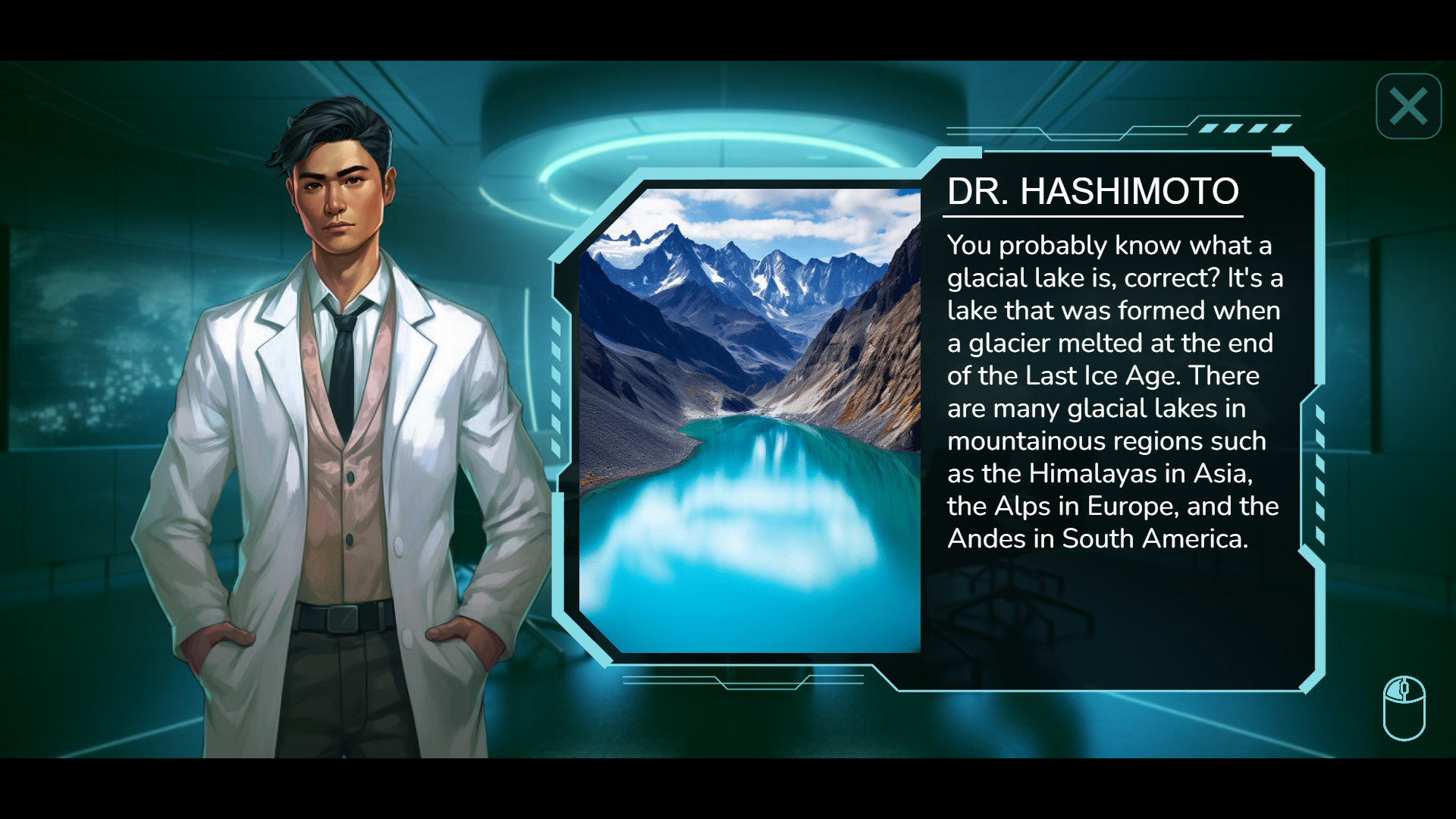
BIG GAME is an Erasmus+ funded online game about climate change, set in the near future. In the game, teams of students role-play as members of the newly established United Nations Anti-Apocalypse Force and develop solutions to environmental crises around the globe. In November-December 2023, the game was played by over 220 school teams from across Europe. The game was designed by a team from Tallinn University in collaboration with partners from Finland, Estonia, Italy, and Romania.
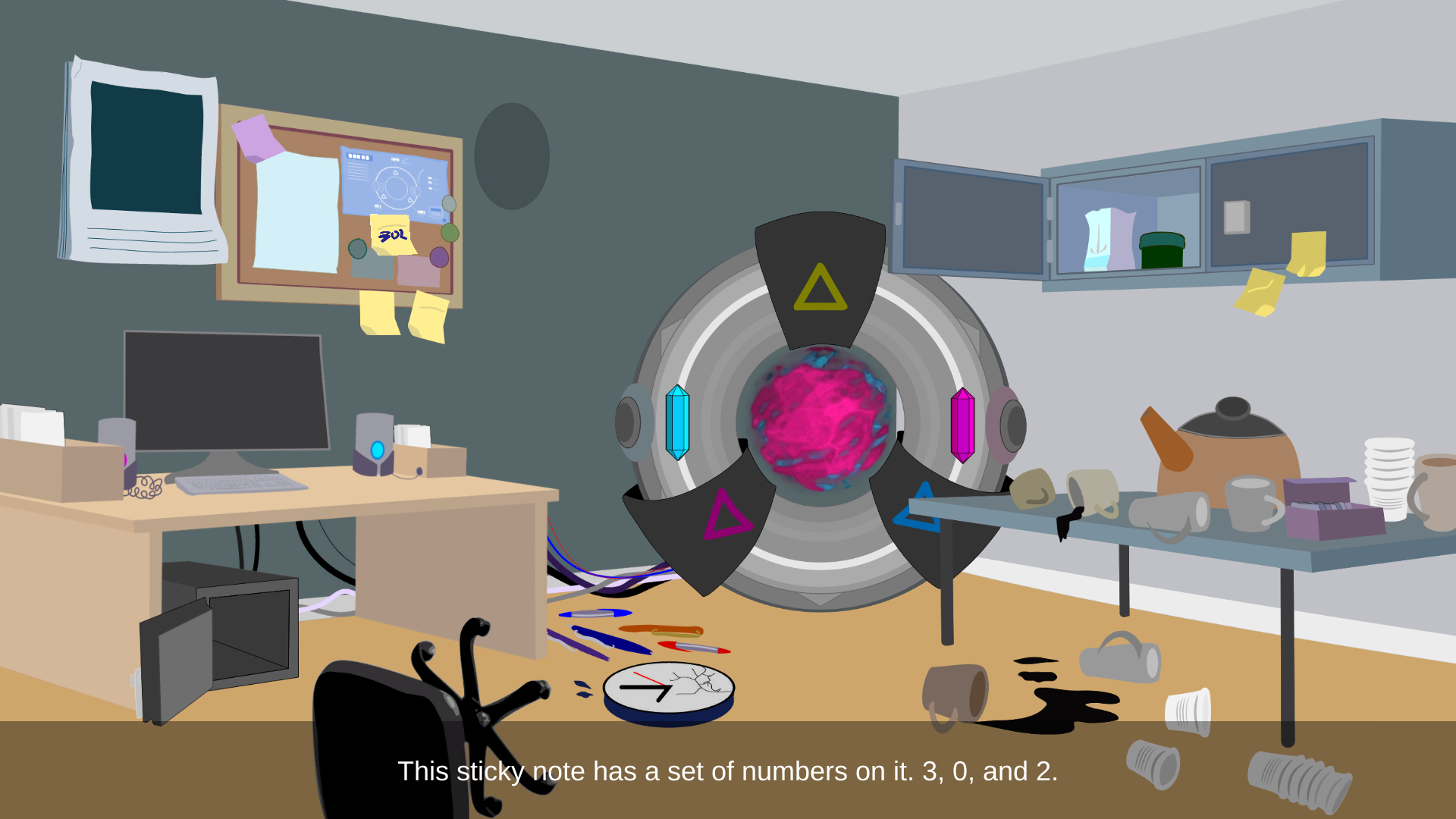
Methodyca is a point-and-click adventure game designed to introduce university students to research methods in the social sciences and design. In the story, the protagonist is a student on a quest to find their missing thesis supervisor. This quest takes them to a parallel world, where they encounter a variety of eccentric characters and unlock mini-games about qualitative and quantitative research methods. The game was funded by the Estonian Education and Youth Authority.
Find more information about the game and play
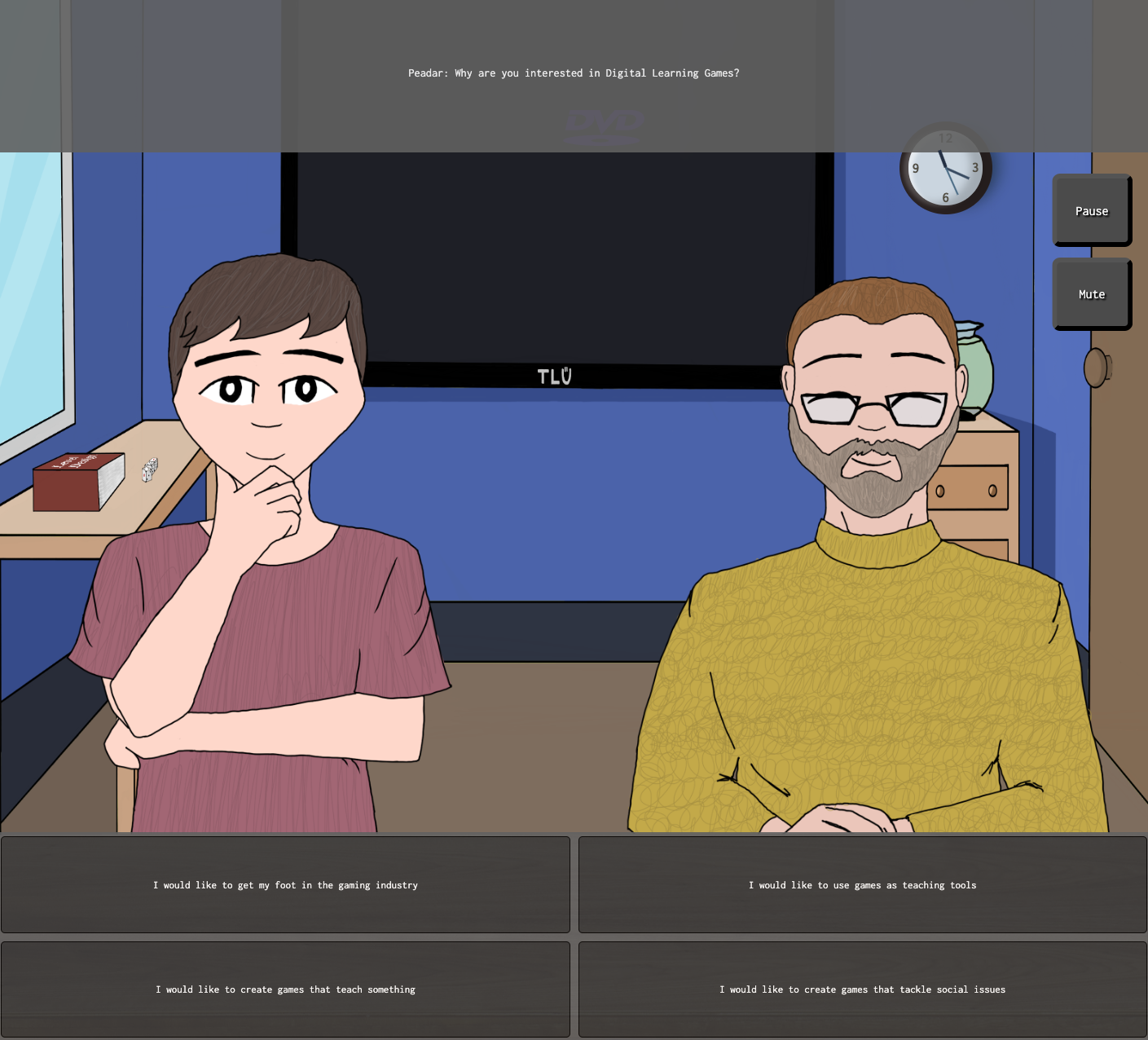
Interview Simulator is a game for the Digital Learning Games (DLG) master's program at Tallinn University. The goal of the simulator is to familiarise the admission interview process and the nature of the DLG programme in general. Learn what kind of questions are asked during the interview and see what kind of responses the DLG academic staff prefers. Keep an eye on the teachers' reactions to your answers! The simulator was developed by students of the Computer Science bachelor's program for the software development course at Tallinn University.
Scholarship
As part of our commitment to fostering academic excellence, Tallinn University offers tuition discounts for the top three applicants (in the first semester) and students (in subsequent semesters) in the programme.
75% tuition discount to the highest-performing applicant or student: The top-performing applicant or student will be awarded a 75% tuition discount. This prestigious award recognises those who have demonstrated exceptional academic ability, innovative approaches to digital learning, or significant contributions to the field of learning games.
50% tuition discount to the second highest performing applicant or student: The second-best applicant or student will receive a 50% discount on tuition fees. This discount is for those who have shown strong potential and excellent performance, contributing meaningfully to the development of digital learning experiences through games.
25% tuition discount to the third highest-performing applicant or student: The third-place applicant or student will be awarded a 25% tuition discount. This is aimed at students who have demonstrated solid academic achievement, creativity, and dedication to advancing the role of digital games in education.
Please note:
- The recipients of the scholarship for the first semester will be announced on September 1, 2027 (once all newly enrolled students are confirmed).
Contact Us
Kristi Oikimus
Study Counsellor and Specialist of the programme
visit usNarva mnt 29, 10120 Tallinn, room A-431
call us(+372) 640 9384
Email uskristi.oikimus@tlu.ee
For additional guidelines regarding the admission procedure, please contact the international admission specialist.
E-MAILadmissions@tlu.ee
Related programmes
Human-Computer Interaction
School of Digital Technologies
Human-Computer Interaction (HCI) is a research-based programme that brings together computing, interaction design, and cognitive psychology. The programme prepares specialists who can analyse human behaviour, design meaningful digital experiences, and create interactive systems grounded in theory and evidence. HCI offers a strong combination of technical, design, and research skills that students consistently value for its depth and international perspective.
Educational Innovation and Leadership
School of Educational Sciences
Education is at the forefront of societal progress, requiring leaders who can introduce transformative strategies and innovative practices. The Educational Innovation and Leadership Master's Programme at Tallinn University prepares you to be one of these leaders. Rooted in the excellence of Estonia's education system, our programme is designed for those eager to drive change and improve learning outcomes worldwide.