
The good game developer must also be a businessman!
Ahmed Elshenawy is an alumnus of the Digital Learning Games Master’s Programme of the School of Digital Technologies. Ahmed finished his studies back in 2021 and today is running courses for new students of DLG. In our interview Ahmed shares his views about educational games, talks about the game industry and explains why the older generations don't want to hear anything about it.

Ahmed, how did you start your studies at Tallinn University’s School of Digital Technologies?
Although my BA is in Civil Engineering, I was always interested in movies and games. At some point, I decided to learn game development by myself and took an online 6-month-long course presented by Michigan State University.
One day, my friend suggested that instead of taking this self-learning path, which could be endless, I should probably make a whole career shift. Considering the fact that I didn’t want to study something technical, but rather soft sciences, the Digital Learning Games MA program caught my attention. When I got familiar with the topics that are taught in the framework of DLG, such as game design and the development of educational games, I thought that this is definitely something I would like to study.
Which main things of the study program interested you mostly?
The idea of combining educational, game, and academic aspects all together seemed interesting. In the past, I read a lot of articles about game development and listened to conference talks, but I have never looked at this topic from the academic side.
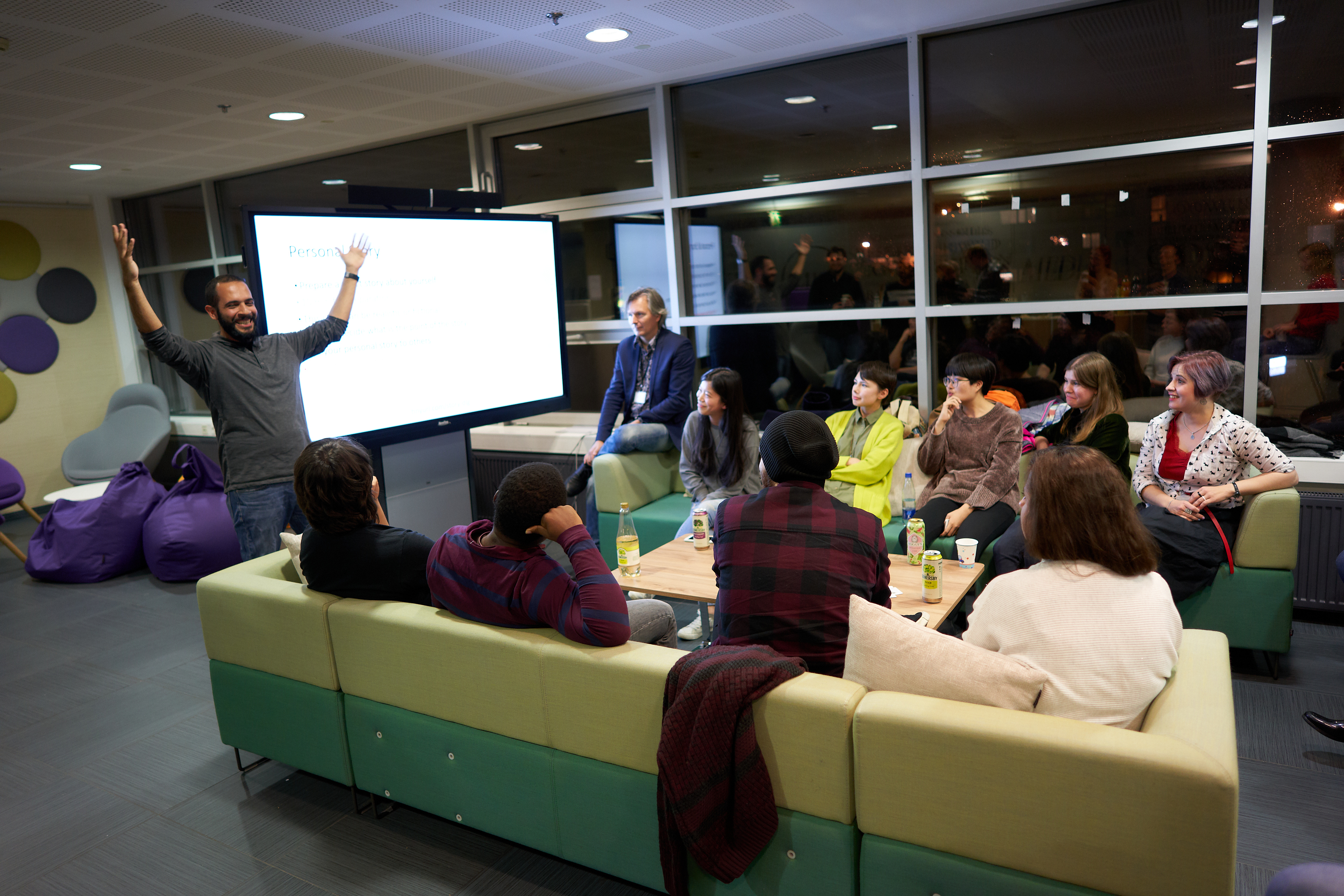
When Associate Professor Martin Sillaots and lecturer of Serious Games Mikhail Fiadotau asked me during admissions what I think about educational games, I said that today they are very boring. Developers forget about the fun part and put the main focus on educational components. A lot of those games are just lectures packaged in a nice graphic design. So I thought about investigating this question and trying to understand how we could make learning games fun and cool.
Have you worked on some interesting projects during your study years? Please tell a little about them.
While I was studying, I did my internship at a studio called Unreal24, which develops VR games. I helped the company to design the new version of the logo for the “Cradle of Sins” team-based competitive game in VR and also helped with motion graphics materials for a live event.
Later on, together with a junior research fellow in DLG, Peadar Charles Callaghan, and 2 other students, we made a game called “Number Snatchers”. It is both educational and fun! This card game teaches simple math under “stressful” conditions: while the player is trying to concentrate and solve mathematical combinations, an alien invasion is happening. In order to win, the player has to show the aliens that he is smarter than them. This game was created in the framework of 2 courses, “Project management” and “Game development”. I have also worked on the famous “Methodyca” game of the DLG program.
You are also a lecturer at Tallinn University. Please tell me more about what exactly you teach.
I teach “Basics of game development” and “Advanced game development” courses in the DLG program.
Ahmed, you are from Egypt. What is the situation there considering the gaming industry? Are people interested in this field?
Yes, they are interested, but the situation is a little bit different than in other countries. The older generation in my country is not taking the topic of games seriously. So if the younger generation wants to study game development, parents would not consider it as something that can become a job in the future. They don't know that the game industry worldwide makes more money than the movie and music industries combined. Especially during Covid19 times, there was a boom in the economy of the game industry. In Egypt, we have enthusiasts, amateurs, and programmers who come together and do something, but usually there is a lack of game designers. They know how to create art, but they don't understand how to design a gameplay experience.
Don't you want to go back and set this industry there now, when you have enough knowledge and experience?
I need a little bit more experience in the game industry. I am interested in the business component of game development: how to create the product, distribute it, and finally sell it. In the past, I used to think that, in order to sell a game, I just had to work hard on its development and share some info before the release date. But I learned that this is not the right way. A lot of games are released at the same time as others, so in order to sell, you have to reach the right audience.
Another important thing is that you don't wait until the game is finished to start marketing it, but you start it from the beginning, in parallel with the development of the game. Everybody has a passion to make something, but only a few want to know how to run a business, make a budget, or do the marketing part. Very often, this is the main reason for failed projects. So that’s why having experience in the business field is crucial for a game developer.
How do you use skills gained while studying in the School of Digital Technologies in your daily life?
During my studies in DLG, I gained knowledge about ways of doing proper research and collecting data. In my work, I often use those methods.
Which features should a good digital learning game have?
The best way to make a good digital learning game is to integrate elements of fun and learning together. Often, during the process of game development, a separation of game and educational aspects happens. In this case, developers either focus on the game or only on the educational aspect. That’s what we, as developers, have to avoid. We have to find the right balance and a way to make those 2 things mesh together.
What problems do you see in the Digital world nowadays, and how can we solve them?
An average person nowadays is using around 5 different apps to get and exchange messages. When a person sees a notification, he wants to answer quickly. People are becoming less and less patient, less attentive and want everything here and now. They are always in a rush, stressed, and tend to forget what they were doing because they already think about what to do next. This is harmful for mental health.
Parents often ask me which games I suggest for 5-year-old kids. The answer is: none! Let them enjoy real stuff, go out, run, play football, ride a bike. Yes, educational games are good, but there is an age and time for that. Digital platforms, social media, and games are not intended to steal precious moments of everyday life; they should be just one part of it.
What is your favorite digital tool?
Web Browser!
What will be your suggestion to prospective students who are a little bit afraid to apply for the DLG programme because of their educational background?
The DLG program is very flexible. It's designed in a way that it gives the opportunity to join it even if the candidate's educational background is not connected with games or design. So go on!
Which values did TLU pass on to you, and have you carried them forward?
TLÜ has taught me how to present my thoughts and debate them with both confidence and respect towards others, as well as not to take things at face value without reasonable proof and authenticity. These values have stayed with me in both professional and personal life.