
English Exposed: Vulnerability & Hope in Culture & Language
While the political and economic stages are dominated by crises, how do literature and culture invite us to be simultaneously vulnerable and hopeful? International symposium English Exposed: Vulnerability & Hope in Culture & Language, which took place at Tallinn University on 8-10 October and was organised by the English department of the School of Humanities and the research project Memory and Environment (PRG2592), brought together leading academics for an international, inter-disciplinary dialogue. For three days, the scholars were grappling with an array of conceptual questions: How to think about vulnerability in today’s world? Is it to be resolved or can we conceive of it as a condition to be accepted and embraced? Is it helplessness and lack of agency or is it a relational, affective and ethical condition? How can it be reconceptualised and recognised for its potential to generate new forms of creativity, solidarity, and critical hope?
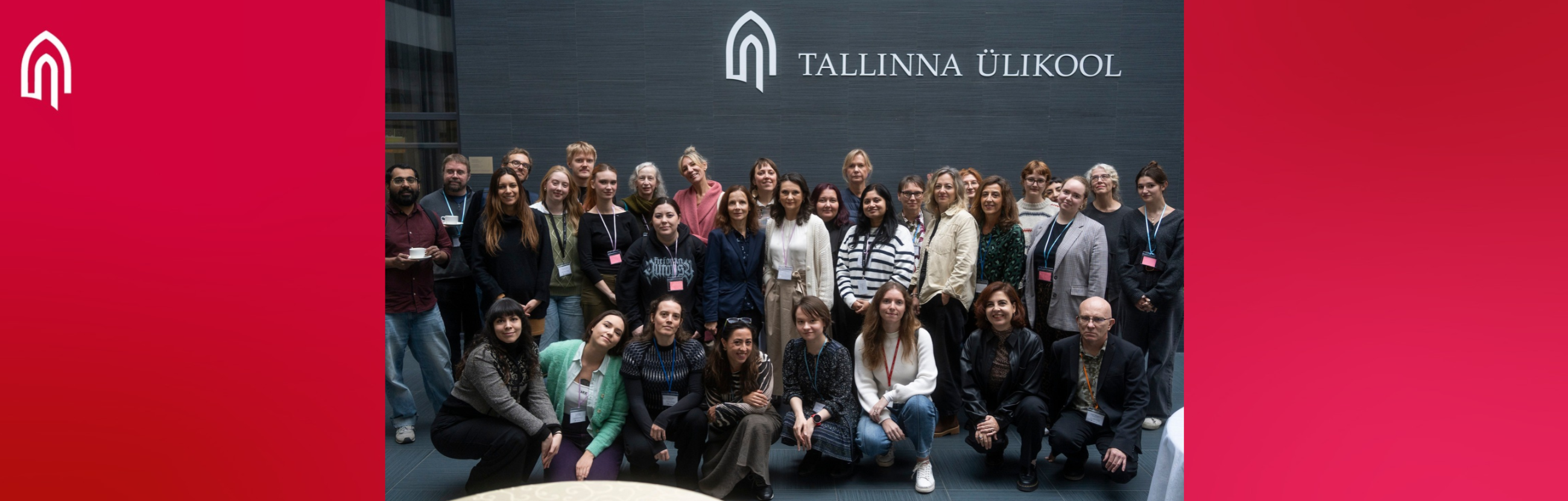
Our symposium found that hope is neither binary nor linear: vulnerability is not an absence of hope, but a natural and necessary stage of it. While vulnerability is both personal and collective, so is hope; this creates kinship, between friends, strangers, animals and nature.
Focussing primarily on Anglophone literatures, the symposium simultaneously called into question the meaning of the English language to these works. When writing in a colonial language, what is the scope to dismantle it, do something new? Adedeji Adeniyi and Avneet Sharma (Tallinn University) scrutinised the English language both as a site of resistance, and as a site of solidarity: they argued that the English language was a form of allyship amongst black British migrants in the UK. Panel V, however, emphasised the importance of turning to different languages and different genres to open our minds to new ideas and consider ways of thinking and living which challenge the western norm.
In Pursuit of Hope
Carolina Sánchez-Palencia Carazo (University of Seville) discussed finding hope through uncertainty and change of environment by analysing Sara Baume’s A Line Made By Walking and Kerri ní Dochartaigh’s Cacophony of Bone. The two stories describe people experiencing difficulties in the present and discovering a way to hope for the future, a theme which echoes the understanding of hope being movement towards something better. As explained by Sánchez-Palencia, history, unlike hope, is finished and linear. By expounding on the theory of radical hope, she connected the concept of embracing current uncertainties and creating purpose from it to kintsugi: the Japanese art and philosophy of repairing broken pottery with golden lacquer that shows the breakage as a part of the object’s history rather than disguising it.
Cristina María Gámez Fernández (Universidad de Córdoba) reframed hope as something co-constituted with attention by everyday practices through Katherine Boo’s Behind the Beautiful Forevers. Regarding its depiction of India’s Annawadi residents’ economic struggles, she discussed the ways of recalibrating hope from economic mobility to spiritual transcendence and certain hopes as being more realisable compared to others. Hope was further described as being ever-changing in nature: with every change in circumstances, the goal moves with it.
Reclaiming Bodies, Reviving Memories
Poet and writer Hannah Lowe discussed, in her keynote, the research process behind her forthcoming book The Woman in the Chinese Collar (2027) in which revived her late aunt through collective reimagination. Lowe detailed her experience with navigating the archives, asking herself, who gets to be archived? She argued that these silences are never neutral: in her search for information about her aunt, embracing contradiction, and accepting non-linearity were conscious acts of anti-imperialism. Lowe was interested in the intersectionality of Jamaica, where her aunt lived, as a colonised country and her aunt’s female body as a sight of male violence. In Chinese Collar, Lowe’s aunt appears as a ghost, in one way regaining her voice, in another, having Lowe put words into her mouth. Lowe rebuilds the archive through poetry and prose. In these fast times, what can we learn if we slow down and look backwards?
Marco Caracciolo (Ghent University), in turn, discussed in his keynote the need to bridge the gap between the personal and the planetary in order to relate the experience of the climate crisis. Caracciolo took examples from Ian McEwan’s Solar and Richard Flanagan’s Living Sea of Waking Dreams to compare the metaphor of the planet being sick with human sickness. He examined the instability of the anthropomorphic body and what this may stand for in the climate crisis: from disappearing limbs to disappearing species, terminal illness and medical intervention, highlighting the necessity for discourse with the medical humanities.
Landscapes & Spaces of Uncertainty
Speakers of Panel I further explored the topic of hope and vulnerability being expressed in time and space. Waste in urban landscapes and using space without a capitalistic purpose was discussed by María Porras Sánchez (Complutense University of Madrid) when analysing Julia Wertz’ art. She questioned the depiction of waste in urban spaces by the artist and the implications of trash being intrinsically connected to New York City. Discussing Capitalocene landscapes as landscapes transformed by capitalism, Porras Sánchez considered the idea of using space for non-capitalistic purposes as subversive and productive.
Hope and vulnerability in spatial anxiety, introduced by Zuzanna Szatanik (University of Bielsko-Biała), further connected depictions of hope with the environment. Charlotte McConaghy and Amity Gaige’s portrayals of being isolated in the wilderness and away from society in Wild Dark Shore and Heartwood were analysed with this idea of vulnerability in uncertain spaces leading to a desire for change and hope. On the basis of these works, Szatanik explored the idea of agoraphobia, most commonly diagnosed in and associated with women, being a gendered experience that creates distinct vulnerabilities and hope when appearing in women.
Watery Vulnerability and Fluid Hope
Panel V addressed the blue humanities, an interdisciplinary area of increasing importance and visibility. As sea levels continue to rise, our experiences with water become more pronounced, as Tomasz Dobrogoszcz (University of Łódź) points out. The panel emphasised a common argument of water as a sight of imperialism; Katarzyna Więckowska (Nicolaus Copernicus University) maintained that polluted water can be viewed as contemporary colonialism: countries which were previously colonised are now the most vulnerable, as their water and land are filled with the waste of western countries. While Katarzyna Ostalska (University of Łódź) proposed the theory of hydrosexuality as a means of reassessing our relationship with water and nature as that of mutuality and not dependence, Anna Maria Karczewska (University of Bialystok) emphasised the need to move away from colonial ideas and view the river as a being, and ourselves as participants within hydrocommunities.
Closing Thoughts
After three days of inspiring talks, our colleagues gathered together for the final roundtable where Marco Caracciolo, Hannah Lowe, and Cristina María Gámez Fernández, in conversation with Julia Kuznetski and Iveta Aare (Tallinn University), brought us back to our first thoughts on vulnerability and hope. Over these three days, it now seemed that to shift from vulnerability to hope, we must shift from staying strong together to staying vulnerable together. If strength in the face of trauma is repression, vulnerability is acknowledging that trauma, allowing us to both look inwards and turn our gaze back. To hold on to hope, we should not think about it as something linear or binary: literature offers many experiences of hope without pinning it down. Having hope inspires imagination, it motivates us toward a vision, but with every step, this vision changes; it is dynamic and unattainable and lets us keep imagining, and keep hoping. As a society, we have codified hopelessness as mental illness, as weakness, when in reality, it is just a part of a constantly dynamic process, not something to be solved.
The roundtable’s final thoughts reflected on the development and growing use of AI: should we stress our vulnerability, and what kind of narratives would we need to inspire us to stay hopeful? In some ways, the panic of AI has returned us to our humanness; an anthropomorphised cognition which isn’t conscious cannot create, only mimic. In order to remain hopeful in times of AI, we need narratives that invite us to reflect on this and we must be porous to the ideas of others. Art is resisting AI. People still want to create: film, writing, graffiti. Even gathering in a physical space to discuss ideas is a form of co-creation. The opposite of hope is not despair, but inaction, so let us create. In being vulnerable, let us be hopeful in uncertain times.
See photos of the symposium HERE