
Europe at a crossroads: A lecture on International law, foreign and security policy, Nordic-Baltic cooperation, and the impacts of Russia’s war against Ukraine
On 9th November 2026, Tallinn University organised a guest lecture and Q&A session with the Swedish Minister for Foreign Affairs, Maria Malmer Stenergard. Our very own Dr. Karolina Aksamitowska was the moderator for this session.
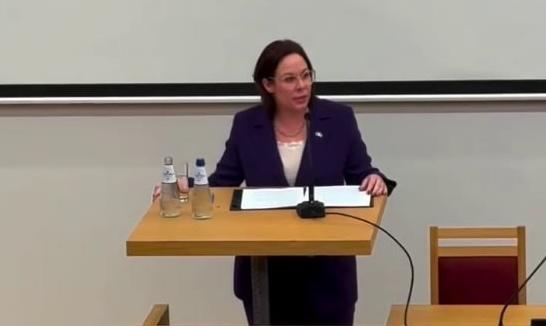
The core message that was delivered by the Swedish Minister was that European security is at a critical juncture, and the decisions made today will determine whether the continent stands up to unprecedented aggression or fails a defining test of history. The lecture served as a stark reminder that academic freedom and national sovereignty are foundational pillars of a
free society, not luxuries to be taken for granted.
Minister Stenergard framed her address entirely around the ongoing war in Ukraine, opening and closing with a haunting image; a photograph of a little girl named Angelina. Wearing red overalls and sneakers carefully tied by her mother Inna, Angelina's head was tilted in a familiar posture of childhood sleep, except she was not sleeping. A Russian bomb had ended both her life and her mother's. "Ukrainians wake up to news like this almost every day," Malmer Stenergard noted, stressing that the coming months will reveal whether Europe acted decisively or failed when war returned to its continent. "Either way, history will judge us."
Highlighting the deep historical bonds between Sweden and the Baltic states, she drew parallels to the past; such as the dark chapter of Baltic soldiers extradited after the Second World War, a mistake for which history has rightfully judged regional governments. Yet, those ties endured through grassroots solidarity, from the historic Monday demonstrations in Stockholm to today's active support for Ukraine.
Echoing Lennart Meri's famous sentiment that politics is "a factory which produces the future", the Foreign Minister warned that the path forward is never a straight line, and inaction carries an unbearable cost.
Minister Stenergard argued that Europe as a whole is still not doing enough, pointing out that Sweden's bilateral support surpasses that of several much larger European economies. To shift the paradigm, she outlined three primary avenues for bolstering Ukraine:
- Bilateral Support: Increasing direct military and humanitarian aid, including upcoming contributions like Swedish Gripen fighter jets to secure Ukraine's airspace.
- EU Loans and Funding: Leveraging collective European financial instruments to keep Ukrainians warm through winter and sustain defense efforts.
- Utilizing Frozen Russian Assets: Using the approximately €210 billions of frozen Russian central bank assets within the EU. Malmer Stenergard called this potential move a "game changer," arguing that while member states like Belgium harbor legal and financial anxieties, the risk must be shared collectively across Europe to ensure justice and provide Ukraine with vital leverage.
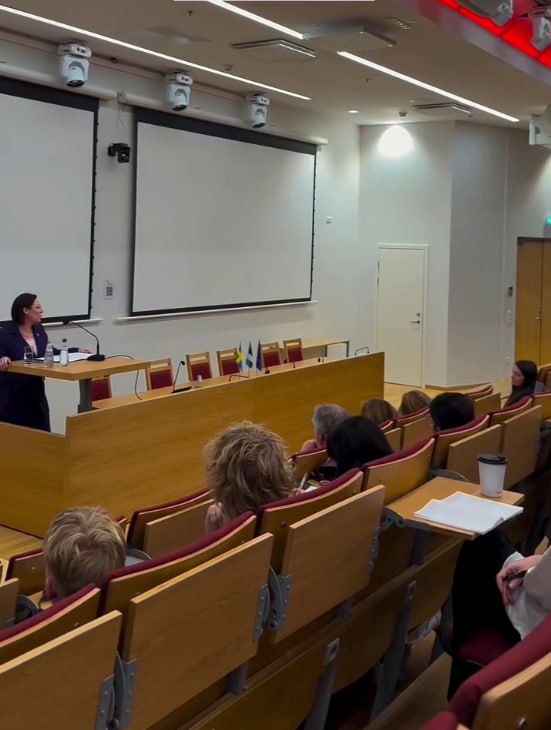
Addressing skeptics who claim Western sanctions are failing, the Foreign Minister pushed back firmly. Citing a UK government study showing international sanctions have cost Russia billions, she noted that alternative metrics reveal an economy far weaker than official Moscow statistics pretend. By targeting Russia’s shadow fleet, oligarchs, and defense supply chains, Europe can successfully increase the cost of Vladimir Putin’s aggression. However, she warned against complacency, pointing out alarming trends like the normalization of relations, the re-entry of Russian athletes into international sports, and the creeping security risks posed by unrestricted tourist visas for ex-combatants.
In her closing remarks, Malmer Stenergard drew a distinction between Sweden and Estonia, observing that Estonia maintains a sharper, invaluable awareness that time and national identity are precious, finite resources. Invoking Lennart Meri's warning against the illusion that a nation's defense is ever "done," she challenged European leaders to prioritize the collective security of future generations over political legacies.
As Europe navigates shifting transatlantic dynamics and the imperative to shoulder greater responsibility within NATO, the Foreign Minister's message from Tallinn was clear: history is watching, and the time to act decisively is now.
The minister also hosted a Q&A session, answering questions from Tallinn University students and international attendees. The discussion centred on European security, the implications of Russia's war against Ukraine, and the challenges facing European diplomacy.
One of the first questions concerned the security implications of allowing Russian nationals, particularly ex-combatants, to travel freely within Europe. Minister Stenergard argued that ex-combatants could pose a security threat and that restricting Russian tourism should be considered from both a security and moral perspective. She expressed concern that Russian citizens should not continue to enjoy the privileges of European tourism while their country wages war against Ukraine. She indicated that restrictions on Russian tourism would be an important consideration in the next sanctions package.
The discussion subsequently turned to China's role in supporting Russia's war effort and the implications for China-Sweden relations. While acknowledging the challenges posed by China's relationship with Russia, the minister emphasized the importance of maintaining diplomatic engagement and bilateral cooperation. She highlighted that she was the first Swedish foreign minister in eleven years to visit China, underscoring the importance of preserving diplomatic channels.
Turning to the question wishing to clarify the proposed use of frozen Russian assets, the minister defended this proposal on both legal and moral grounds. She stressed that the assets under consideration belong to the Russian Central Bank, not individual Russian citizens. Given that Russia initiated an unprovoked war against Ukraine, she argued that using these assets to support the country was justified.
This position also informed her response to concerns about the economic consequences of continued European assistance to Ukraine. When questioned about whether increased financial and military support could place an excessive burden on European economies, Minister Stenergard argued that the long-term costs of insufficient support would be considerably greater.