
Bridges, Not Walls: Building Connections in Estonia
How can newcomers feel more connected and included? At a Tallinn University workshop on 27 October, participants explored how social innovation can help build stronger connections between newcomers and locals.
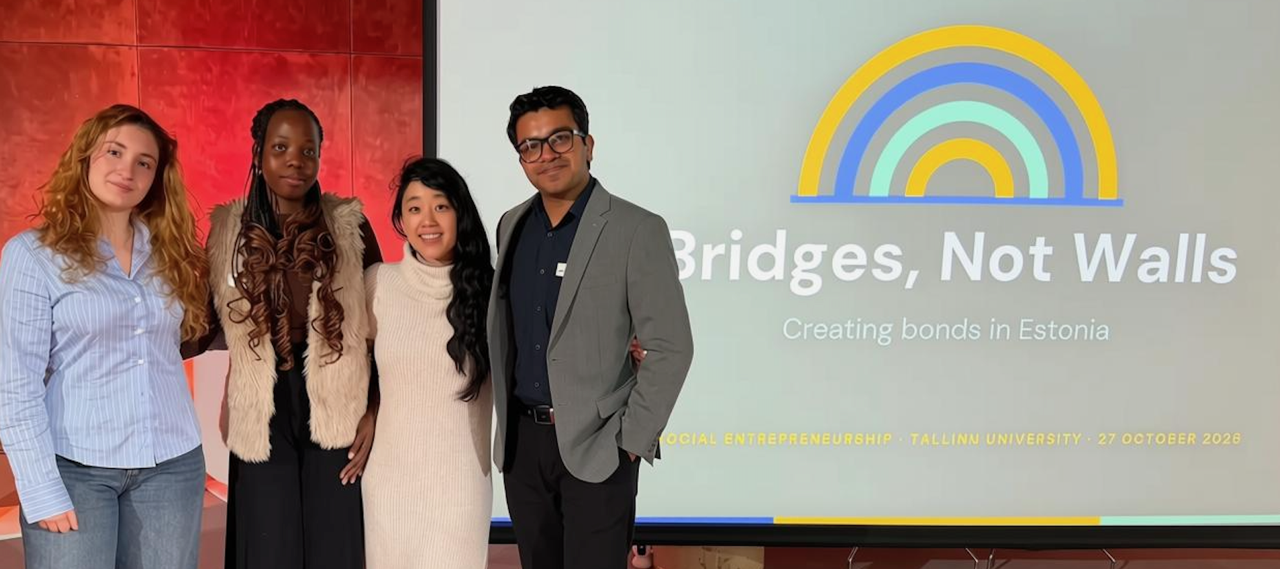
Being surrounded by people is not the same as being connected. That simple truth sat at the heart of Bridges Not Walls, the workshop we hosted at the conference Nordic Best Practices: Newcomer Integration through Social Innovation. We are four MA Social Entrepreneurship students at Tallinn University, and four newcomers to Estonia: Hamza from Pakistan, Corey from Hong Kong, Sona from Azerbaijan and Anu from Nigeria. We built the workshop together around one question: how can newcomers and locals stop misreading each other and start building real bonds?
Why bridges, not walls
Arriving in a new country is a lot at once. Newcomers juggle new skills and jobs, a new language and unfamiliar social norms, while friendships grow slowly. Isolation can creep in, even in a busy city. Some of it comes down to style. Estonian norms such as personal space and comfort with silence can feel distant to someone who grew up with constant conversation. Meanwhile, a newcomer's openness can feel unfamiliar, even intense, to locals. Both sides misread each other, and both end up a little lonelier. Our purpose was to build a bridge into Estonian society, starting from something everyone has: personal values and a need to belong. We wanted to treat newcomers not as people to be "integrated", but as social innovators and co-creators. That meant listening to them, not just talking to them.
The workshop moved through five stages:
- Culture: what is different?
- Personal values: what matters to me?
- A shared problem: what keeps us apart?
- Empathy: how does it feel on the other side?
- Action: what is one small step I can take?
What we did
A quick look at Estonian culture Hamza opened with a short presentation on key Estonian cultural values, such as personal space, comfort with silence and a deep connection to nature. The aim was not to explain Estonians, but to make the unwritten rules visible. We then shared own stories of connection each of us shared how we have built connections here, and how our home cultures could meet Estonian culture halfway. Hamza talked about cricket: in Pakistan, it turns strangers into teammates, and a shared activity can become a meeting point here too. Corey shared how making dumplings together brings Chinese families around one table. Sona described Azerbaijani tea culture, where offering a guest a cup of tea is an invitation to stay and talk. Anu shared how, in Nigeria, warm greetings and lively community gatherings make connection feel natural, which is why Estonia's quieter style can take time to read.
A quick survey
Sona and Anu asked the group three questions: What makes you feel welcome and included? What makes you feel less connected? How did you feel in those moments? The answers set the tone. Everyone needs connection, and being surrounded by people doesn't mean you instantly make friends. It takes effort on both sides.
The cultural connection line
Next, everyone stood up and moved along a line depending on how much they agreed with each statement:
- I enjoy chatting with people I've just met.
- I'm comfortable sharing silence with someone new.
- I show my feelings openly.
The room spread out. Everyone was different. Then we asked:
- Have you ever wanted to join a conversation but felt unsure how?
- Have you ever felt left out, even with people around?
- Does being invited help you feel more welcome?
This time, almost everyone moved to the same spot. That was the key moment of the workshop: we have different styles, but the same need. Being different doesn't mean we don't want to connect. From there, we talked openly about the biases and barriers that keep people apart.
Build your own cultural bridge
Corey created a sheet called ‘What Connects Us’ where participants chose a value or tradition they love from their own culture and one from Estonian culture, then designed a bridge between them. For example: in China, families make dumplings together for the Moon Festival, a symbol of unity. In Estonia, people treasure the quiet of mushroom picking in the forest. The bridge: go mushroom picking together and learn to enjoy the silence, then turn the mushrooms into dumplings in a shared kitchen, where the newcomer invites their Estonian friends to talk. Each side learns the other's way of connecting.
Finally, each of is worked in groups of three with the participants who agreed on one small, concrete step they would take to build a bridge and meet new people. Small is the point: a step you actually take beats a big plan you never start.
What participants told us
- The What Connects Us sheet was informative and inspiring. People liked its simple structure: what matters to me, what matters to others, what could bring us together, and one small step. The same themes kept coming back: family, food, traditions and places. These are bridges almost anyone can cross.
- People loved the activities run during the session, hearing our own stories as newcomers and also working as a team to think of innovative ways to socially promote inclusion themselves.
Try it yourself
Bridges Not Walls works anywhere people meet: NGO’s, educators, student groups, workplaces, and newcomers who have just arrived.
Download the What Connects Us template (A3) here.
How to run it?
- Start with culture. Share a few local cultural values and invite questions.
- Share stories. Ask people when they felt connected, and when they didn't.
- Move. Run the connection line with the six statements above.
- Build bridges. Fill in the A3 sheet in pairs or small groups.
- Commit. Each group picks one small step and shares it with the room.
Walls are easy to build without noticing: a silence read as coldness, openness read as intrusion. Bridges take effort from both sides. But as our workshop showed, the will to connect is already there.
So here is our invitation: this week, take one small step. Invite someone new for coffee, a walk or a trip to the forest, and let both the silence and the conversation do their work.
Thank you to everyone who joined us at Nordic Best Practices: Newcomer Integration through Social Innovation.