
Human-Computer Interaction alumna Maria Vous: “Digital solutions alone won’t save the world”
Maria Vous completed her master’s degree in Human-Computer Interaction at Tallinn University's School of Digital Technologies. Maria kindly agreed to talk about the role of the digital world nowadays and explain what HCI is about!
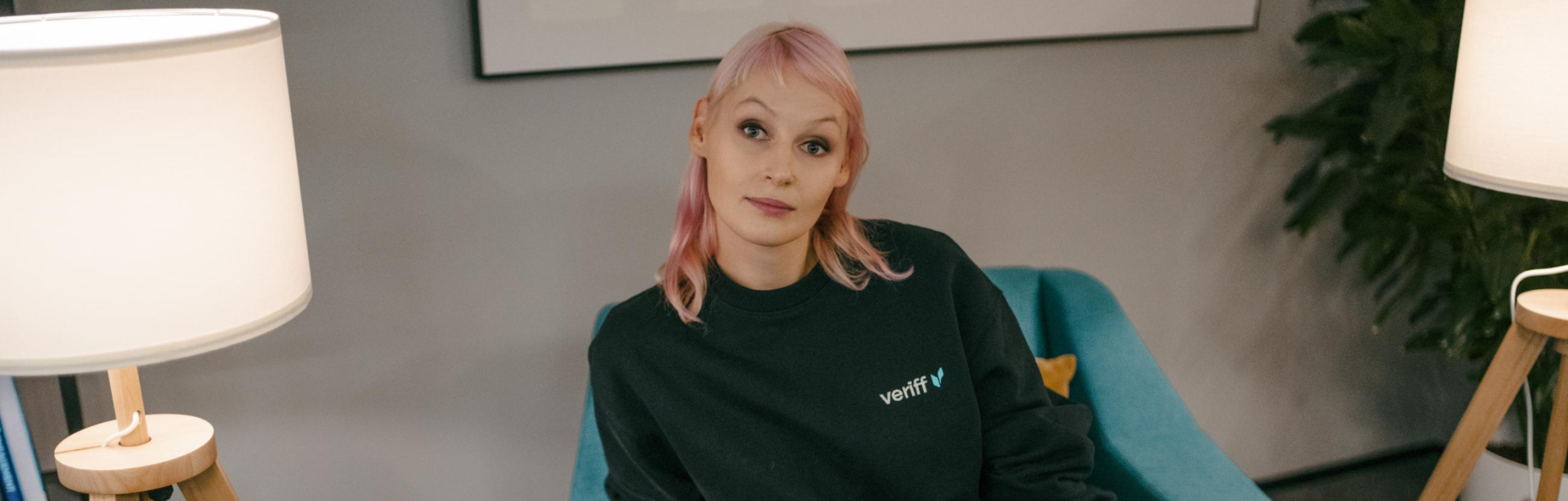
Maria, you have a bachelor’s degree in Journalism and a master’s degree in Communication Management from Tartu University. How did you decide to study Human- Computer Interaction at Tallinn University?
While I was doing my master's in Communication Management, I had already been working in the marketing department of a software and product development company for several years. My interest in product management, service design, and user experience was very high, and I knew I needed something else. After a little research, I found a Human-Computer Interaction master's program in the School of Digital Technologies at Tallinn University. This program seemed to contribute to the learning of technical skills, along with soft skills. That sounded very interesting to me, and so I applied!
Were your expectations fulfilled?
Sometimes it was challenging, but at the same time an inspiring process. I think it's easier if, before studying HCI, the person has some understanding of or background in the product development world, even if these are minimal touchpoints as a designer, project manager, researcher, developer, or intern.
One thing I can say surely about this program is that it taught us what human-computer interaction should look like. HCI tried to make us very responsible regarding how we develop technology and showed all the concerns and the consequences we have to take into account. This was the main idea that our teachers were trying to make us understand. To show that it's not just about having solutions. Digital solutions don't just save the world. If you have a digital solution, you'll still have a server that uses a lot of energy. So it is a trade-off, and you really have to make conscious decisions and see all the details, which may make your life complicated as a designer or researcher, but have a big impact on other people's lives. I think this was the philosophical background behind HCI, which I really liked.

Did you work on some interesting projects during your studies?
First of all, I would like to mention that we had a really cool and deep course about how to evaluate users' experience. Amazingly, the university gives us a chance to try out those things and to do the whole product development journey as a researcher or designer, because in agencies you will never have time for that.
I remember we also had a theoretical project where the main task was to map how different technological systems interact with each other and try to do some very basic tech architecture. For that, we needed to come up with a product idea which would use different data sources and have devices interacting with each other. Our group came up with a "Talking plants'' idea, a companion for elderly people who often feel lonely. It would then be connected to the person’s tracker, and as soon as it saw that he/she was anxious or tired, it would say: “Hey… I need some water now” or “I need to get more sun, take me to another room!”. This was super nice, because here again we had to think about finding a solution to the problem, not just designing a cool device.
Which skills gained from HCI studies do you use on an everyday basis?
Usability testing is a regular part of my work. Although I had some understanding about it before coming to TLÜ, in university I got more knowledge and structural view of it. Usability testing has a lot of forms and options. It’s possible to measure how much time a person spends on this or that online operation, which issues they face, and so on. And gathering this kind of information is very important in our work.
What problems do you see in the digital world today?
One of the main problems is understanding how to protect people’s privacy and keep them secure from online threats. Identity verification is not just about verifying your name or checking how old you are, but about keeping honest users safe and stopping fraudsters. Another big problem in the digital world is the protection of children, who are a target of many online threats that could be avoided by identity verification. How can we stop this?
Who is responsible for providing this security for kids? Parents?
I think this is the responsibility of designers, developers, and product owners. They should understand and take into account that this exact product that you are working on is meant for kids. In general, product teams add some elements that catch kids’ attention, but most of those products are not made specifically for children. The question is: do you want to have universal design for everyone, or do you want to build a target-based product and try to make it more accessible?
Do you have a favorite digital tool?
Miro, the digital whiteboard! It's a very helpful tool for visualizing ideas, workshops, collaborating with your colleagues, and mapping processes and flows.

What would you advise to the new students of the Human-Computer Interaction programme?
The biggest thing I got from the School of Digital Technologies was people. I remember my really cool teachers: David, Vladimir, Sonia, and others. I advise new students to make contacts, collaborate, work with different people, exchange ideas, and be open-minded. Be ready to gain new knowledge and also have your own input in that process. You have to involve yourself and be curious! If you are curious, you will succeed!