Doctoral Research Explores How Vibration Can Communicate Emotions, Memory, and Social Support
Touch is a powerful yet underutilized sense in digital interaction. Expanding the role of mediated touch technologies could enhance remote communication, support wellbeing, and enrich educational experiences, believes Yulia Sion, who defended her doctoral thesis at Tallinn University.

In her doctoral thesis, Yulia Sion investigates how vibration, commonly used in mobile devices as simple alerts, can become a meaningful channel for communication that conveys emotions, supports social connection, and represents personal experiences.
The research explores how “tactons”, structured vibration patterns, can be designed to carry rich and interpretable meaning. Using a Research through Design approach, the work combines experimental studies, wearable prototypes, and co-design with users. Across multiple contexts, including public speaking, accessibility for blind and low vision people, and the representation of personal memories, the research develops new methods for designing expressive vibrotactile feedback and examines how people interpret it in practice.
The meaning of vibration in digital communication
The findings show that vibration can communicate more than simple signals such as alerts or notifications. Participants associated specific vibration patterns with emotional qualities such as reassurance, encouragement, and tension. In studies on remote public speaking, vibrotactile feedback was interpreted as a form of social support, similar to a reassuring touch, helping participants manage anxiety and maintain focus. In another study, participants translated elements of their personal memories into tactile patterns, demonstrating how touch can represent abstract and subjective experiences. Co-design with blind and low vision participants resulted in a set of tactile cues for perceiving environmental information, highlighting the potential of vibration as an alternative to sound-based navigation.
A key contribution of the thesis is a novel co-design framework for creating expressive tactons. Rather than treating vibration as a purely technical parameter, this approach supports designers in translating emotional, experiential, and contextual meanings into tactile form. The research also introduces practical tools, including wearable vibrotactile devices and a haptic design system, which can support future applications.
Helping designers create meaning
The work expands the role of touch in digital interaction. While most technologies rely on visual and auditory channels, this research demonstrates that touch can function as a primary medium for communication, particularly in situations where other senses are limited or overloaded. The findings are relevant for accessibility, remote communication, wellbeing technologies, and multisensory storytelling.
By rethinking vibration as a carrier of meaning rather than a simple signal, the thesis extends existing approaches and advances the design of more inclusive and emotionally aware touch technologies.
The thesis defense
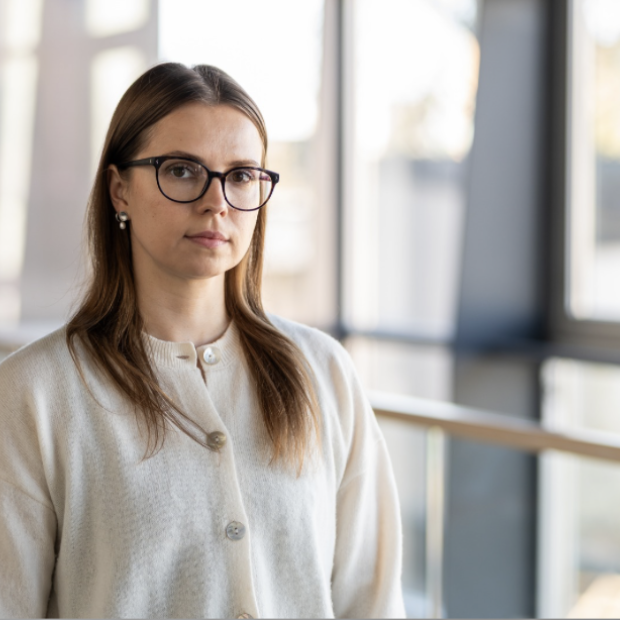
Yulia Valerievna Sion defended her doctoral thesis at the Tallinn University School of Digital Technologies on April 21, 2026. The topic of her doctoral thesis is “Exploring the Horizons of Vibrotactile Experience: From Tactile Memories to Social Support”.
The thesis supervisor is David Jose Ribeiro Lamas, professor of Human-Computer Interaction at Tallinn University.
Opponents are Oliver Schneider, Associate Professor at the University of Waterloo and Gionata Salvietti, Associate Professor at the University of Siena.
The dissertation is available in the ETERA digital environment of the Tallinn University Academic Library.