
Environmentally friendly Erasmus
Erasmus+ mobility begins with the journey to your destination. Many destinations across Europe can be reached comfortably by train, bus and ferry – and often, the journey itself becomes part of the experience.
When travelling overland from Estonia, keep in mind that there is no single ticketing platform covering all train travel across Europe. Depending on your route, you may need to use the websites of several national railway operators or purchase separate tickets for different parts of your journey. However, it is worth exploring the Interrail pass options below, especially the Erasmus+ passes, to make your train journey easier. Students who choose greener modes of travel may also be eligible for additional financial support.
Here you will find a practical guide to help you get started, plan your route and find the right places to buy tickets.
We encourage all students to make environmentally conscious choices in their everyday lives and to choose more sustainable modes of transport whenever possible.
.png)
Erasmus+ sustainable travel grant
Travel support is available to all students participating in Erasmus+ study mobility. For Erasmus+ journeys of up to 500 km, students are encouraged to use low-emission modes of transport, such as train, bus, ferry or carpooling.
Choosing sustainable travel also makes you eligible for a higher travel grant. Travel is considered sustainable when at least half of the total round-trip journey is completed using low-emission modes of transport.
Air travel does not qualify as sustainable travel.
| Distance between place of origin and destination (km) | Standard travel grant | Sustainable travel grant |
| 10 to 99 km | 28 euros per participant | 56 euros per participant |
| 100 to 499 km | 211 euros per participant | 285 euros per participant |
| 500 to 1999 km | 309 euros per participant | 417 euros per participant |
| 2000 to 2999 km | 395 euros per participant | 535 euros per participant |
| 3000 to 3999 km | 580 euros per participant | 785 euros per participant |
| 4000 to 7999 km | 1188 euros per participant | - |
| 8000 km and more | 1735 euros per participant | - |
Funded travel days (if needed)
- up to 2 travel days (1+1) for standard travel
- up to 6 travel days (3+3) for sustainable travel
For example, the travel support available from Tallinn to the following destinations may be as shown in the graph below (as of 2026), following the Interrail Erasmus+ Global Pass price comparison.
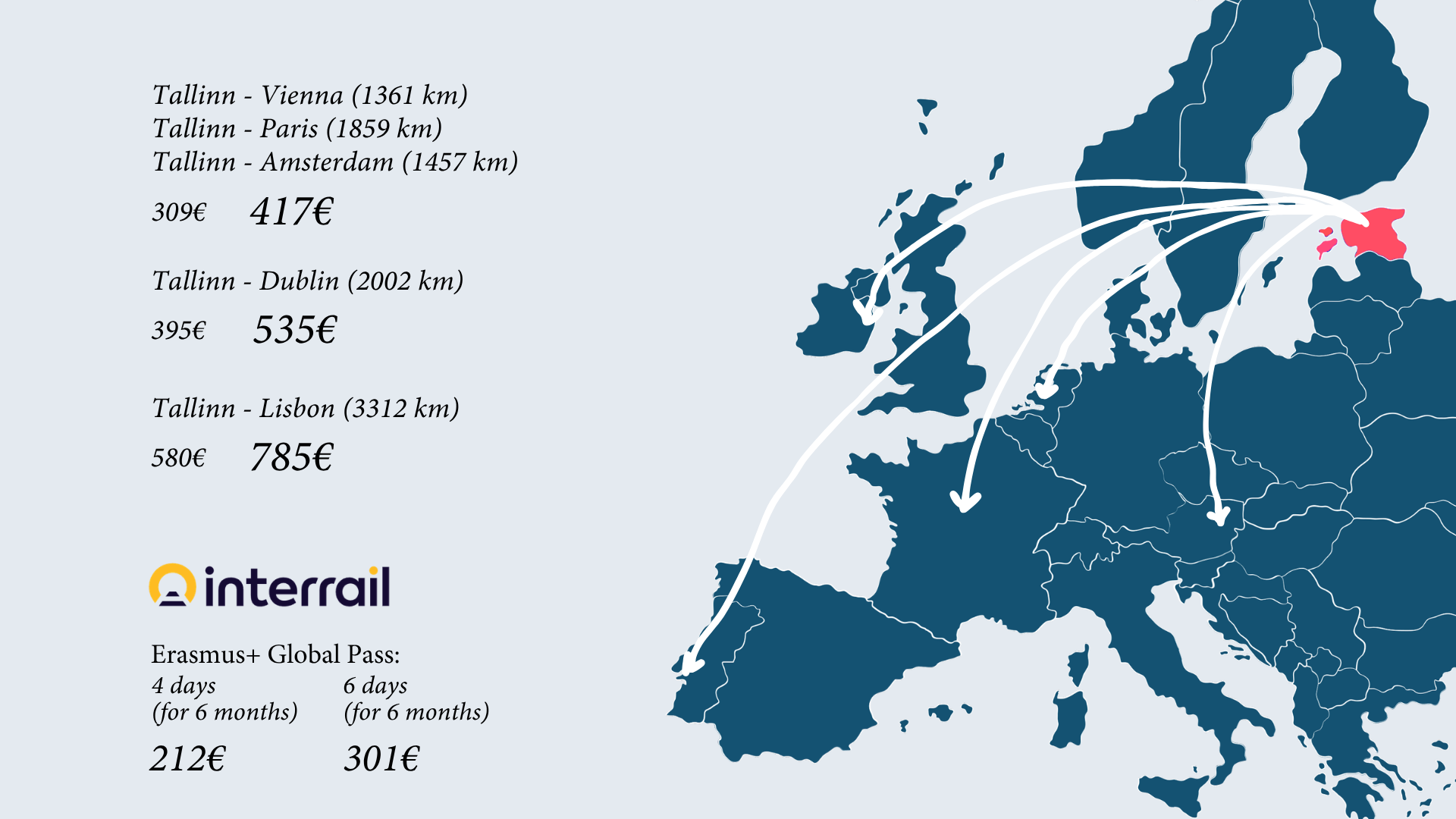
Even if you make just half of your journey using green travel options, you can still have enough travel support left for the return journey. We especially recommend keeping an eye out for special offers and discounts, including Interrail promotions.
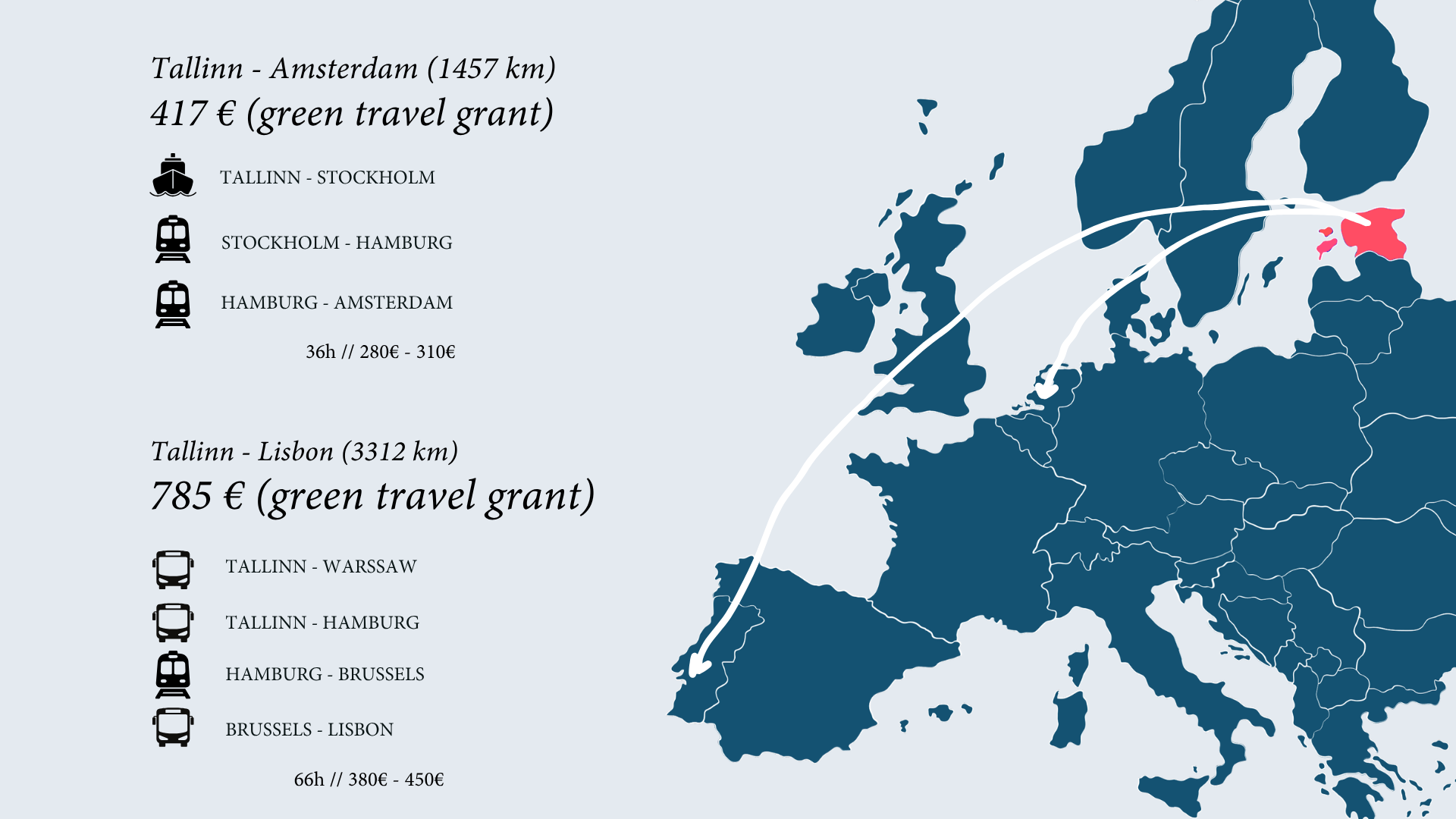
Below are example routes to two destinations: Amsterdam and Lisbon. The journey times refer to continuous travel without additional stops or overnight breaks (saving on accomodation), while prices may vary depending on how far in advance you book and which operators you use.
Go2Rail - you don't need to travel alone
Travelling to your Erasmus+ destination by train can mean a long journey with several connections. But chances are you are not the only student making your way across Europe to an Erasmus+ destination at the same time.
Go2RAIL is an initiative for students that aims to make travelling to international mobility destinations by train easier and more social.
Instead of travelling alone, Go2RAIL helps connect students heading to the same or similar mobility destinations. Through dedicated chat groups, students can get in touch with each other, share travel information and, if they wish, plan their journey together.
How does Go2RAIL work?
- Enter your Erasmus+ destination on Go2RAIL.
- Verify that you are a student. You will need an active university email address to use the service.
- Find other students travelling to the same destination.
- Get in touch. Share routes, compare ticket options, or arrange to travel part of the journey together.
Interrail Erasmus+ Global Pass options
One pass for your entire journey. Erasmus+ participants can use the Interrail-based Erasmus+ Global Pass, a multi-day rail pass designed to support sustainable travel across Europe. Two options are available: a 4 travel day pass, valid for 6 months, and a 6 travel day pass, also valid for 6 months.
The pass gives you the flexibility to travel across different European countries and can be used both for travelling to and from your mobility destination and for exploring Europe by train during your free time.
The Erasmus+ Global Pass can be a convenient option if you:
- travel through several countries and use multiple train operators;
- prefer not to buy separate tickets for each part of your journey;
- want more flexibility when planning your route;
- would like to make stops along the way;
- want to use the same pass for both your journey to and from your Erasmus+ destination.
Please note: The Interrail Pass does not cover all travel costs. Many high-speed, international and night trains require a separate paid seat or sleeper reservation. On popular routes, it is a good idea to book these well in advance.
Why travel greener?
Erasmus+ considers a journey to be green travel when at least half of the round trip is completed using lower-emission modes of transport, such as train, bus, bicycle or carpooling. Ferry travel may also qualify when combined with other lower-emission transport, for example by continuing your journey by bus, tram or train.
Erasmus+ supports green travel with a higher travel grant. When using lower-emission transport, you may also receive individual support for up to six travel days, if the longer journey requires additional travel time.
Before buying your tickets, check with your Erasmus+ coordinator which conditions apply to your mobility and grant.
We want to explore the world while taking care of it
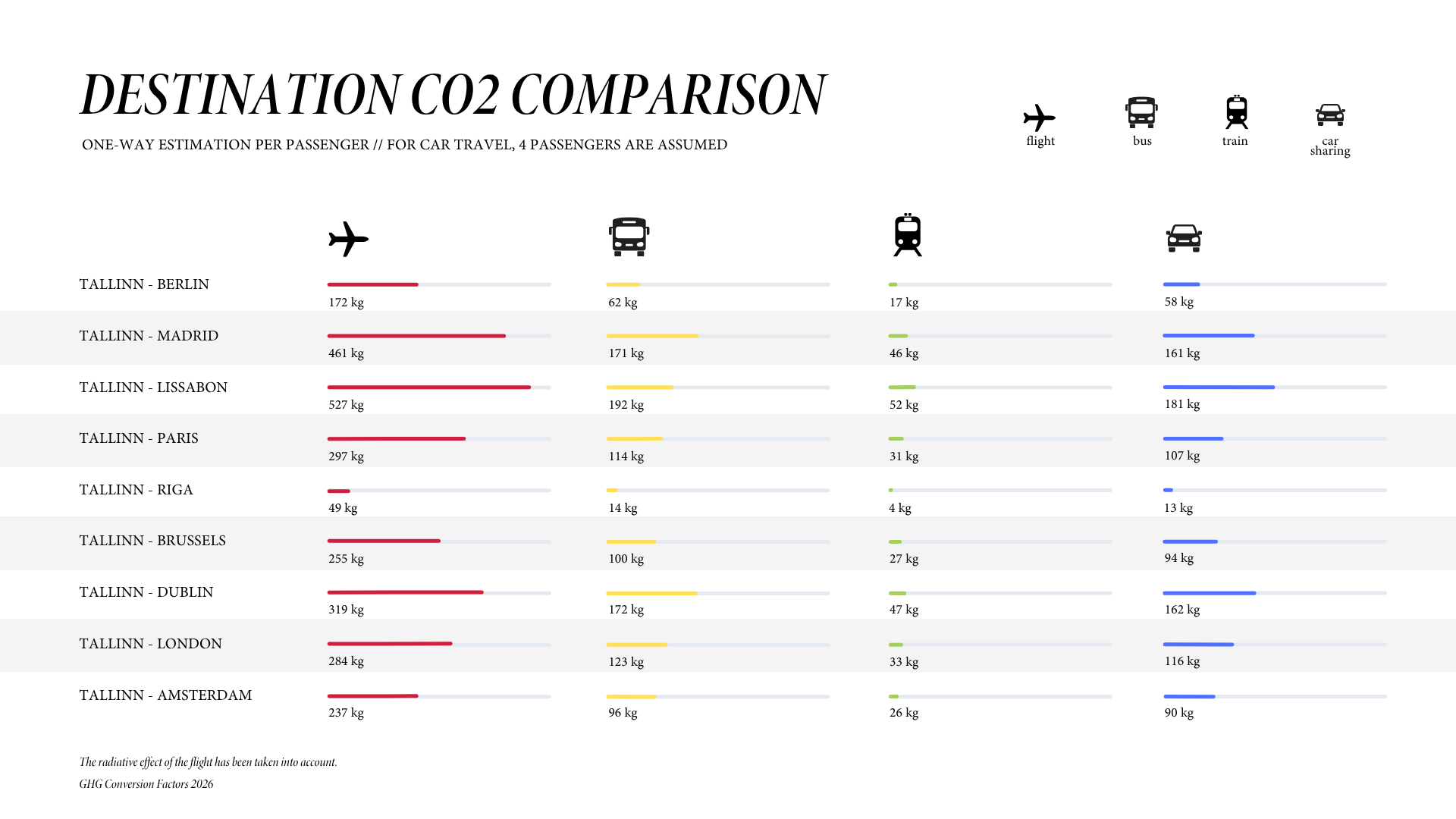
When we go abroad, we usually think about what we will bring back with us: new knowledge, friends, languages, experiences and perhaps a real souvenir or two. CO₂ does not have to be one of them.
Travelling greener does not mean that every Erasmus+ participant should always choose the most complicated or time-consuming route. It simply means that before booking a flight, it is worth asking: “Could I get there another way?”. If slow travel is not possible this time, you can still make more sustainable choices while living at your destination or travelling around the region. Give yourself the opportunity to make a difference and lead by example!
How to start your journey from Estonia?
By train through the Baltics: Tallinn – Tartu – Riga – Vilnius – Warsaw – onwards to Europe
This is a particularly good option if your destination is in Poland, Germany, Czechia, Austria or elsewhere in Central or Western Europe.
You can travel by train from Estonia through Latvia and Lithuania. From Tallinn towards Riga and Vilnius, connections are operated by Elron, Vivi and LTG Link. Elron also allows you to purchase a single ticket for journeys from Estonia to Latvia or Lithuania through its own ticketing system. Passengers starting their journey in Estonia have reserved seats for their connecting train in Latvia.
Start here to find connections between Estonia, Latvia and Lithuania:
To continue towards Poland, check:
By bus to a major railway hub: Tallinn – Riga – Vilnius – Warsaw – onwards by train. You do not have to make the entire journey using the same mode of transport – combine different options to find the most convenient route.
From Estonia, one convenient option is to take an overnight bus to Warsaw and continue your journey from there by train.
Check connections:
How to plan your route?
Europe does not have a single rail ticketing system where you can always find every connection and purchase your entire journey on one ticket. It is therefore a good idea to first plan your route and only then start buying tickets.
Rome2Rio – combines trains, buses and other modes of transport in a single search and shows approximate journey times and price ranges. Rome2Rio does not sell tickets itself but directs you to external booking providers.
Deutsche Bahn – useful for finding train connections across many European countries. It shows connections, transfers and timetables, and also allows you to adjust the amount of time you would like to have between connecting trains.
The Man in Seat 61 – a very comprehensive guide to travelling around Europe by train. Its step-by-step guides explain how to reach different European cities, where to change trains and which operators to use when looking for tickets.
Omio – allows you to compare train, bus, ferry and flight connections in one search, including prices, departure times and journey durations. Tickets for many connections can also be purchased directly through the platform, although we recommend comparing the price with the transport operator's own website before booking.
Rail Europe – allows you to search for and purchase tickets from many European train operators in one place. You can also add a stopover to your search, which can be useful when planning a more interesting route. For example, you could search for a journey from Warsaw to Amsterdam with a stop in Berlin.
European Sleeper – offers overnight train connections between several European cities, allowing you to combine travel and accommodation.
BlaBlaCar – a popular carpooling platform that connects drivers with available seats with passengers travelling in the same direction.
Mollow – features more than 700 train routes and travel ideas across Europe and beyond. It is particularly useful if you are thinking: “I need to get to Spain, but what interesting route could I take to get there?”
Green Travel Handbook
If you would like to learn more about how green travel can help protect the environment, download the English-language guide below.
The guide offers ideas and practical tips for making your mobility experience more sustainable. It also includes stories from Erasmus+ participants who have taken longer green journeys between different mobility destinations across Europe.
The green journey doesn’t end when you arrive
Arriving at your Erasmus+ destination by train or bus is a great start. But your mobility usually lasts much longer than the journey there – so the everyday choices you make in your new home city matter too.
You do not need to completely reorganise your life during Erasmus+ or try to be “perfectly green”. Start with small choices that work for you, your new city and your everyday life.
Get around like a local
During your first few days, find out how people get around in your new home city. Is there a discounted public transport pass for students? Does the city have a bike-sharing scheme? Can you walk between your accommodation and the university?
In many European university cities, cycling, trams, the metro or buses may be the easiest way to get around every day. Green Erasmus recommends checking local student public transport passes and bike-sharing schemes even before you arrive.
Explore your surroundings
A neighbouring town, a national park, a small seaside village or a local hiking trail might have much more to offer than yet another quick flight to the other side of Europe.
Green Erasmus encourages you to use your mobility period to discover your new home region and, whenever possible, travel overland. Local train and bus connections can be much easier to navigate than international ones, and many countries offer discounts for young people and students.
Eat local and try more plant-based food
Explore local food, markets and small restaurants. Choosing food made with local ingredients can also help support local businesses.
At the same time, you can try to:
🥕 eat more plant-based meals;
🥦 choose seasonal produce;
🛒 plan your shopping to avoid food waste;
🥡 take your leftovers with you;
👩🍳 organise shared dinners with other Erasmus+ students.
Don’t bring your entire household with you
If you are going abroad for one semester, you do not need to buy everything new. Check with your host university, local ESN section or student groups for:
- second-hand shops and flea markets;
- Facebook Marketplace and local reuse platforms;
- university swaps and exchange points;
- items being given away by previous Erasmus+ students.
Learn the local recycling rules
Waste sorting rules in your new country may be very different from those in Estonia. Do not assume that a yellow, green or blue bin means the same thing everywhere.
Check:
- the instructions provided by your dormitory or accommodation;
- recycling points at your university;
- your local municipality’s website.
If you are unsure, ask. After all, studying abroad is also an opportunity to discover how other countries approach and solve the same challenges.