
Education Research Club Discusses the Importance of Responsible, Meaningful, and Slow Research
The Education Research Club seminar “Towards Responsible, Meaningful and Slow Research”, held on 4 November, addressed the accelerating pace and growing volume of research. The seminar was led by Tobias Ley, Professor of Learning Analytics and Educational Innovation at Tallinn University.
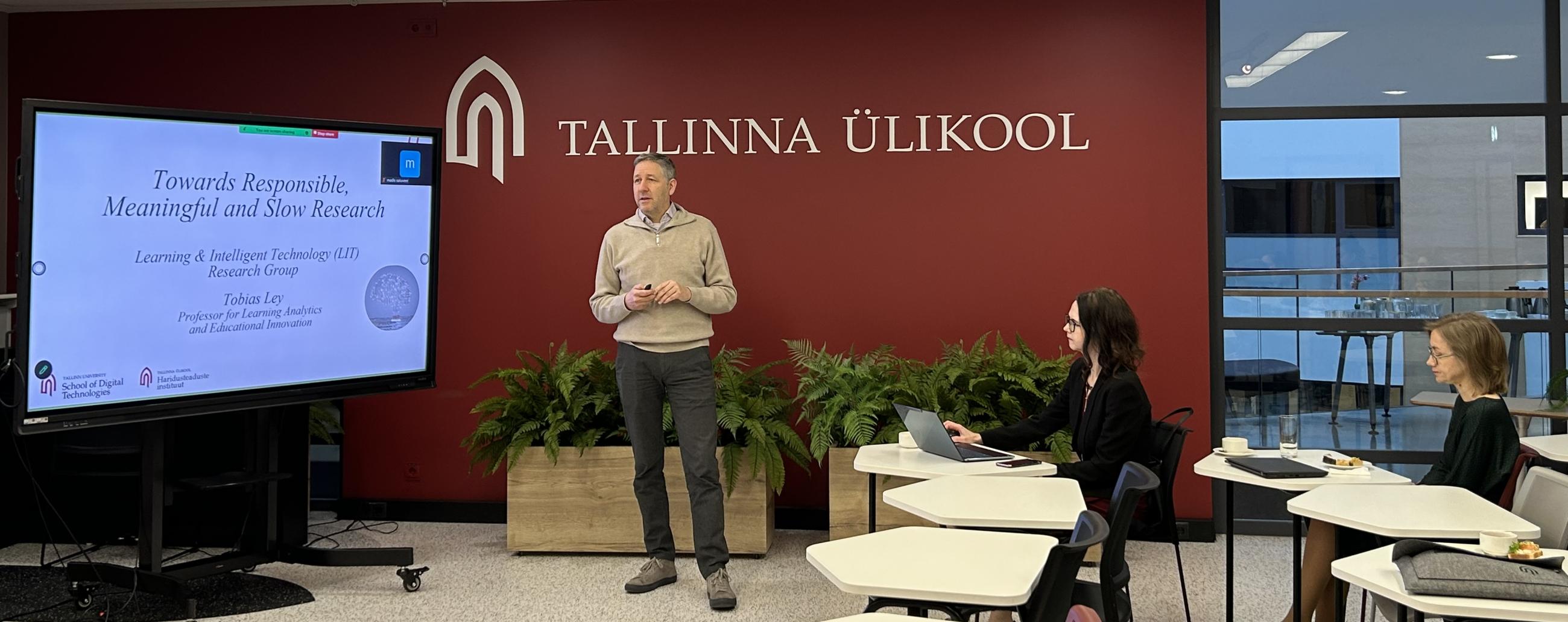
According to Ley, quantitative indicators – such as the number of publications and citation rates – tend to outweigh the actual quality and societal impact of research when research performance is evaluated. “The number of scientific publications is increasing, competition for research funding is intense, and organising high-quality peer review within reasonable timeframes is becoming increasingly challenging. Generative AI also plays a role, making it possible to produce texts and content on a much larger scale than before.”
As an alternative, the professor introduced the Slow Science movement, which values quality over quantity and depth over haste. “Slow Science is not about slowing down research for the sake of slowing down. Rather, it is about creating the time and space researchers need for in-depth thinking, thorough engagement with the literature, and meaningful collaboration.” According to this approach, research evaluation should primarily focus on the substantive value, rigour and significance of research, rather than relying solely on bibliometric indicators.
30 Years of Research in Educational Technology
Ley invited participants to reflect on the quality, meaningfulness and sustainability of research, as well as the opportunities offered by intelligent learning technologies, artificial intelligence and learning analytics and their application in teacher education, higher education, mathematics education, early childhood education and workplace learning. He also introduced the work of the Learning & Intelligent Technology (LIT) research group, which focuses on integrating technology with educational practice.
“The LIT research group is celebrating 30 years of research and development in educational technology at Tallinn University this year,” Ley noted. The group's roots go back to the Centre for Educational Technology, established in 1996 within the Faculty of Educational Sciences at Tallinn University (then Tallinn Pedagogical University). In 2006, the centre became part of the field of digital technologies and has evolved over the decades into an important research and development centre.
From the perspective of Slow Science, Ley emphasised the importance of developing teachers' digital competence and pedagogical reasoning, supporting the adoption of technology in educational institutions, and examining its impact on learners and organisations. As an example of the LIT research group's work, he presented the Estonian Research Council's team grant project (2027–2031), “Developing Teacher Professional Judgment in Technology-Rich Classrooms”. The project focuses on how teachers develop situation-sensitive professional skills and teaching quality in technology-rich learning environments. It will follow teachers' professional development from initial teacher education through to everyday classroom practice. The project is led and implemented by Tammets, Ley, Poom-Valickis, Kasepalu and Sillat.
How Can We Foster a More Meaningful Research Culture?
Although digital and AI-based tools provide increasing amounts of data on learners' progress, participation and learning experiences, more data does not automatically lead to better teaching. Ley emphasised that what matters is teachers' ability to notice, interpret and use this information in ways that support learning and well-being.
The discussion also referred to international initiatives such as the Coalition for Advancing Research Assessment (CoARA), which advocates reforming research assessment, and the Slow Science Manifesto. These initiatives call for changes to the principles of research evaluation and greater recognition of the qualitative impact of research.
Tobias Ley stressed that building a more responsible research culture starts with everyday choices. “In the practice of the LIT research group, this means investing in long-term, trust-based collaborations, being selective when deciding which projects to pursue, and asking whether a proposed research project would still be worth undertaking even if it did not receive funding.”
It is equally important to focus on a smaller number of publications with greater substantive impact, take peer review seriously, and serve as role models and mentors for early-career researchers. Artificial intelligence should primarily be used for tasks that do not require critical scientific judgement.
At the end of the seminar, Tobias Ley encouraged participants to critically examine their own research practices, contribute to decisions concerning the evaluation and organisation of research, and recognise and promote good research practices within their research groups and departments.
The discussion served as a reminder that the value of research lies not merely in the number of publications or the speed at which they appear. Equally important are the substantive quality of research, collaboration, trust, and the ability to generate knowledge that matters both to the research community and to society at large.
The Education Research Club is a monthly research seminar series organised by the Institute of Educational Sciences at Tallinn University. It introduces key research areas and findings from the School to both its staff and a wider public.