What connects school development in Estonia and New Zealand?
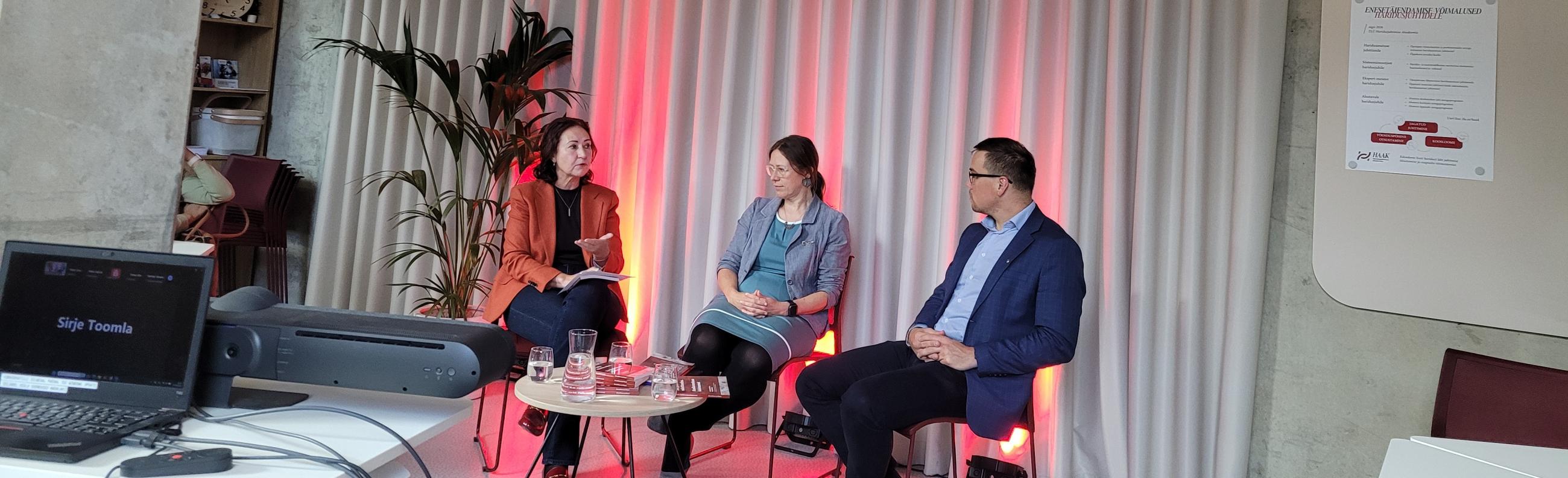
From 14 to 22 September, HAAK welcomed Frauke Meyer, Associate Professor at the University of Auckland, who is one of the authors of the book It’s Not Rocket Science: A Guide to the School Improvement Cycle.
A few years ago, the book was translated into Estonian under the leadership of Harno and with the support of the European Social Fund. Since then, it has become a valuable resource for many Estonian educational leaders in understanding and leading change and school development.
Inspired by the book, an open discussion evening was held at the Centre for Educational Leadership. Eve Eisenschmidt, who moderated the discussion, summarised it as follows:
“Although Estonia and New Zealand are geographically far apart, and we tend to look towards New Zealand as a country with one of the world’s leading education systems, we actually have a great deal in common.
We also approach school development in remarkably similar ways:
- A clear direction and a long-term plan are essential, while it is equally important to recognise and celebrate small wins and progress along the way.
- Leadership needs to be distributed, and teachers need to feel that they can influence what happens in their school.
- Developing new solutions requires teachers to learn, and time for this learning needs to be deliberately planned.
- Decisions should be well reasoned and based on evidence.”
Frauke Meyer and Linda Bendikson’s approach to the school improvement cycle therefore complements our Future School methodology. Frauke introduced the school improvement cycle and helped participants explore its implications during seminars for students of the Educational Leadership and Innovation master’s programme and microdegree programmes.
During her visit, Frauke also visited several Estonian schools. One of the key ideas that emerged was the importance of recognising and celebrating small wins throughout the development cycle.
“While analysing our work together, we realised that we actually achieve plenty of these small wins, but perhaps, in a typically Estonian way, we are too modest to notice and celebrate them,” commented Tiia Rosenberg from Ruila School.
A similar reflection emerged from the visit to Tallinn German Gymnasium. Maive Merkulova noted:
“During the development process, we need to make deliberate stops along the way – to look at where we are, what has changed, what works and what does not, and adjust our next step when necessary. Good school development does not mean following a plan to the very end simply because that is what was once written down. It means continually asking: is what we are doing actually taking us where we wanted to go?”
Frauke observed that the challenges facing schools in New Zealand and Estonia are not so different after all. New Zealand, too, is looking for mathematics teachers and considering how to engage parents more effectively and build strong partnerships with them.
In Estonian schools, she was particularly impressed by the systematic approach to developing students’ general competences. This provides a rhythm and structure for the entire school year and is supported by a student diary tailored to the school’s specific needs.
In addition to meeting practitioners, Frauke held several discussions with our researchers in the field of educational leadership. Topics included the goals of school development, support for new educational leaders, and the development of a more gender-aware school culture.
Despite the considerable time difference between Estonia and New Zealand, several next steps were agreed upon, including plans for educational leaders’ study mobility and the initiation of comparative research.