BFM’s New Research Project Helps Estonian Data Owners Connect Their Data Without Losing Control
A three-year research project is launching at Tallinn University’s Baltic Film, Media and Arts School (BFM), with the aim of finding a way to connect data held by media companies, memory institutions and the state while ensuring that each data owner remains in control of their own data. The project has received funding in the second round of the Estonian Research Agency’s thematic research and development programmes (TemTA). It is the only Tallinn University project to receive funding in this round.
“Estonia’s media and registry data contain a unique picture of our society, but at present that picture exists in fragments. We want to show that data can be connected without anyone having to give up their data or lose control over it. This is exactly the kind of trustworthy solution Estonia’s data economy needs if we want to create value from our own data in the age of artificial intelligence,” said Indrek Ibrus, the project’s principal investigator and Professor of Media Innovation at Tallinn University, BFM. “Although we are starting with media, the same approach can also be applied to cultural heritage, research data and data exchange in the public sector.”
Over the decades, media companies, memory institutions and public-sector organisations in Estonia have accumulated vast amounts of valuable data about Estonian society, including news articles and television programmes, library records, business register data and statistics. However, this data is scattered across different organisations and companies, leaving much of its potential value untapped. At the same time, international platforms and AI companies are able to create value from data on a scale that Estonian organisations cannot achieve on their own.
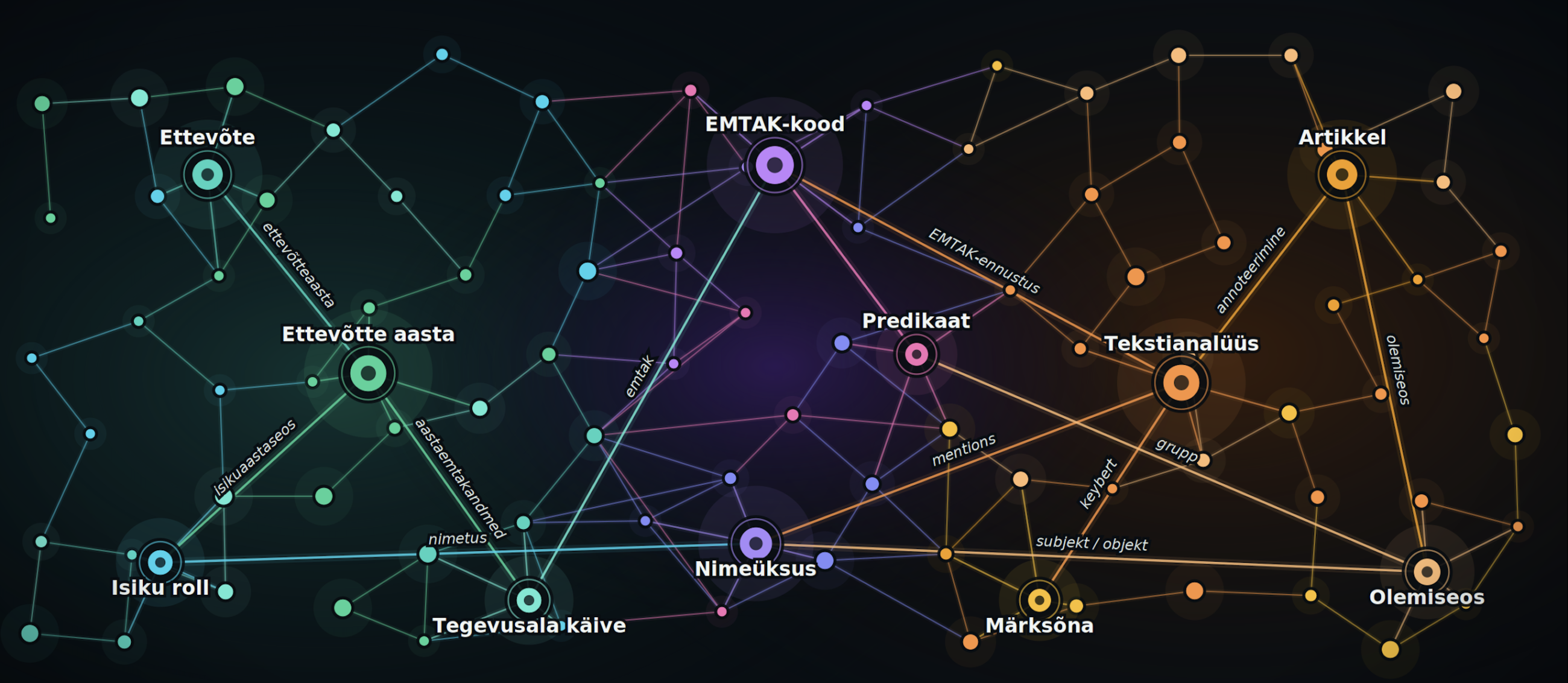
At the heart of the project is a knowledge graph – a machine-readable network that connects data about people, companies, organisations, topics and events, while showing how these relationships change over time. Tallinn University researchers have already experimented with such a graph in previous projects, using more than 20 years of media content provided by partners. AI can identify names, topics, keywords and attitudes in articles and broadcasts and connect them into a large-scale network representing Estonian society and public life. Such linked data enables researchers to study the dynamics of society, the economy and other fields in entirely new ways. Connected databases of this kind are also needed to train reasoning AI models.
The new project will therefore explore how such an infrastructure could be jointly managed by multiple data owners. The solution is inspired by the logic of X-Road: data is interconnected and can be analysed together when necessary, while remaining fully under the control of its respective owners. Blockchain technology will make the updating and use of data transparent and verifiable for all parties. This will also make it possible to license data to third parties, while ensuring that the owner always knows who is using their data and for what purpose.
The project will develop a framework defining the conditions under which data can be brought into such a system, linked with other data and subsequently licensed. Copyright, data protection and contractual restrictions will all be taken into account. The project is particularly timely given the growing demand for high-quality Estonian-language media data.
The project partners are Estonian Public Broadcasting (ERR), Delfi Meedia, Õhtuleht Kirjastus, Äripäev, Telia Eesti, the National Library of Estonia, Statistics Estonia and the Estonian Association of Media Enterprises. The Tallinn University team includes media researchers, data scientists, computer scientists and legal scholars from three different institutes at the university. Two new doctoral researchers will join the project, which will result in at least two doctoral theses. The project will run until 31 August 2029.
The aim of the Thematic Research and Development Programmes (TemTA) is to direct research towards solving real-world problems faced by businesses and society. The programme is funded by the European Regional Development Fund and the Ministry of Education and Research and implemented by the Estonian Research Agency. In the second round, 65 projects were awarded funding from 112 applications, with a total of €50.6 million allocated. Each project must involve at least two companies or professional associations.
More information:
Indrek Ibrus, Professor of Media Innovation at Tallinn University, BFM