
Learning to Make Sense of the World Through Literature and Film
Marta Marita Lauri, a graduate of the Literature, Visual Culture and Film Studies programme and current junior research fellow at Tallinn University School of Humanities, reflects on how her curiosity about literature, film and visual culture shaped her academic journey. She shares how her studies at Tallinn University deepened her understanding of culture, memory and meaning—and ultimately led her to pursue a career in research.
My interest in literature and film goes back to childhood. Having grown up surrounded by shelves of DVDs, and having learned English largely through books, I have always seen art as a way of thinking about the world and its contradictions. A yellowed copy of Carlos Ruiz Zafón's "The Shadow of the Wind" was the first book that moved me, and it left me with the thought that if art can affect us this deeply, it must be an important lens for understanding everything we do.
I first completed a bachelor's degree in Japanese Studies at Tallinn University, with a second major that combined modules in Chinese culture and anthropology. Over time I noticed that the case studies to which I was most drawn came from literature and film. The Literature, Visual Culture and Film Studies (LVF) programme offered the opportunity to examine them more closely.
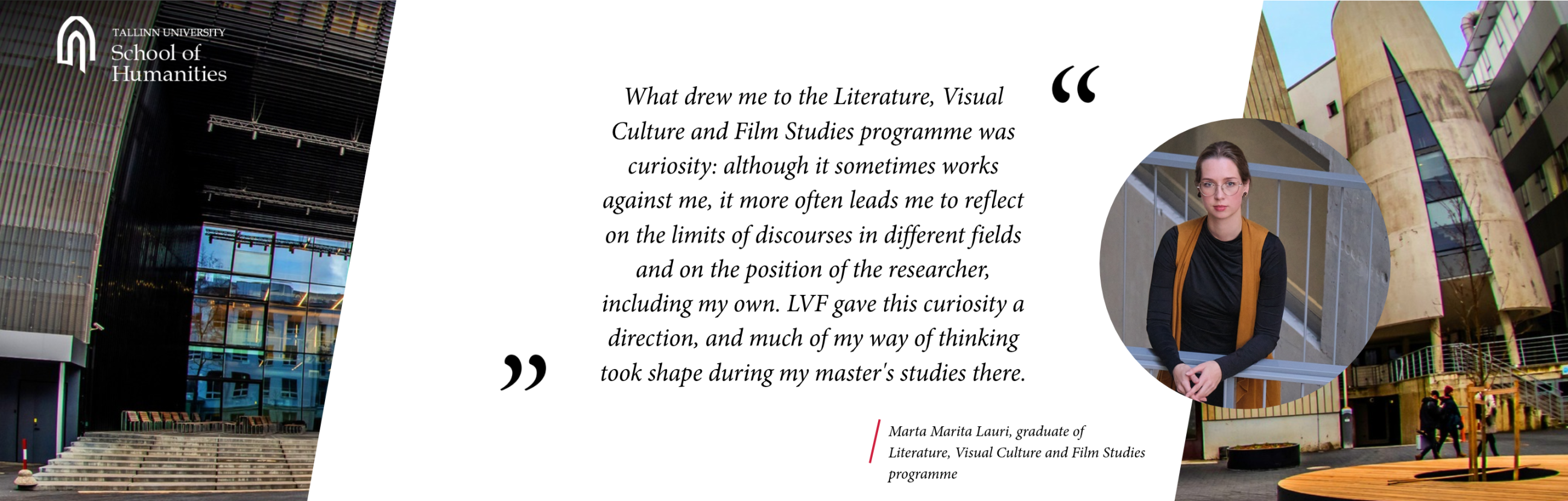
What drew me to the programme was curiosity: although it sometimes works against me, it more often leads me to reflect on the limits of discourses in different fields and on the position of the researcher, including my own. LVF gave this curiosity a direction, and much of my way of thinking took shape during my master's studies there.
LVF was the first academic environment in which I studied alongside peers from a wide range of cultural backgrounds and belief systems. Working through texts and discussions with people who started from such different points made me question the systems of knowledge I had taken for granted: how they are organised, what they make visible or leave out, and what they present as valuable or natural. These are questions I am still investigating.
Several courses gave me the means to pursue these questions. The Postcolonial Studies seminar with Lecturer Piret Peiker examined how colonial encounters shape individual and collective ways of perceiving, and whose perspectives come to define the stories a culture tells about itself and whose are left out, while Professor Eneken Laanes's seminar on the Eastern European past in literature and film looked at how a violent past can remain present in a society without ever being properly mourned, and how film and literature allow us to take on memories of events we have not lived through ourselves, treating memory not as a record of the past but as something mediated, shared and contested.
The Word and Image course with Research Fellow Mari Laaniste at the Estonian Academy of Arts approached seeing as a learned, culturally shaped habit rather than a neutral act, and considered how images carry ideology and how their framing and captions guide what a viewer takes to be real. Associate Professor Teet Teinemaa's courses on film adaptation, narratology and film analysis, which were entirely new territory for me, showed me how rich a single cinematic code, such as the language of sound, can be for analysis, and how well it can tell a story on its own. The second edition of "Grammar of the Edit" by Roy Thompson and Christopher J. Bowen remains a book to which I return.
Studying during the pandemic gave particular weight to Professor Daniele Monticelli's seminar Illness: Narratives, Imagery, Politics, held in the autumn of 2020, when illness had suddenly turned from a private matter into a collective one. Bringing together literature, film, art and theory from ancient Greece to the present, the seminar traced how illness acquires cultural and political meanings beyond the biological, and how our stories can either make it meaningful or be unsettled by its disorder. It placed different periods in dialogue around a single phenomenon, which allowed for close reading and a depth of analysis that I have since come to value in any seminar.
Looking back, studying in the LVF programme alongside my peers taught me to examine my own perception and the ways in which I make meaning. Along with this came intermedial literacy and skills in multimodal discourse analysis, which are increasingly relevant now that our perception is co-created by many media at once. These experiences also led me to explore semiotics and psychology, and eventually to continue in academia.
I now work as a junior research fellow at Tallinn University and am a doctoral student in the Studies of Cultures programme, where my research brings together contemporary aesthetics, intermedial cultural analysis, narrative studies and magical realism. My dissertation examines magical realism and magical thinking as ways of articulating current social, ecological and technological crises, focusing on how magical realist narratives convey the lived experience of crisis when predetermined concepts risk flattening emergent phenomena or forcing them into rigid historical schemas.
To an Estonian student considering LVF, I would say: come curious and open to new ways of seeing. Because your peers bring their own frames of reference, you learn from one another as much as from the readings. Over time, you come to think critically about the narratives we create and uphold, and about how they shape the way knowledge is organised.
Learn more about Literature, Visual Culture and Film Studies MA programme here
Admissions are open! Apply via DreamApply by 1 March 2027. Local and eligible applicants may apply via SAIS until 29 June 2027 at 1 PM (EEST).