Memory and Environment: The Intersection of Fast and Slow Violence in Transnational European Literatures
This project studies how questions of cultural memory and the environment are explored in contemporary European cultures through the medium of transnational literature. In our postmigratory societies cultural memory is often divisive: people clash over their different linguistic, cultural or religious heritage. The recent pandemic, but even more the intensification of climate crisis, has raised our awareness about planetary connectedness. The project innovates methodologically in bringing together transnational memory studies, environmental humanities and ecocriticism to inquire how transnational authors explore the intersection of diverse violent postcolonial and postimperial histories and their environmental impact in different cultures in Europe. We investigate how literature experiments with genre and translingual practices to represent the non-human scale of environmental change and to imagine human subjects in a new way as enmeshed transcorporeally in their environment.
Research staff
Eneken Laanes' main research fields include cultural memory studies, trauma studies, critical theory, multilingualism, autobiographical writing, public history, visual history, Eastern European memory cultures, contemporary transnational literature in Estonian, German, English, Italian and Russian. She holds a PhD in Comparative Literature, which she earned from the University of Tartu in 2009.
Selected publications related to the project’s topics:
Laanes, Eneken, Jessica Ortner and Tea Sindbaek Andersen. 2025. Literature and Mnemonic Migration: Remediation, Translation, and Reception. Berlin: De Gruyter.
Laanes, Eneken. 2024. “Katja Petrowskaja’s Translational Poetics of Memory.” New German Critique 152: 51−78. DOI: 10.1215/0094033X-11165784.
Laanes, Eneken. 2024. “Memory Translation and Minor Transnationalism.” Dynamics, Mediation, Mobilization: Doing Memory Studies With Ann Rigney. Eds. Astrid Erll, Susanne Knittel and Jenny Wüstenberg, p. 237−242. Berlin: De Gruyter. DOI: 10.1515/9783111439273-034.
Comer, Margaret, and Eneken Laanes. 2023. Perpetrators, Collaborators and Implicated Subjects in Central and Eastern Europe. Special Issue of The Slavic and East European Journal 67 (3).
https://seej.org/issues/67.3.html
Julia Kuznetski's main research areas include contemporary Anglophone literature, literary and cultural studies, environmental humanities, new materialism, ecofeminism, blue humanities, gender studies, and transnational literature. In this project, she examines the representation of the social and gendered dimensions of environmental crises in transnational literature, including postcolonial Anglophone and Francophone literature, as well as Slavic and Finnish literature. What role do narratives play in creating and revealing the blind spots of history and memory? How does literature help to reconceptualise the scales of time and space by connecting multidirectional memory with the planetary one? Key concepts include slow violence, scales of nature and environment, hyperobjectivity, the materiality of nature and memory, environmental justice, relationality, vulnerability, and scalar literacy.
She is currently writing a monograph on the entanglement of environment, history, and memory in contemporary women’s writing.
Kuznetski holds both an MA and a PhD in Literary Studies.
Selected publications related to the project’s topics:
Kuznetski, Julia; Battisti, Chiara; Pellicer-Ortin, Silvia (2024). Introduction: Literature and Crises Across Historical Scales. In: The Routledge Companion to Literature and Crisis. (1−11). London and New York: Routledge. DOI: 10.4324/9781003362883-1.
Pellicer-Ortín, Silvia; Kuznetski, Julia; Battisti, Chiara; (2024). The Routledge Companion to Literatures and Crisis. Routledge.
Kuznetski, Julia; Pellicer-Ortín, Silvia (Ed.) (2023). Kuznetski, Julia; Pellicer-Ortín, Silvia. “We Too”: Female Voices in the Transnational Era of Crises, Migration, Pandemic and Climate Change. Special issue of Women: A Cultural Review. (1−161). London: Taylor and Francis.
Kuznetski, Julia (2023). Precarious Bodies in Precarious Times: HerStorical Transcorporeality in Emma Donoghue’s 'The Pull of the Stars'. Women: a cultural review, 34 (1-2), 100−117. DOI: 10.1080/09574042.2023.2184989.
Kuznetski, Julia (2020). Transcorporeality, Fluidity and Transanimality in Monique Roffey’s Novel 'Archipelago'. In: Susana Onega and Jean-Michel Ganteau (Ed.). Transcending the Postmodern: The Singular Response of Literature to the Transmodern Paradigm. (195−212). London & New York : Routledge. DOI: 10.4324/9781003037583-14.
Aigi Heero’s research focuses on contemporary German-language literature, literature and memory studies, German linguistics, and the didactics of German language. In the Memory and Environment project, she explores how German-language literature reflects and negotiates questions of memory, place, and ecological awareness. Her particular interests lie in German transnational literature, narratives of migration, and representations of Germany’s difficult history. She also investigates the role of geographical metaphors, eco-criticism, and relationality in literary texts.
Aigi Heero earned her MA in 1997 and her doctoral degree (Dr. phil.) in 2001 from the University of Freiburg in Germany.
Selected publications related to the project’s topics:
Heero, Aigi (2024). Unveiling Implicit Collective Memory: Images of Ukraine in Dmitrij Kapitelman’s Novel "Eine Formalie in Kiew". Oxford German Studies, 53, 4, 597−614. DOI: 10.1080/00787191.2024.2437873.
Heero, Aigi (2024). Voices from transition: literary reflections on postsocialist life in German and Estonian contemporary literature. Philologia Estonica Tallinnensis, 9, 129−153. DOI: 10.22601/PET.2023.09.05.
Heero, Aigi (2023). Die Wendezeit in Estland. Gohar Markosjan-Käspers Roman "Elena". Baltische Erzähl- und Lebenswelten. Kultur-, literatur-, translations- und sprachwissenschaftliche Aspekte. (149−162). De Gruyter. (Schriften des Bundesinstituts für Kultur und Geschichte der Deutschen im östlichen Europa; 87). DOI: 10.1515/9783111381886-010.
Heero, Aigi (2021). Siirdeaegsed valupunktid kirjandusteoste peeglis: Gohar Markosjan-Käsperi romaanid „Penelopa“ ja „Elena“. Philologia Estonica Tallinnensis, 6, 13−35. DOI: 10.22601/PET.2021.06.01.
Kadri Tüür is currently instructor of Estonian language and culture at University of Toronto. She is also part of the research project Memory and environment: The intersection of fast and slow violence in transnational European literatures at Tallinn University. She holds a BA in Estonian Literature from the University of Tartu (1999), an MA in Comparative Literature from the University of Turku (2002), and an MA in Semiotics and Culturology from the University of Tartu (2003). She holds a PhD degree in semiotics from University or Tartu (2017).
Her main areas of research are environmental humanities, ecocriticism, ecosemiotics, and (more specifically) representations of nature in literature.
Selected publications related to the project’s topics:
Kaljundi, Linda; Mänd, Anu; Plath, Ulrike; Tüür, Kadri (eds.) (2024). Baltic Human-Animal Histories: Relations, Trading, and Representations. Peter Lang.
Kuznetski, Julia; Tüür, Kadri. Estonian literature and ecofeminism. In: Douglas A. Vakoch (Ed.). The Routledge Handbook of Ecofeminism and Literature. (233−243). London: Routledge. DOI: 10.4324/9781003195610-23.
Studia Vernacula, Estonian research journal for craft research - editor-in-chief, 2017-2024
Tüür, Kadri. Semiotics of Nature Representations: on the Example of Nature Writing. University of Tartu, 2017.
Epp Annus' main research fields include Baltic cultures and societies, Russian imperialism/colonialism, culture and society in the USSR, decoloniality, and environmental studies. She earned her PhD in Estonian Literature from the University of Tartu in 2002.
Selected publications related to the project’s topics:
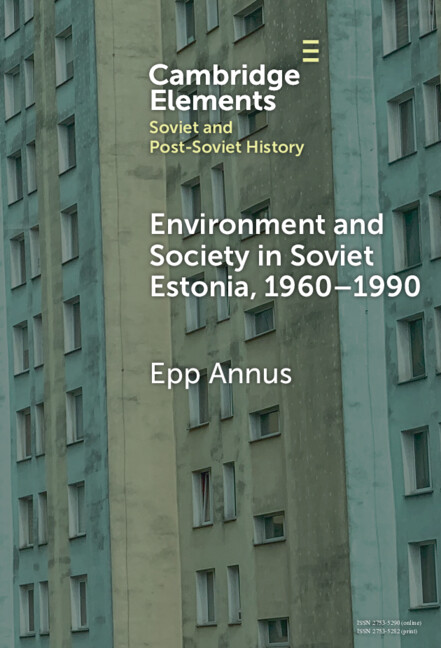
Annus, Epp (2025). Environment and Society in Soviet Estonia, 1960–1990 An Intimate Cultural History. Cambridge: Cambridge University Press.
Annus, Epp (2024). Neoliberalism or postmodernism? Decolonizing Soviet Estonia, 1987–1991. Journal of Baltic Studies, 1−21. DOI: 10.1080/01629778.2024.2396822.
Annus, Epp (2023). Rethinking Soviet Selfhood in the Era of the Anthropocene: From the Foucauldian Paradigm to the Naturecultural Theory of the Subject. Slavic Review, 82 (2), 401−422. DOI: 10.1017/slr.2023.166.
Annus, Epp (2018). Soviet Postcolonial Studies: A View from the Western Borderlands. London and New York: Routledge. DOI: 10.4324/9781315226583.
Pierangelly Del Rio's research interests are Anglophone contemporary memoirs, literary texts of an auto/biographical character, eco-criticism, and memory studies. She focuses primarily on the way in which authors engage with the entanglement of slow violence, environmental degradation, and the marginalisation of historically otherised peoples. Furthermore, she looks at how authors who engage in environmental advocacy, sustainable living practices, and food growing turn to literature to construct an autobiographical self that is deeply intertwined with histories of human and more-than-human relationships.
Her main areas of research are memoir, slow violence, environmental justice, climate change, relationality, collective memory.
Mariia Ivanova's research interests include postcolonial theory, memory studies, identity, and contemporary Ukrainian prose. Her current work focuses on the transformations and negotiations of cultural identity in Ukraine as represented in novels written since 2014. In particular, she examines processes of cultural (self-)decolonisation, cultural hybridity, attempts to bridge gaps within collective national identity, and the role of language and memory in shaping cultural identity. One of her key objectives is to deepen the understanding of the traces and aftermath of cultural colonialism —both imperial and Soviet — in contemporary Ukraine, as well as to analyse how literature addresses existing cultural divides.
Keywords: Ukrainian literature, memory, cultural identity, hybridity, postcolonialism.
Yana Sinitsyna’s research interests are contemporary Ukrainian literature, memory studies, postcolonialism, trauma theory and political discourse. Her current research examines how the environmental impacts of ecological catastrophes, Chornobyl in particular, are represented in literature and how these representations can be used as a critical lens for approaching and opening the dialogue about ecocide in the context of modern war. The key objective of this research is to show how Chernobyl’s physical destruction creates the conditions for generational memory and trauma analysis. It crosses over with the memory of the Soviet state-organized repressions and total control of public narrative and illuminates the importance of commemorative practices in the face of the new ecological crisis caused by Russia’s war against Ukraine.
Kevin Loigu's areas of research include cultural memory, literary studies, and visual culture. He holds a BA in cultural studies from the University of Tartu (2016) and an MA in literature, visual culture and film studies from Tallinn University (and Utrecht University; 2020). For this project, the focus is on the industrial landscapes of Northeast Estonia, their history from the perspective of (colonial) modernisation and its environmental impact. This is an interdisciplinary project where artistic research and practical approaches add to a broad theoretical framework. Keywords include landscape, spatial memory, collective memory, nostalgia and photography.
Selected publications related to the project’s topics:
Human Cities - SMOTIES, Fassi, Davide, De Rosa, Annalinda, Eller, Inge and Dumiak, Michael. Remote Places, Public Spaces: The Story of Creative Works with Ten Small Communities. Berlin, Boston: Birkhäuser, 2024. https://doi.org/10.1515/
Marta Marita Lauri's research fields encompass contemporary aesthetics, transmedial cultural analysis, narrative studies, and magical realism. Her doctoral dissertation investigates the functions of magical realism and magical thinking as methods of crisis communication in the context of contemporary social and technological crises. She specifically examines how magical realist narratives articulate and mediate the lived experience of crisis when predetermined concepts risk flattening emergent phenomena or forcing them into rigid historical schemas. The study analyses sign strategies across literature and screen media that forge new vocabularies and support crisis navigation in conditions of radical uncertainty, where conventional discourse reaches its limits. The primary aim of her research is to deepen the understanding of how magical realist aesthetic forms operate in public discourse as instruments of adaptation and meaning-making.
Keywords: magical realism, magical thinking, crisis communication, contemporary aesthetics, transmedial cultural analysis, narrative studies.
Call for papers
The Earth Remembers: Environment and Memory in Literature
October 6-8, 2027
Conference on Ecocriticism and Memory Studies
Tallinn University, Estonia
As Super El Niño exacerbated global warming in the summer of 2026, in Europe the depleting Danube revealed the traces of World War II in the form of Nazi warships, still residing at the bottom of the central water artery of the continent. In another part of Europe, the blowing up of the Kakhovka dam in Ukraine in 2023 unleashed the residue from World War II and the Chernobyl nuclear catastrophe, carried by the flood of Kherson into the Black Sea, which thus became newly legible as an archive of political disasters and their environmental consequences. In 2026, the Office of the United Nations High Commissioner for Human Rights has issued a Call for Input on Environmental Destruction and its Human Rights Impacts in Gaza both before and after October 2023. The recent siege of the Strait of Hormuz has revealed geopolitical scars and economic uncertainty, while leaving the precariousness of the ecosystem of the strait itself outside major conversations. All these contexts signal the entanglement of environmental harm with violent histories and their memory, producing a vision of the Anthropocene as “the story of how people treat the environment and how people treat each other” (Lewis and Maslin; Mentz).
This conference brings together ecocriticism, environmental humanities and memory studies to explore the many ways in which the questions of environment and memory intersect in literatures of the past and present. Ecocriticism’s interest in how literature can give form to expanded temporal and spatial scales of environmental transformations such as climate change, species extinction, and toxic drift has always implicitly included the questions of memory. However, if cultural memory has for a long time been theorised anthropocentrically as selective and politically determined, environments as “ghost habitats” (Mabey) may serve as archives and potential witnesses to the Wasteocene (Armiero), an era of toxic residue, slow violence (Nixon) and social injustice, which is characterised by contaminating substances as much as by contaminating narratives that hierarchise or erase memories of environmental destruction. Against this background, literature has a viable role in unsilencing entangled memories and vulnerabilities, as well as bringing together human and nonhuman scales.
Our conference will ask how landscapes, places, water bodies, species, weather, material environments, and ecological processes function not merely as settings or metaphors but as active agents in the production, transformation and preservation of memory. Conversely, it also considers how cultural memories shape perceptions of environments, determine what forms of environmental loss become visible or memorable, and influence the ways communities imagine ecological futures in the processes of proleptic or anticipatory remembering (Colebrook, Craps). We invite contributions that consider how different literary forms and genres can make perceptible temporalities and scales of environmental change that exceed human experience, and reshape our understanding of place, responsibility, belonging, and planetary futures.
Special stream: Ecocide and environmental impact of historical violence
This special stream within the larger conference explores more specifically the questions of literary engagement with ecocide and the environmental impact of war, occupation, genocide, colonialism and other forms of historical violence. How do contemporary literatures represent the entanglement of violent histories and environmental change? We are particularly interested in the relationship between historically concentrated forms of violence such as war, genocide, and occupation, and slow violence – environmental destruction whose effects unfold gradually across generations. Colonialism, imperialism, and extraction may produce environmental legacies that extend far beyond the historical events through which they are conventionally remembered. We particularly encourage transnational, comparative, and interdisciplinary approaches that bring different (postcolonial) literatures, histories, geographical contexts, languages, and theoretical perspectives into dialogue.
We welcome papers exploring these and other aspects of memory and environment in literature:
• Human, non-human, and more-than-human memories
• Temporal and spatial scales of environmental memories
o human and more-than-human temporalities
o local, regional, national, transnational, and planetary scales
o relations between individual experience and large-scale environmental transformation
• Transcorporeality and material interdependence
• Animals, plants, water, soil, and other more-than-human agents of memory
• Embodied and differential experiences of environmental change
• Intergenerational and delayed environmental effects
• Rethinking the human subject and its relationship to the past through environmental relations
• Ecocide and the environmental impact of historical violence in war, occupation, genocide, colonialism, and imperialism
• Environmental (in)justice, indigenous environmentalism, decolonial ecocriticism
• Environmental impact of industrialisation, extractivism, plantation economy, pollution, etc.
• The intersection of event-centred violence and slow violence
• The representation of the environmental impact of contemporary wars and genocide
• Literary forms (genres, tropes, narrative perspectives) and formal experimentation in ecocriticism
• Mimetic, a- or anti-mimetic literary approaches to memory and the environment
• Ecolinguistics, ecostylistics and cognitive literary studies
• Ethics, justice, and environmental memory
• Forms of critique and hope in literatures of environmental memory
We welcome contributions from literary studies, memory studies, environmental humanities, ecocriticism, comparative literature, postcolonial studies, area studies, and related fields.
Keynote Speakers
Anna Barcz, T. Manteuffel Institute of History of the Polish Academy of Sciences
Rob Nixon, Princeton University
Hanna Teichler, Goethe University Frankfurt
Please submit your paper and panel proposals by 15 January 2027 to the following e-mail address: earthremembers@tlu.ee. For paper proposals please submit an abstract (max 300 words) and a short bio. For the panel: the panel description (max 300 words), the abstracts for 3–4 papers (max 300 words each) and the bios of the presenters. Acceptance notice will be sent by 15 February 2027.
The conference is organised by the project “Memory and Environment: The Intersection of Fast and Slow Violence in Transnational Literatures” (led by Eneken Laanes, Estonian Research Council, 2025–2029) in collaboration with the Estonian Association of Comparative Literature and the working group of Literature and Memory of Memory Studies Association.
Upcoming events
Memory x Environment: Book Club #1
November 17 at 17:30, Tallinn University A-121
The event is held in English, pre-register here
In our contemporary society, cultural memory is divisive and contested: we clash over different linguistic, cultural, religious, and environmental heritage. The recent pandemic and worsening climate crisis have raised awareness about planetary interconnectedness. Our Book Club is an intellectually enriching space focused on books that raise questions of cultural memory, ecology, history, and human-nature interconnectedness.
We read widely—from non-fiction to literary fiction and sci-fi—and welcome anyone with a passion for reading and critical discussion.
Past events
- Keynote: "Passport in a Mushroom Basket and the Dead Cow: Environment and Society in Soviet Estonia and Beyond"
Part of Fourth Annual BASEES Baltic Study Group Workshop Parallel Memories: People, Place and Environments in the Baltic States
October 30-31, 2026
- Book Discussion: The Solidarity of the Shaken: On the Collective Subject of the Belarusian Revolution of 2020, by Tatiana Shchyttsova
Part of ASEEES Virtual Convention 2026
October 16, 2026
Member of the research project “Memory and Environment", associate professor Epp Annus, took part of the ASEEES Virtual Convention on Friday, October 16, as one of the Book Discussion Roundtable speakers.
The roundtable discussion focuses on a new collective political subject that emerged during the mass protests in Belarus in 2020. The discussion will focus on this subject's specifics and the political antagonism of 2020, which the author of the book characterizes as a "contest over sovereignty" between a tyrannical ruler and a pro-democracy protest community. Issues to be addressed include the non-violent nature of the protest movement, the new political positioning of the feminine subject, the affective dimension and temporality of the protests, and the rethinking of the national question. The roundtable aims to reveal the philosophical, moral, and political significance of the 2020 Belarusian Revolution in a global context.
- International Symposium "English Exposed: Vulnerability and Hope in Culture and Language"
Organized by Tallinn University, School of Humanities' English Studies department and the research project “Memory and Environment"
October 8-10, 2026
In a world marked by overlapping crises—wars, epidemics, climate catastrophe, democratic erosion, technological acceleration, and the growing entanglement of artificial intelligence with everyday communication—vulnerability has emerged as an increasingly recognised condition. English, as a global language of culture, education, governance, and digital mediation, is deeply implicated in these processes: it both exposes subjects to new forms of precarity and offers resources for articulation, resilience, care, and hope.
How to think about vulnerability in today’s world? Is it to be resolved or can we conceive of it as a condition to be accepted and embraced? Is it helplessness and lack of agency or is it a relational, affective and ethical condition? How can it be reconceptualised and recognised for its potential to generate new forms of creativity, solidarity, and critical hope?
This symposium invited scholars working across literary studies, cultural studies, linguistics, and language education to explore how vulnerability manifests in the world and is represented in and through English and Anglophone cultures today. Among others, keynote speakers Marco Caracciolo (Ghent University) and Hannah Lowe (award-winning British writer and poet) explored these subjects.
- "A Vocabulary of Our Own" - vocabulary in Eastern European studies
Organized by Södertörn University's Centre for Baltic and East European Studies (CBEES)
September 10, 2026
Eneken Laanes participated as an invited expert at the international interdisciplinary workshop "A Vocabulary of Our Own: Translating, Reclaiming, and Creating Concepts for Research in Central and Eastern Europe, the Baltic Sea Region, and Central Asia" for early career scholars on 10 September at Södertörn University, Stockholm, Sweden.
At the roundtable, Laanes discussed appropriate conceptual vocabulary for the study of Eastern Europe.
-
Memory Studies Association Conference in Buenos Aires
Organized by Torcuato Di Tella University
July 31, 2026
The project organised the panel “Memory and Environment in Transnational Literatures” at Memory Studies Association Conference at the Torcuato Di Tella University, Buenos Aires. Project members Aigi Heero and Julia Kuznetski discussed in their paper “Liquid Archives: Transgenerational Memory and Ukrainian Present” water as a carrier of memory in Natascha Wodin’s novel Sie kam aus Mariupol and Tanja Maljartshchuk’s text Forgottenness.
Eneken Laanes’s paper “Decolonization and the Memory of Ecocide” deals with Yuliya Musakovsk’s poetry to show how the current ecocide in Ukraine has raised the questions about the environmental impact of Soviet colonialism.
- Conference „What Moves Society – German Studies in the Nordic Countries and the Baltics“
Organized by Aue Foundation (Helsinki), the University of Oulu, and Tallinn University (Department of German Studies and the research project Memory and Environment), in cooperation with the Finnish DAAD Alumni Association.
May 7-8, 2026
Keynote speakers: Professor Mathias Albert, Associate Professor Maris Saagpakk, and Dr Benjamin Schweitzer.
- Ukrainian Poetry Reading and Discussion with Halyna Kruk, Julia Musakovska
Organized by Tallinn University, School of Humanities
February 5, 2026
One of the ways to document reality and lived experience is through poetry. Poetry sets no boundaries in regards to length, complexity, symbolic weight or in-between-the-lines meanings. But it should be honest. Capturing the horrifying experience of the war can prove to be an enormous task both for a poet and a reader but the war has many faces, so does the war poetry. It can open up new perspectives of looking at Ukrainian history and culture, it can put a start to re-thinking social and cultural mainstream narratives or nourish a long postponed wish to delve into Ukrainian literature. We exist as long as we remember, and even though poetry can push some buttons on painful experiences of either past or present, it can more importantly re-activate our ability to remember and create some new memory patterns.
Speakers: Halyna Kruk and Julia Musakovska
Moderators: Aija Sakova and Yana Sinitsyna.
- Book Talk - Terra Invicta: Ukrainian Wartime Reimaginings for a Habitable Earth. Ukrainian artists and humanists respond to the identity-defining war
Organized by Tallinn University, School of Humanities & RUTA Environmental Initiative
December 8, 2025
Presenters: Adrian Ivakhiv, Kateryna Botanova, Kateryna Filyuk, Lesia Kulchynska, Taras Polataiko, Maria Sonevytsky, Oleksiy Vasyliuk, Olya Zikrata. Moderator: Epp Annus
The Russian invasion of Ukraine in February 2022 produced not only military and humanitarian responses but also scholarly and artistic ones from Ukrainians looking to the future of their country.
Terra Invicta is a series of critical and creative articulations of pasts, presents, and possible futures involving humans and the more-than-human world. The authors suggest that Ukraine is caught in an environmental war, waged by a fossil-fuel superpower against people who are prepared to lay down their lives to protect their land. This volume explores the relationship between Ukrainians – a multiethnic and multireligious people with a complicated history – and the Ukrainian land, the zemlia to which they belong. Themes include decoloniality, ecocultural identity, the politics of reconstruction, and artistic responsibility amid a war for national survival. Contributors emphasize the value of reviving multispecies relations with the land, positively transforming multicultural relations with history, and reinvigorating grassroots engagements with the state and society.
Terra Invicta grapples with the role of artistic expression in the face of war and collective loss and what it means to commit to a place, a land, a territory, in a world set in constant motion.
Adrian Ivakhiv holds the J.S. Woodsworth Chair in the Humanities at Simon Fraser University, Vancouver, Canada. Until 2024, he was a Professor of Environmental Thought and Culture at the University of Vermont, USA. His books include The New Lives of Images: Digital Ecologies and Anthropocene Imaginaries in a More-than-Human World (Stanford University Press, 2025), Shadowing the Anthropocene: Eco-Realism for Turbulent Times (Punctum, 2018), and Ecologies of the Moving Image: Cinema, Affect, Nature (Wilfrid Laurier University Press, 2013). Born in Toronto to Ukrainian refugee parents, he was a Canada-USSR Scholar in 1989–90 in Kyïv and Lviv and has conducted research in Ukraine intermittently since then. He has published on the cultural politics of Chornobyl, Ukrainian-Polish borderland identities, Ukrainian environmental ethics, and the Ukrainian Native Faith and Neo-Pagan movements. Since 2014, he has hosted the blog UKR-TAZ: A Ukrainian Temporary Autonomous Zone (blog.uvm.edu/aivakhiv-ukrtaz)
Kateryna Botanova (born in Khmelnytskyі, Ukraine) is a cultural critic, curator, and writer based in Basel, Switzerland. She is a co-curator of the Swiss multidisciplinary biennial Culturescapes; a guest senior curator of the Research Platform of the Pinchuk Art Centre (Kyïv); guest curator at the Jam Factory Art Centre in Lviv; advisory board member of RUTA Association; and a member of PEN-Ukraine. Her essays on the impact of the war on culture and the arts have been included in books published by Routledge, Forum Transregionale Studien, and Ibidem Verlag. She is editor of Reclaiming History: Decoloniality and Art in Ukraine after 1991 (PinchukArtCentre, 2025).
Kateryna Filyuk (born in Odesa, Ukraine) is a curator and researcher who served as chief curator at the Izolyatsia Platform for Cultural Initiatives in Kyïv from 2017 to 2021. She co-founded the publishing house 89books in Palermo, and is currently a PhD student at the University of Palermo and a visiting researcher at FOTOHOF Archiv (Salzburg). In 2023–24, she was a visiting PhD student at the Central European University (Vienna) and a predoctoral fellow at the Bibliotheca Hertziana at Rome’s Max Planck Institute for Art History. She lives and works in Palermo and Kyïv.
Lesia Kulchynska is a curator and visual studies researcher who has taught communication and cultural/media studies at the National University of Kyïv-Mohyla Academy and at Kyïv Academy of Media Arts; has been a Fulbright Scholar at New York University and postdoctoral fellow at the Max Planck Institute for Art History, Berlin; and curated The School of the Lonesome at the Kyïv Biennial in 2015. She lives in Helsinki, Finland.
Taras Polataiko (born in Chernivtsi, Ukraine) is a painter, photographer, performer, and video and installation artist who received his BFA at the Moscow State Stroganov University of Fine and Industrial Arts, and his MFA at the University of Saskatchewan. His work has been exhibited at art exhibitions around the world, including the Sao Paulo Biennale (2002), the Palau de la Virreina and Antoni Tapies Foundation in Barcelona (2003), the Center for Contemporary Art Ujazdowski Castle in Warsaw (2000), the Lombard-Fried and Schroeder Romero galleries in New York City, and many others.
Maria Sonevytsky (born in Yonkers, NY) is an associate professor of anthropology and music at Bard College, New York State, and the author of Wild Music: Sound and Sovereignty in Ukraine (Wesleyan University Press, 2019) and the 33 1/3 Europe book Vopli Vidopliassova’s Tantsi (2023). She produced the Chornobyl Songs Project for Smithsonian Folkways (2015). She has conducted fieldwork in northern and western Ukraine and Crimea since 2008.
Oleksii Vasyliuk (born in Vasylkiv, Kyïv Oblast) is a zoologist, ecologist, and graduate of Taras Shevchenko National University (Kyïv). In 2014, he co-founded and currently leads the Ukrainian Nature Conservation Group. He has authored over seven hundred publications and co-authored four books in environmental monitoring and conservation, has served as an adviser to government representatives, and has initiated or co-initiated the creation of more than sixty protected areas in Ukraine.
Olya Zikrata (born in Kerch, Autonomous Republic of Crimea, Ukraine) is an artist-researcher currently based in Montreal, Canada. She holds a PhD in interdisciplinary humanities from Concordia University and writes on sound and post-Soviet activisms.
The event was hosted in collaboration with RUTA Association for Central, South-Eastern, and Eastern European, Baltic, Caucasus, Central and Northern Asian Studies in Global Conversation & Tallinn University, School of Humanities. It was organized under the auspices of the research project PRG2592 “Memory and Environment: The Intersection of Fast and Slow Violence in Transnational European Literatures”.
- TÜHI Research Seminar - Memory and Environment: The Environmental Impact of Political Violence in Ukraine, Past and Present
November 11, 2025
Speakers: Epp Annus, Aigi Heero, Julia Kuznetski, Eneken Laanes
The seminar introduced the research project “Memory and Environment: The Environmental Impact of Violent Histories in Transnational European Literature” (2025–2029, Estonian Research Council; PI Eneken Laanes), launched in 2025.
The project explores the intersections of cultural memory, heritage, and the environment in contemporary transnational literature and culture. It brings together scholars from memory studies and the environmental humanities to ask how contemporary literature—often produced by multilingual authors with migration backgrounds—and culture more broadly represent the environmental impact of different violent histories; how they depict environmental change on scales difficult for humans to perceive; and how they address embodied human entanglements with the environment and its transformations.
The seminar focused in particular on Russia’s war against Ukraine and examined whether postcolonial theory—traditionally used to analyze the environmental effects of historical violence in Europe’s colonial contexts—can also be applied to the Ukrainian case.
- A book discussion with Darya Tsymbalyuk "Ecocide in Ukraine; The Environmental Cost of Russia’s War" (Polity, 2025)
Organized by Tallinn University, School of Humanities
March 9, 2025
Darya Tsymbalyuk discusses her book in conversation with Epp Annus
Russia’s war on Ukraine has not only destroyed millions of human lives, it has also been catastrophic for the environment. Forests and fields have been burned to the ground, animal and plant species pushed to the brink of extinction, soil and water contaminated with oil products, debris, and mines. The devastation of biodiversity and ecosystems across Ukraine has been immeasurable, long-lasting and its consequences stretch beyond national borders. In Ecocide in Ukraine, Ukrainian researcher Darya Tsymbalyuk offers an intimate portrait of her beloved homeland against the backdrop of Russia’s war and ecocide.
Darya Tsymbalyuk is an Assistant Professor at the Department of Slavic Languages and Literatures, and the Committee on Environment, Geography, and Urbanization (CEGU) at the University of Chicago. Her academic papers and public essays explore narratives about environments, multispecies worlds, displacement, embodied knowledge, and entangled colonial histories of Ukraine. Her writing has appeared on the BBC’s Future Planet and open Democracy websites, among many other publications. In addition to her research and writing, Darya also works with images through drawing, painting, collage, and video essays.
Epp Annus is an associate professor at Tallinn University; she also lectures at Ohio State University (USA). Her interests include Baltic cultures and societies, Russian imperialism/colonialism, decoloniality, and environmental studies. Her recent and forthcoming books include Environment and Society in Soviet Estonia, 1960-1990 (Cambridge UP, forthcoming 2025) and Soviet Postcolonial Studies: A View from the Western Borderlands (Routledge, 2018). She has published two novels, some poetry and several children’s books.
This event is organized by Tallinn University, School of Humanities, the project PRG2592 “Memory and Environment: The Intersection of Fast and Slow Violence in Transnational European Literatures” and the project TF2324 “Exploring Patterns of Subject-Formation in Estonian Culture, 1956-1998”.
- History is not an accident II: the return of molotovs and ribbentrops?
Organized by Tallinn University, School of Humanities & RUTA Association
March 7, 2025
The U.S. is trying to strike a deal with Putin’s Russia. It does so over the heads of Ukraine and Europe. This move echoes some of the darkest moments in European history: the Munich Agreement of 1938, the Soviet-Nazi Pact of 1939, and the Yalta Conference of 1945.
At the same time, Trump and his officials are leading a denigration campaign against Ukraine and attempting and planning to exploit its natural resources. This marks a crucial turning point in transatlantic relations. Experts from the RUTA region and beyond will discuss the implications. What do these events mean for Ukraine, Europe, and the world?
Speakers: Kseniya Oksamytna, Terrell Jermaine Starr, Mart Kuldkepp
Moderator: Una Bergmane
Kseniya Oksamytna is a Reader in International Politics, City St George’s, University of London. Her research interests focus on international organisations, security, and peace operations. Her book, “Advocacy and Change in International Relations: Communication, Protection, and Reconstruction in UN Peacekeeping,” was the winner of last year’s Chadwick Alger Book Award by the International Studies association.
Terrell Jermaine Starr is an independent journalist based in Ukraine whose work helps non-experts understand world politics and why we should care. His expertise focuses on Ukraine and Eastern European politics, as well as communicating foreign policy issues in accessible ways.
Mart Kuldkepp is an Estonian Scandinavianist and historian. He completed his PhD in Scandinavian Studies at University of Tartu, Estonia, in 2014. In 2015 he joined University College London (UCL) where he is currently Professor of Estonian and Nordic History. Mart specialises on Scandinavian and Baltic history and politics – especially foreign and security policy – and early 20th century wars. He is also interested in contemporary Baltic and Scandinavian politics, especially foreign and security policy.
Una Bergmane is a Latvian historian working on the Soviet collapse. She is a researcher at the University of Helsinki. Her first book, “Politics of Uncertainty. The United States, the Baltic Question, and the Collapse of the Soviet Union” was published in 2023 by OUP.
The event is being organized by RUTA Association for Central, South-Eastern, and Eastern European, Baltic, Caucasus, Central and Northern Asian Studies in Global Conversation & Tallinn University, School of Humanities. The event is funded by the project PRG2592 “Memory and Environment: The Intersection of Fast and Slow Violence in Transnational European Literatures.”
- History is not an accident: three years of Russia’s full-scale war against Ukraine
Organized by Tallinn University, School of Humanities & RUTA Association
February 21, 2025
History is not an accident, and Russia's war against Ukraine is not an isolated "local" conflict. It is part of a broader web of Russia's imperial/ colonial violence. Three years of Russia’s full-scale war against Ukraine have destroyed lives, environments, and cultural heritage, and have been accompanied by Russia’s other imperial interventions, taking different forms across various regions in a large part of the world.
Presenters: Maia Barkaia, Erica Marat, Iryna Zamuruieva.
Moderator: Epp Annus
Maia Barkaia is an associate professor at the Georgian Institute of Public Affairs (GIPA). She holds a B.A. in Oriental Studies, an M.A. in Modern Indian History, and a Ph.D. in Gender Studies. These academic backgrounds have shaped her research and teaching interests, which center on Postcolonial and Gender Studies. Her work explores themes such as Imperial Entanglements, Modernity, and Inequalities in the Caucasus and Asia during the 19th and 20th centuries. She is also the co-editor with Alisse Waterston of Gender in Georgia: Feminist Perspectives on Culture, Nation, and History in the South Caucasus, published by Berghahn Books (2017, 2021).
Erica Marat is a Professor at the College of International Security Affairs of the National Defense University. She has authored several books, including most recently Transformative Violence: When Routine Cruelty Sparks Historic Mobilization (Oxford University Press 2024). She is currently working on a project on decolonial developments and processes in Central and North Asia and South Caucasus. She is also engaged in a research project on China’s and Russia’s provision of public services for illiberal governments in 15 countries across five continents.
Iryna Zamuruieva explores human-environmental relationships through photography and writing. Iryna’s current focus is on the environmental history and political ecology of rapeseed cultivation in central Ukraine. Most recently Iryna has been an artist in residence at Street Level Photoworks in Glasgow and a research fellow at the Institute for Human Sciences (IWM) in Vienna and worked on climate and land policy at Verture in Edinburgh.
Publications
Environment and Society in Soviet Estonia, 1960–1990 An Intimate Cultural History
Author: Epp Annus
This Element investigates how natural environments and social ideas and circumstances were intertwined in fundamental ways. Various aspects of Estonian environmental thought and practices are analyzed as tied to local, intimate environments, while being at the same time connected to the global circulation of ideas.