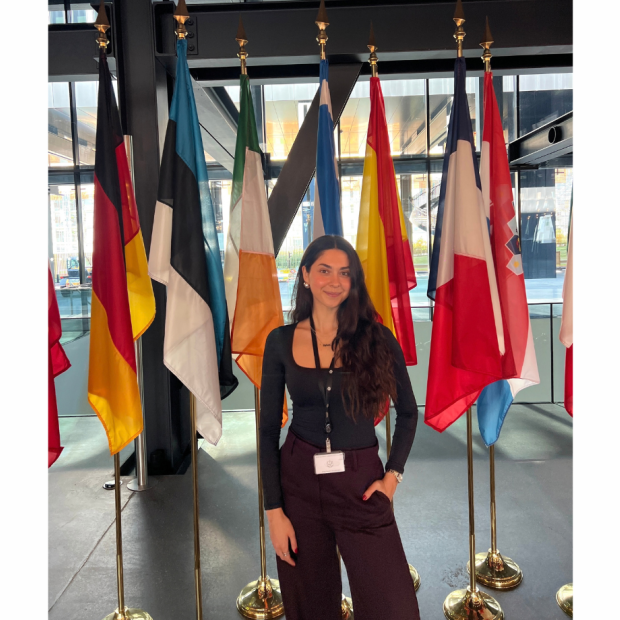
Beyond the Traditional Path: Roosa’s Journey from Tallinn University Law School to DLA Piper
Read Roosa’s journey from an unexpected start at Tallinn University to an international legal career in IP, technology and gaming law. In this interview, she shares how studying law in English became one of her greatest strengths, how international experience shaped her professional path, and why choosing a different route can open doors you never imagined.

Why did you choose to study law in English at Tallinn University?
I applied to Finnish law schools three times. On my final attempt, I was rejected despite reaching the minimum acceptable score, as there were too many applicants at the cutoff point. At the time, I wasn’t aware of TLU or its law programme – having done my high school in Finland, the only path I knew was studying at a Finnish university.
Fortunately, a friend who was studying at TLU told me about the university and the opportunities it offered. I still remember my biggest concern was to study in English, as I didn’t consider myself particularly strong in the language. Despite this, I decided to apply - and looking back, it was one of the best decisions I’ve made. Not only did I complete my law degrees with honours and distinction, but I also significantly improved my English skills, now being completely fluent in it. I believe this has been the key factor in securing the traineeships and jobs I’ve had in international companies.
What did the international study environment at TLU give you professionally?
One of the most valuable aspects of TLU for me was the community of like-minded people. Having lived a third of my life abroad, I was naturally drawn to an environment where others were also looking beyond Finnish borders, willing to think differently and dare to dream big. Many of my fellow students
shared that same international mindset, and I still keep in touch with several of them - some have even become close friends of mine.
Academically, the international environment was just as impactful. Many professors came from abroad, including the United States, which brought a different perspective to teaching. From what I understand from Finnish law students, Finnish law schools often rely on large mass lectures where professors speak with a very limited interaction or student participation. In contrast, TLU offered smaller, more focused classroom seminars with a more engaging and interactive, US-style teaching approach. Courses were highly interactive and often included presentations, which made learning more dynamic and practical. I also grew significantly more confident in speaking and presenting in English before an audience - something that has proven invaluable in my professional life later.
How did your career path continue after graduating from TLU and what role did further studies, internships and work experience play in your path?
One of the most valuable aspects of TLU for me was the community of like-minded people.
During my 3rd year spring at TLU, I secured a full-time internship at Nokia Technologies for a year, which led me to take a gap year and defer my LL.M. studies. Balancing studies, work, training, and volunteering during my bachelor’s degree at TLU had been very rewarding - but also quite demanding - so I felt it was the right moment to take a short break and gain full-time work experience before continuing with my master’s degree. While taking a gap year is not necessary, if you find yourself in a similar position, I encourage you to take the opportunity. Gaining work experience will be incredibly valuable and will also strengthen your prospects when applying for jobs after graduation. There’s no need to rush through your studies, especially since most of the LLM degrees abroad are 1-year programs compared to Finnish 2-year programs.
I then continued my master’s studies at the University of Edinburgh, completing an LL.M. in Intellectual Property Law. The year was academically intense, with full-time studies and no opportunity to work alongside them. Despite the demanding workload, it was without a doubt one of the best years of my life. The program was highly international, exposing me to diverse cultures and perspectives. I also formed close friendships that have lasted beyond my studies - I’ve even attended weddings in India and Bangladesh since then. These are lifelong memories I would never have gained had I stayed in Finland.
After graduating in 2023, I held several fixed-term roles at Fintraffic, Supercell, and RELEX Solutions before joining DLA Piper as an Associate. My international background and studies have been key factors in setting me apart from other applicants, as companies highly value international experience and strong communication skills in English. Exposure to different cultures during your studies also prepares you for the business world, where you’ll need to collaborate with clients, colleagues, and partners from diverse backgrounds, and, for example, negotiate agreements across countries and cultural contexts.
While it is certainly possible to pursue a master’s degree in law in Finland after TLU, I strongly recommend considering studying your LLM abroad. Embrace internationality and turn it into your strength. It can truly become your superpower, but you have to make it one!
How did you move from an international law degree towards legal work connected with Finnish clients and Finnish legal practice?
I completed an internship during my TLU studies at a small, one-person law firm, where I gained hands-on experience across a broad range of areas, including family law, succession law, criminal law, and disputes between private individuals. Although these were not areas I was particularly interested in pursuing long term, the experience was invaluable. It allowed me to develop essential skills such as legal research and drafting applications for summons, directly within the context of Finnish law. Working on these kinds of matters brings you very close to the practical application of the law and helps build strong foundational skills that will stay with you throughout your career. This internship also played a role in helping me secure my current position: It demonstrated that, despite my strong international background, I am fully capable of handling tasks related to Finnish law as well.
My number one piece of advice is not to be too selective when it comes to internships. The most important thing is to gain practical experience - whether that is at a top-tier law firm, a small one- person practice, or within a company. Over time, you will build experience, progress into more advanced roles, and eventually, after graduating, you will have greater freedom to choose your career path.
For international students aiming to work in a law firm in Finland and qualify as attorneys-at-law, this path is entirely achievable with an international law degree. After completing my LL.M., I applied for recognition of the comparability of my degree to the Finnish Master of Laws. The Finnish National Agency for Education issued a conditional decision of comparability, which required me to complete a certain number of ECT credits in key areas of Finnish law, such as family and succession, procedural, constitutional, criminal, and administrative law. These courses can be completed either by obtaining study rights at a Finnish law faculty or through an open university. I chose the latter and have been completing the required courses alongside full-time work. It has been a journey, but at this stage, grades are not the primary concern; the key objective is to complete the required credits.
After finishing all the necessary coursework, I received the final decision of comparability. This decision is required in order to take the Finnish Bar examination and ultimately qualify as an attorney at-law in Finland.
How did you become interested in IP, entertainment, data and technology law?
I have always been more interested in working with companies rather than private individuals, and choosing an international law degree often naturally steers you toward a more commercial career path rather than traditional roles such as a national judge or a governmental authority, although those paths are absolutely possible as well.
During my studies at TLU, IP stood out to me as one of the most interesting areas of law. After securing internships related to IP and technology, I quickly realised that the intersection of these two fields was the perfect fit for me. I believe this is largely due to the rapid pace at which technology evolves and to effectively advise clients, you need an understanding of the underlying technical solutions. This makes the work especially engaging - there’s always something new and challenging to learn, so no two days ever feel the same! I initially found it difficult to choose between an IP- focused LL.M. and a technology law programme, and even after selecting the IP track, I approached my studies from a technology-oriented perspective.
I have also been fortunate to gain excellent work experience after graduating, with my traineeship at Supercell being one of the most impactful highlights. In fact, it had such a strong influence on me that in my current role at DLA Piper, within the IP and Technology (IPT) team, I not only work on a wide range of IP and technology matters but also lead our gaming sector work in Finland, which has been incredibly rewarding!
What advice would you give to Finnish applicants considering Tallinn University’s Law programme in English?
Understand and accept that you are choosing a path that differs from the traditional Finnish law school route. That is not a disadvantage, quite the opposite. This path can be incredibly rewarding, but it requires commitment, confidence, and persistence.
Dare to think big and differently and stay focused on your own journey rather than comparing yourself to others. A touch of “delusion”, combined with courage and taking action, can take you so far - something I believe has been true in my own experience. My favourite life motto captures this perfectly: “turn your delulus into trululus.”