
Tallinn University researchers presented an AI-assisted digital twin concept for city planning
Researchers and students from Tallinn University’s School of Digital Technologies presented the results of their collaboration with Tallinn City on the development of a user-centred digital twin concept for urban planning and city governance.
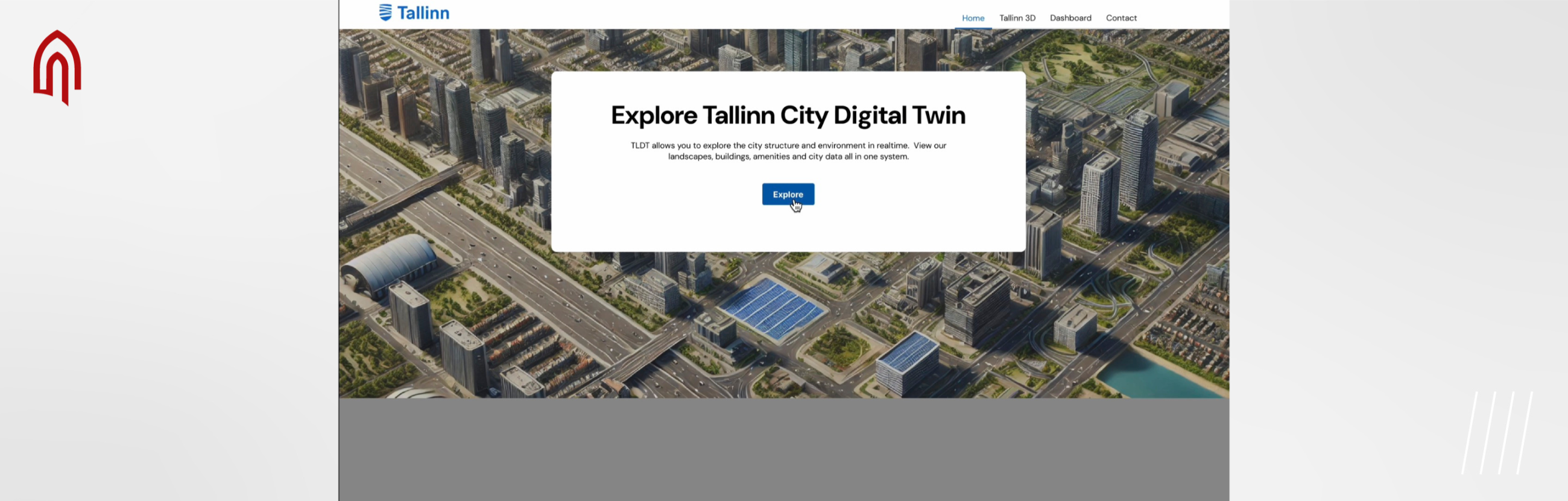
The project explores how a 3D digital twin of Tallinn could be redesigned around the everyday needs of city officials. Rather than focusing solely on visualising city data, the team investigated how artificial intelligence and natural language interfaces could help users find, understand, and analyse information more efficiently.
The project originated from Tallinn University’s Interaction Design Workshop course and has grown into a long-term collaboration with Tallinn City. The presentation highlighted how the initiative has evolved over more than two years and is now exploring opportunities for expansion to other municipalities, including Pärnu and potentially other Baltic cities.
A central finding of the project is that the challenge for cities is not a lack of data, but rather the fragmentation of information across different systems, departments and databases. Through interviews, co-design workshops and prototype testing with Tallinn City employees, the team identified common needs across departments, including easier access to planned building information, improved data discovery, and better support for planning and decision-making.
To address these challenges, the researchers developed a prototype featuring an AI assistant integrated into a digital twin environment. Users can ask questions in natural language, receive answers linked to their original sources, and view relevant information directly on a 3D map. During the presentation, the team demonstrated several scenarios, including locating planned buildings, supporting urban tree planning, and identifying alternative traffic routes during roadworks.
The project also included a comparative analysis of digital twin platforms in Tallinn, Riga and Vilnius. While the cities offer different levels of functionality and maturity, the researchers identified an opportunity for Tallinn to differentiate itself through AI-assisted data access and decision support.
The discussion following the presentation focused on data interoperability, standardisation, transparency, and the challenges of integrating information from multiple sources. Participants also explored future opportunities, including simulations, compliance checking, socioeconomic analysis, and other AI-assisted planning tools.
The project team emphasised that the current prototype is an early proof of concept. The next development steps include integrating additional real-world data, improving the database structure, and expanding AI capabilities to support more advanced municipal workflows.
The project was presented by Estere Estella Mitule, Chris Kristjan Kivaste, Ayushi Raina, Mustafa Can Özdemir, Kaur Allaje and Anderson Freitas. The project originated from Tallinn University's Interaction Design Workshop course within the Human-Computer Interaction master's programme.