
Culture heritage-based digital learning games developed through international collaboration at TLU
During the spring semester, Tallinn University hosted the international Erasmus+ BIP programme “Navigating the Future: Immersive Technologies, Storytelling, and the Future of Information and Data Science Professionals”, which was connected to the ELU project “Future Learning and Creative Technologies: What Stories Do Memory Institutions Tell?”. The project combined digital technologies, cultural heritage, storytelling, and game-based learning.
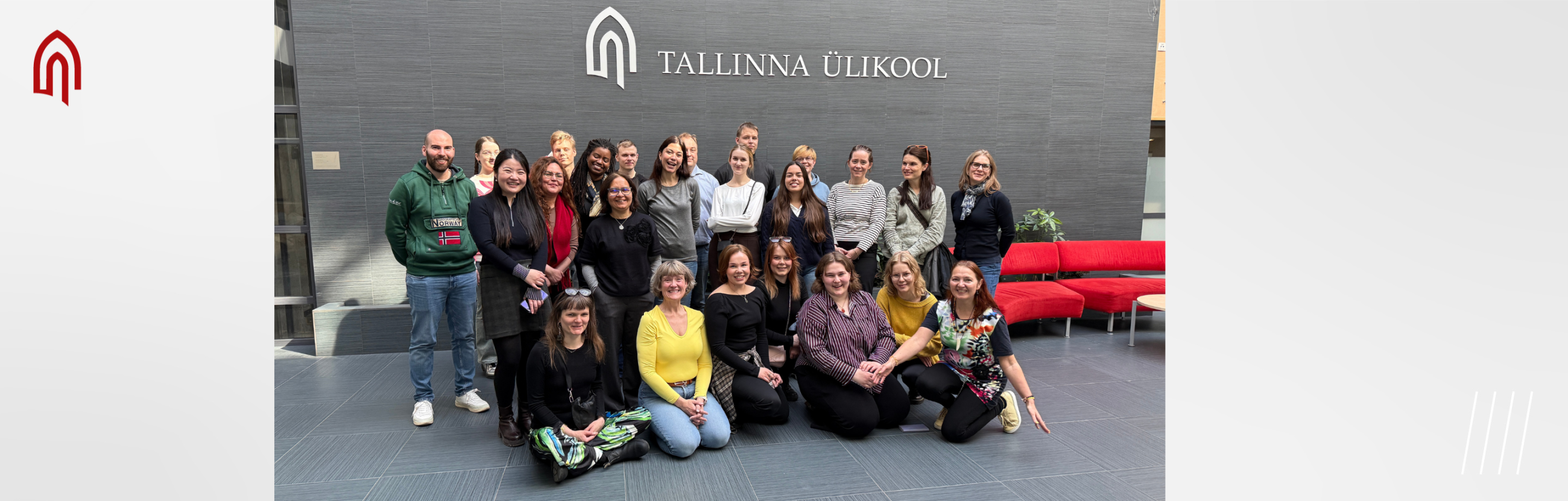
The programme brought together students and academic staff from Estonia, Iceland, Portugal, and Finland. From Tallinn University, students from the Informatics programme at the School of Digital Technologies and students from the adult education and vocational pedagogy programmes at the School of Educational Sciences participated in the programme. The programme was supervised by Lecturer Merle Laurits and Professor Kai Pata together with academic staff from the University of Coimbra, the University of Iceland, and Tampere University of Applied Sciences.
The BIP intensive study week took place at Tallinn University from 13 to 17 April 2026. The week brought together 27 students and eight academic staff members from four countries. During the week, students participated in short lectures, discussions, workshops, and group work focused on how cultural heritage, digital technologies, and storytelling can be used in contemporary education.
/DTI/20260417_150958.jpg)
Within the ELU project, the Estonian context focused on Viking heritage and the Salme ship burials. Informatics and pedagogy students conducted information searches, analysed historical sources, and designed a narrative-based digital learning game called “Salme Saga”. The aim of the game is to make archaeological and historical knowledge experiential for learners by allowing them to take on the role of a Viking Age character and make decisions that influence the course of the story.
/DTI/20260414_120844.jpg)
At the same time, the international partners developed game solutions based on their own cultural heritage. The Icelandic, Finnish, and Estonian groups focused on Viking heritage, while the Portuguese group explored Roman history. As a result, a variety of learning game prototypes were created using platforms and formats such as Kahoot!, Roblox, and escape rooms.
An important part of the project was also the study of the technological readiness of memory institutions. Within the ELU project, observations were conducted in eight Estonian museums and survey data were collected from 15 museum professionals. The results showed that digital solutions are increasingly used in Estonian museums, but their implementation remains uneven. Digital screens, audio guides, and digital exhibitions are already common, while more innovative solutions based on artificial intelligence, chatbots, augmented reality, or virtual reality are still used to a limited extent.
/DTI/20260415_161227(0).jpg)
The study also revealed that museum professionals generally have positive but cautious attitudes towards digital solutions. The main challenges identified included technical limitations, lack of time, limited resources, insufficient skills, and uncertainty regarding the reliability of technology. At the same time, there was a clear willingness to experiment with new solutions when accompanied by sufficient technical and methodological support.
During the BIP week, participants also visited Estonian museums, including the Seaplane Harbour of the Estonian Maritime Museum. The museum visits provided an opportunity to analyse how cultural heritage is exhibited, which digital solutions are used, and how such experiences could be applied in the development of learning games. In addition to academic activities, joint cultural and social events supported international collaboration and team building.
At the end of the programme, the groups presented their game concepts and initial prototypes. According to participant feedback, the most highly valued aspects of the programme were international collaboration, the exchange of ideas, practical workshops, and intercultural communication. The project demonstrated that memory institutions can serve as important environments for digital and experiential learning, where cultural heritage, research-based content, and creative technologies support the creation of new learning experiences.
The idea for the ELU and BIP collaboration project was initiated by Merle Laurits, and both projects were carried out in collaboration with Professor Kai Pata. The project established a foundation for further cooperation between universities, museums, and educational institutions and provided an opportunity to explore how stories from the past can engage learners through contemporary digital solutions.