
From Balinese Fishing Hands to a Tallinn University Laboratory: The Story Behind Berrichi’s Science-Based Skincare Products
What began as entrepreneur Berit Joosep’s personal search for a solution to a skin concern has, in collaboration with researchers at Tallinn University, grown into Berrichi—a science-based natural cosmetics brand. At the core of the products are furcellaran derived from the Estonian red algae Furcellaria lumbricalis and astaxanthin obtained from microalgae. As a result of a collaboration that began in 2014, an innovative skincare line based on a combination of algae-derived ingredients was developed.
The story of Berrichi, a natural skincare brand, began from a deeply personal place. Founder Berit Joosep spent years searching for a solution to her skin concerns, but conventional medicinal creams and antibiotic treatments provided only temporary relief. Once the treatments ended, the problems returned, and it eventually became clear that the same cycle could not continue. “Berrichi was not born out of a desire to simply create another cosmetics brand. It came from a very personal need to find a solution that would genuinely work,” Joosep explains.
Her first answers were sought in nature and in traditional knowledge at home: how her mother and grandmother had dealt with skin problems, and which plants, oils and natural ingredients were used before skincare became something found on pharmacy shelves or beauty counters. This led her to natural cosmetics, and she began formulating her own creams and testing them in her kitchen. However, it soon became clear that a good idea also requires scientifically developed formulations to function properly. Her kitchen-made cream of water and oils did not remain stable without a suitable binding agent and began to separate. “Experimenting in my kitchen quickly made me realise that a good idea alone is not enough. To create a functioning and stable product, you need knowledge, experimentation and the right partner,” says Joosep.
From Balinese Fishermen’s Hands to Science
A turning point came during a trip to Bali. There, Joosep noticed fishermen whose faces were weathered by sun and sea, yet whose hands were surprisingly soft. The contrast stayed with her and raised a question: could the answer lie in the seaweed they came into contact with every day? “The fishermen’s soft hands in Bali made me wonder: what does nature already know that we have not yet learned to use?” she recalls. Back in Estonia, a chance encounter led her to someone working in aquaculture, who then introduced her to Professor Rando Tuvikene at Tallinn University.
This marked the beginning of Berrichi’s collaboration with Tallinn University in 2014. The University provided scientific expertise that an emerging cosmetics brand could not develop on its own. Professor Tuvikene introduced Joosep to the red algae Furcellaria lumbricalis, which grows in Estonian waters. This macroalga is a source of bioactive compounds, including furcellaran. Furcellaria lumbricalis is a unique renewable natural resource found in the Baltic Sea, with applications in both the food and cosmetics industries. The collaboration with Tallinn University proved decisive for Berrichi’s development.
Initial research was supported by Enterprise Estonia (EAS), now the Estonian Business and Innovation Agency (EIS). According to Joosep, such research and development work would not have been possible for a start-up without external support. Product development in collaboration with Tallinn University lasted for three years.
From Algae Research to Sustainable Product Development
The scientific collaboration went far beyond simply adding a research-based narrative to a finished product. The research and experimentation directly shaped the formulation itself. Joosep’s original kitchen-made cream did not remain stable, but furcellaran helped bind the formulation and improve its stability. At the same time, its role was not purely technological; from Berrichi’s perspective, its effects on the skin were equally important. “Our collaboration with Tallinn University allowed us to move from belief to knowledge. We did not want to simply say that seaweed is good—we wanted to understand what it actually does in a product and on the skin,” Joosep explains.
“Because Furcellaria lumbricalis is a macroalga, the substance derived from it does not penetrate deep into the skin. Instead, it forms a thin film on the skin’s surface, helping to maintain moisture balance. Moisture is one of the most important factors for healthy skin, as it supports elasticity, barrier function and a healthy appearance,” she adds.
Berrichi’s innovation, however, is not limited to the use of a single local algae. In collaboration with researchers at Tallinn University, the team began testing a combination of furcellaran and astaxanthin derived from microalgae. Furcellaran comes from red macroalgae, while astaxanthin is sourced from microalgae. According to Joosep, such a combination of algae-derived compounds had not previously been used in cosmetics anywhere in the world. This combination has become one of Berrichi’s defining features, highlighted in product descriptions as algae-derived antioxidants with moisturising and anti-ageing properties. “The combination of furcellaran and astaxanthin became much more than just a list of ingredients for us. It became the scientific core of our products,” Joosep says.
Trust Built Through Learning from Mistakes
Berrichi’s development has not been a story of success alone, but also of learning. After the first larger production batch, the company made the difficult decision to recall the entire batch due to an ingredient affecting the product’s scent. Although the products were safe to use, the user experience did not meet Joosep’s expectations, and some customers raised similar concerns. “The most critical feedback can be the most valuable for a brand. It forces you to honestly look at what can be improved,” she says. The experience reinforced the understanding that trust is built not only on promises, but also on the willingness to acknowledge and correct mistakes.
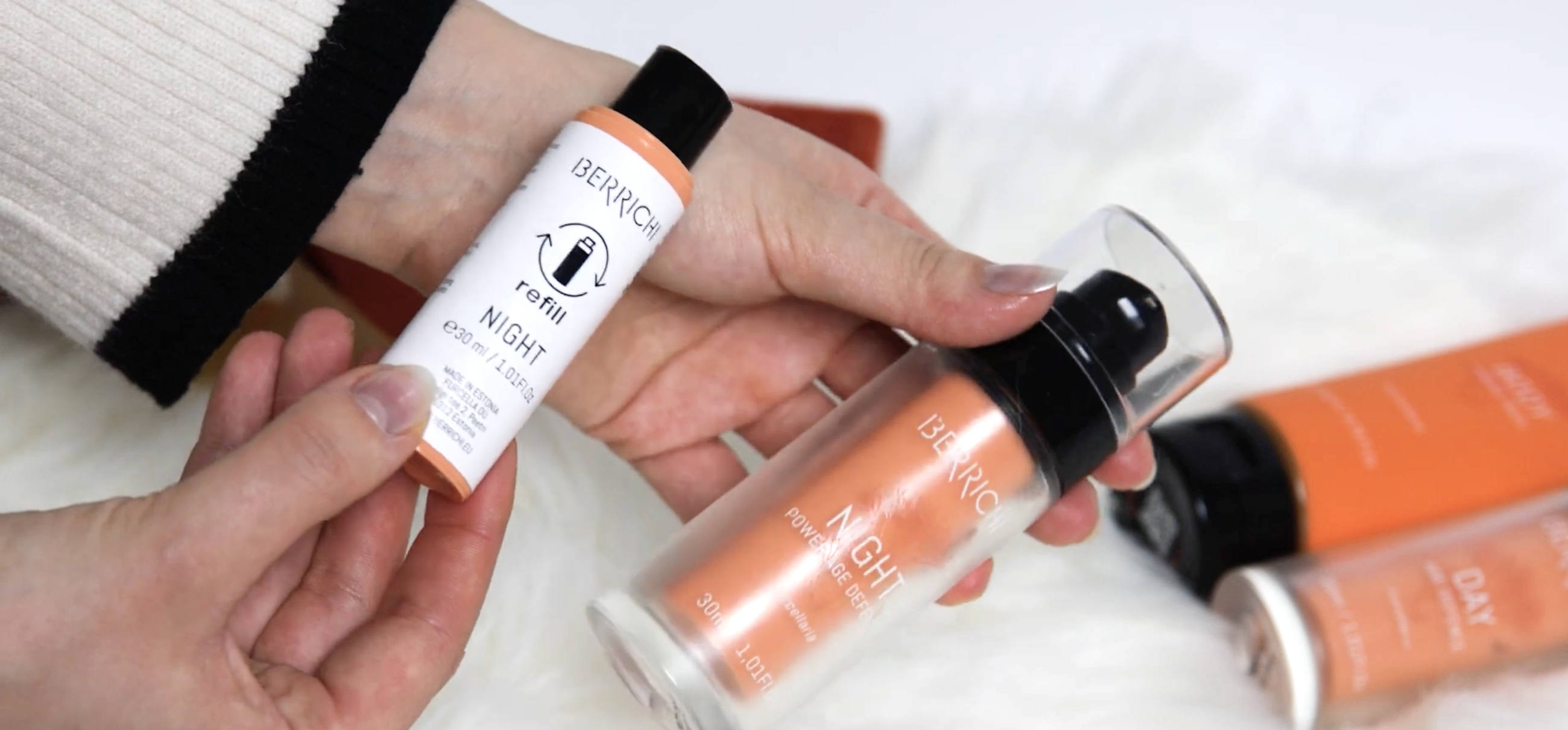
In addition to valuing local raw materials, sustainability has been an integral part of Berrichi’s product development philosophy. Initially, this meant primarily choosing natural and skin-friendly ingredients, but over time the same thinking was extended to packaging. Driven by customer feedback and the company’s own initiative, a refillable packaging solution was introduced. Joosep’s idea that a cream’s trace on the skin should not leave a large footprint on the planet captures the brand’s broader mission: to combine skincare, science and environmental responsibility.
For Berit Joosep, it all began with a personal search for a solution to her skin concerns. In collaboration with researchers at Tallinn University, it has grown into something much larger—a science-based skincare brand rooted in Estonian natural resources, continuously seeking new ways to make beauty more conscious, sustainable and science-driven.
Watch Berit Joosep’s lecture “Creating Conscious Beauty” at the Tallinn University anniversary conference “Tallinn University 21 – Towards the Future with Wisdom!”: