
Interaction Design in Context: Gabriela Beltrão’s Workshops at Universidade Eduardo Mondlane
During her doctoral fieldwork in Mozambique, Gabriela Beltrão conducted a series of interaction design workshops at Universidade Eduardo Mondlane. These sessions explored how design methods can be situated within local academic and socio-technical contexts, contributing to capacity building and research exchange.
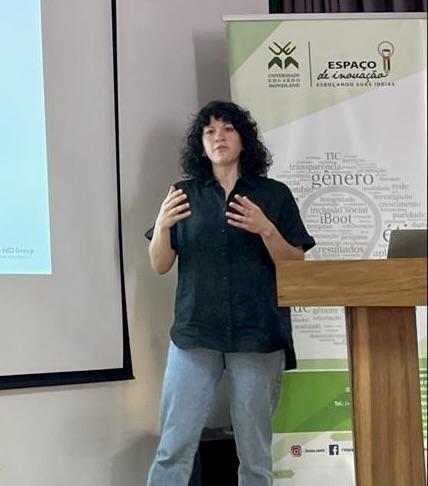
As part of her doctoral research, Gabriela Beltrão visited Universidade Eduardo Mondlane (UEM) in Maputo, where she facilitated a set of workshops focused on interaction design. The initiative was embedded within a broader fieldwork strategy, aimed at grounding design research practices in real-world institutional and cultural settings.
The workshops introduced core interaction design principles while emphasising their adaptability. Rather than presenting design methods as fixed procedures, the sessions framed them as flexible, context-sensitive tools. Participants—primarily doctoral and advanced master’s students—were encouraged to engage with local challenges and translate them into design opportunities.
A central aspect of the workshops was the use of generative techniques. Through structured activities, participants externalised their experiences, mapped socio-technical systems, and developed early-stage concepts. This approach aligns with a generative design research perspective, where the goal is not only problem-solving but also expanding what can be imagined and articulated within a given context.
Importantly, the workshops also functioned as a space for mutual learning. While participants engaged with interaction design methods, the process simultaneously provided insights into local practices, constraints, and priorities. This reciprocal dynamic is critical in international research collaborations, particularly in capacity-building contexts, where knowledge exchange must move beyond one-directional transfer.
The initiative contributes to ongoing efforts to strengthen research and teaching in digital technologies at UEM. It also reinforces longer-term institutional collaborations, where doctoral fieldwork becomes a vehicle for both academic inquiry and infrastructural development.
In this sense, the workshops were not isolated training events, but part of a broader strategy to embed design research practices within evolving academic ecosystems.