
Progress in Colour Studies: a new volume on colour research
Colours are all around us, yet the way we perceive and express them in language is far from universal or self-evident. The recently published volume Progress in Colour Studies: Colour Expression and Cognition brings together the latest research on the relationships between colour, language, and perception, offering a multifaceted insight into this rapidly developing field. The book is the result of international collaboration, with its roots in a conference held at Tallinn University in 2022. In a conversation with Associate Professor of Linguistics and Translation Studies Mari Uusküla, we explore the origins of the volume, its central themes, and discuss why colour studies are more relevant today than ever before.
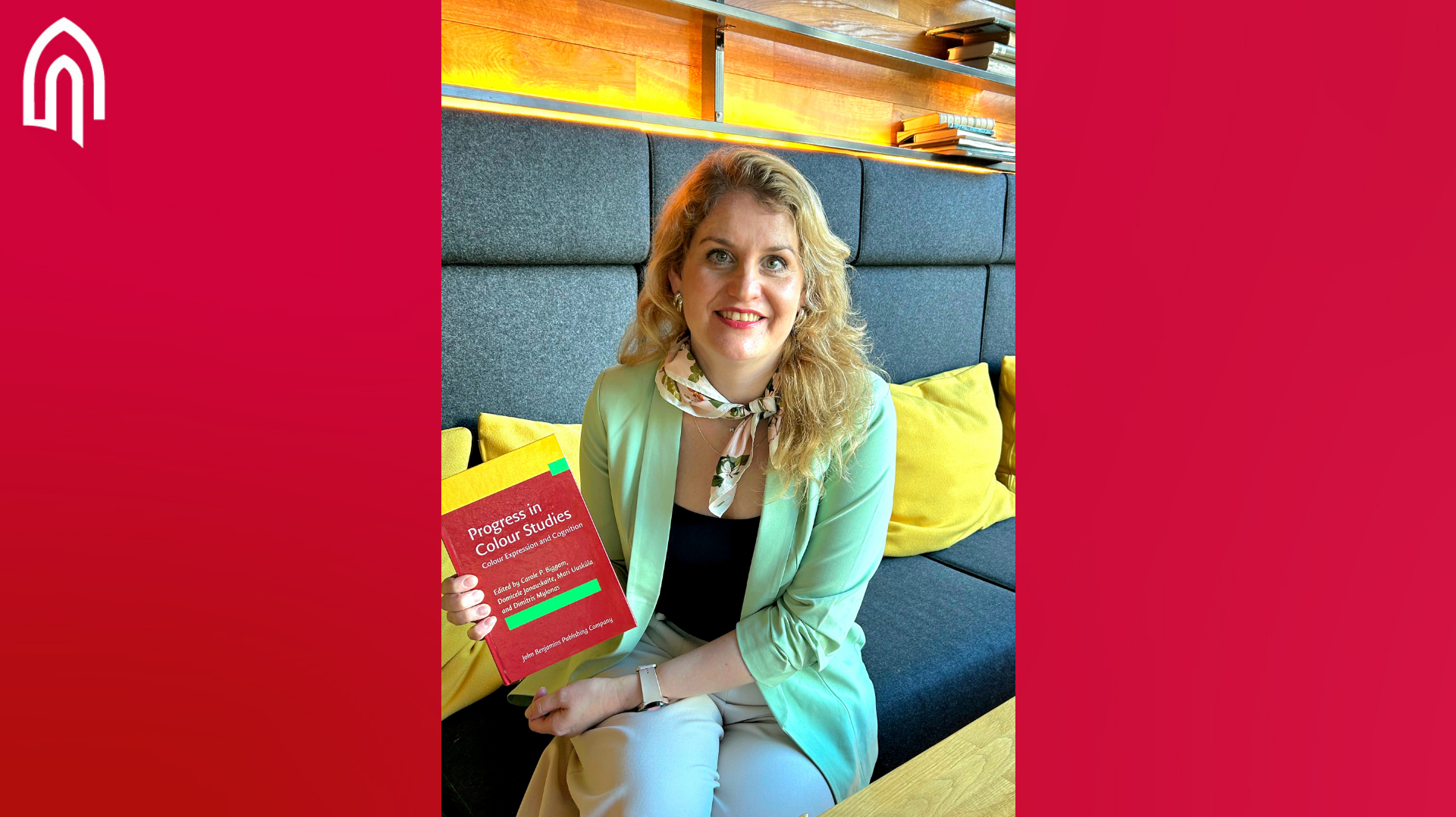
What did it feel like when you found out the book had finally been published? Why is this moment significant for you?
It really was a special feeling. These days, journals and books usually appear online first, so we were already able to admire an electronic copy of our book at the beginning of February. But my heart truly started racing at the moment I opened the cardboard box that had arrived in the mail and saw the book emerging from it—an actual, tangible book that I had edited myself. That was the moment when it finally began to sink in what these three and a half years of work had led to. Before that, everything had felt rather abstract. There is nothing more tangible in the world than printed books. I suppose I am, after all, a rather material person.
How did the idea for this book originate? How is it connected to the conference held at Tallinn University in 2022?
The volume Progress in Colour Studies: Colour Expression and Cognition is directly connected to the conference held at Tallinn University in 2022, which was originally planned for 2020. But we all know very well what happened in 2020. As a result, we had to postpone the conference for two years. Unfortunately, in February 2022, Russia launched its invasion of Ukraine, and once again the conference was under serious question, even though the world was already recovering from the pandemic. Many potential participants were afraid the war might spread and did not dare to travel to our region. We received letters from colleagues in Western Europe and North America who explicitly told us they could not come to Estonia because their families were worried, and because they feared the Baltic region might be next. So we had to decide whether it made sense to hold the conference at all, or whether the number of participants would be so small that we would not even be able to cover the accommodation and flights of invited speakers through participation fees.
At this point, we must thank our home institution, which had already promised some financial support. My excellent colleague Domicele Jonauskaite, originally from Lithuania and now working in Switzerland and co-editor of the volume, suggested that we simply go ahead with those participants who were willing to attend. Said and done. From 7–10 September 2022, the fifth Progress in Colour Studies conference took place—with the smallest number of participants so far—but we still had four full days of presentations, discussions, and shared social time. Previous conferences had been held in 2004, 2008, and 2012 at the University of Glasgow, and in 2016 at UCL in London.
What was your role as a co-editor in the preparation of the book? How did the collaboration within the international editorial team develop?
The first editor of the volume, Carole P. Biggam, who initiated the Progress in Colour Studies conference series and the subsequent book volumes, was very much the driving force behind this book. Already in Tallinn, she was convinced that we should submit a proposal to John Benjamins Publishing Company to ensure the continuation of the series. Carole is undoubtedly the most experienced among us, so she took on a leading role. In addition, she reviewed all edited chapters and contributed both substantive and linguistic editing.
My colleagues Domicele Jonauskaite and Dimitris Mylonas and I shared similar responsibilities—we each edited the chapters assigned to us by Carole. The process began with finding peer reviewers for each chapter, as we wanted to produce a volume that would be well respected within the academic community. In addition to editing, Domicele and I wrote the preface, while Dimitris handled communication with the publisher. I was also responsible for compiling the alphabetical index, as by the end of 2025 the other editors were heavily occupied with other commitments.
What are the main questions and themes addressed in the book?
The book is structured so that each chapter forms an individual study or essay. They can therefore be read separately or as a whole, depending on the reader’s preference. The volume opens with a theoretical reflection by Carsten Levisen on whether colour is a linguistic universal at all, or rather an Anglocentric artefact—a construct that gained prominence following the influential 1969 study by Brent Berlin and Paul Kay, which fundamentally reshaped colour research. Levisen provides examples of cultures in which colours are not assigned the same linguistic importance as in Western societies. I consider this one of the strongest chapters in the volume.
Many chapters focus on individual colours and their meanings across languages. For example, together with David L. Bimler, we examine whether dividing blue into two categories (as in Italian or Russian) affects the perception of the boundary between blue and green. Danuta Stanulewicz and Adam Pawłowski explore the colour green, while Stanulewicz together with Ewa Komorowska also investigates the meanings of beige in Polish. Veera Hatakka analyses the Finnish words tumma and vaalea, and Paula Teixeira Moláns focuses on the category of orange in Galician.
The volume also addresses broader relationships between colour and perception. Domicele Jonauskaite discusses why studies on colour–emotion associations should be interpreted with caution, while Carlo Gaddi compares whether results from colour naming tasks differ between adults and children. A doctoral student from Tallinn University, Merle Oguz, compares colour idioms in Estonian, Swedish, and Turkish, and Isabel Espinosa Zaragoza examines the use of colour in naming lipsticks.
What makes this book distinctive compared to other works in colour research?
Several aspects make this book distinctive. First, it brings together the most recent research (primarily in linguistic colour studies), which would otherwise be scattered across different journals and easily lost in the ever-growing volume of publications. Second, it is a collection focused mainly on linguistic and psycholinguistic approaches to colour—earlier Progress in Colour Studies volumes covered a broader range of topics, whereas this one is more specialised. Third, it provides a strong continuation of the existing series, maintaining an unbroken tradition (the first volume appeared in 2006, and the previous one in 2018).
Why is the study of the relationship between colour and language important today?
Colour perception is only one part of the rich world of human perception. We also experience our surroundings through smell and taste; we perceive the shape, size, and movement of objects; we notice time and speed, and how objects are positioned in space relative to each other and to ourselves. We also perceive environments as a whole—the landscapes in which we move and act.
All these experiences are mediated to others through language. That is precisely why it is so fascinating to study how we put our perceptions into words: what we actually say, how we are understood, and what we aim to achieve. Language is not merely a neutral tool—as J. L. Austin famously emphasised—but something people use to perform actions.
Studying colour from the perspectives of linguistics, psycholinguistics, and psychology is therefore essential for understanding the relationship between language and perception. An added value of this volume is the wide range of languages included: Estonian, Finnish, English, Spanish, French, Italian, Greek, Galician, Polish, Lithuanian, Latvian, Czech, Danish, Dutch, Hungarian, Bislama, Hamari, Mursi, and others.
If you had to summarise the book in one sentence, how would you do it?
The volume brings together the latest research in colour linguistics and psychology and is well worth reading for anyone interested in colour.