
Building with Purpose: An Artificial Intelligence for Sustainable Societies Student’s Perspective
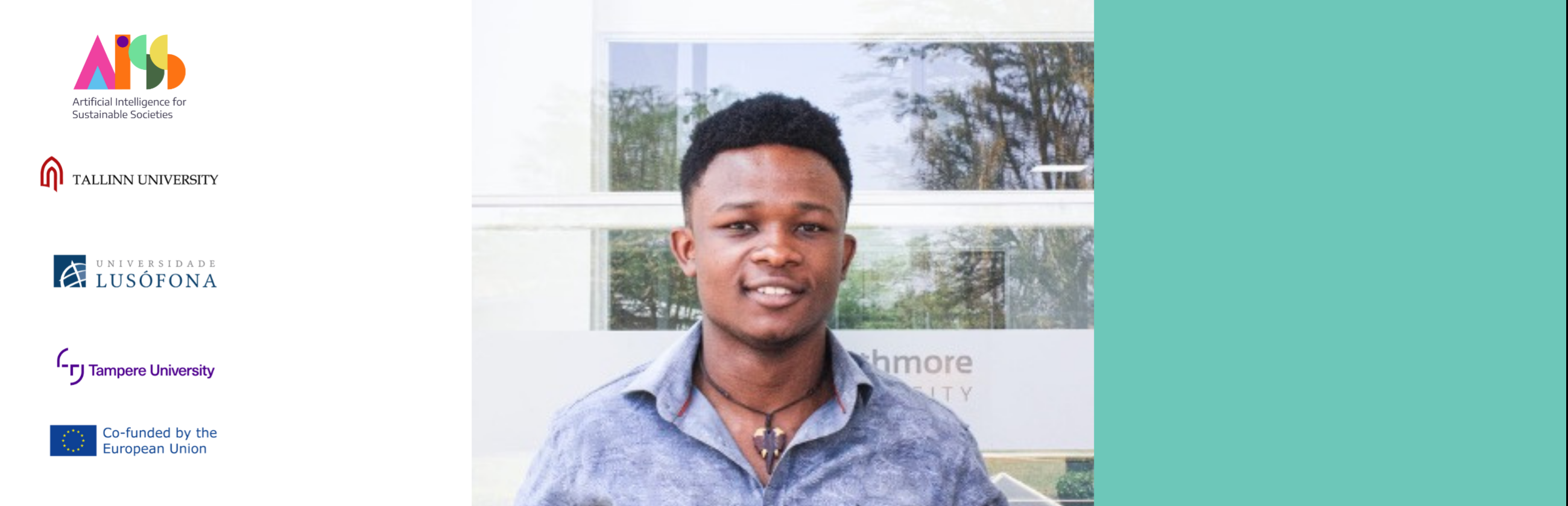
Baranaba Mudanyi Mugabane is a student in the Artificial Intelligence for Sustainable Societies master’s programme at Tallinn University School of Digital Technologies. During his studies, he has worked on several AI-related projects and developed a strong interest in how technology functions in real-world contexts. We asked him what motivated him to apply, which skills have been most useful in his work, what he has learned during the programme, and how he sees his future in the AI field.
What motivated you to apply for the AISS programme at Tallinn University School of Digital Technologies?
It was a timely decision for me. I was just about to graduate from my bachelor’s studies in Informatics and Computer Science at Strathmore University, and at the time, I was doing an exchange programme at Tallinn University. AI was making major headlines, and it felt like a natural progression from what I studied during my bachelor’s degree.
Which skills or knowledge did you gain during your studies that were especially useful in your internship or research work?
Skills in academic reading, writing, and research methodology have been especially useful in my research work.
You have worked on several AI-related projects during your studies. Could you describe one of them and explain what skills or ways of thinking it helped you develop?
The one that matters to me the most is still an ongoing one. It is an experimental passion project that is quite open-ended and actually still difficult to precisely and succinctly describe. At the moment, I would describe it as a platform for deploying autonomous AI agents.
One of the key goals and constraints of this project is high generalizability, so that the same AI agent framework can be used to deploy agents in many different contexts.
One important skill and way of thinking that this constraint is helping me to develop is the ability to break down things to their core underlying principles.
What has been the most important lesson or experience for you during the programme?
Both in and out of the classroom, I have learned that things take time. So give things time.
I see myself as a builder. A good example that may resonate with other builders who are passionate and eager to build and deploy technology is related to technology adoption.
Imagine you are building an AI solution for a particular agricultural problem. The natural agricultural cycle for the plant involved, let's say pineapples, is 18 months. This means that the technology you are building is tied to this cycle. You can’t turn an 18-month cycle into a one-month cycle by planting 18 times more pineapples.
In addition to this, since pineapples are planted for human consumption, you are likely to run into matters of policy and approvals, which also have their own cycles and timelines.
As a builder, you have to take all this into account when thinking about the adoption time of your technology.
It is a tempting pitfall to always try to speed up everything. My experience has taught me to cultivate patience and allow things to take their natural time.
What are your current career or research plans?
I feel like the dust of the AI frenzy is yet to settle, and there are still a lot of greenfield areas that are largely unexplored when it comes to AI and its implications.
This new age of AI has only been here for about three years now, and we are yet to fully understand the implications of this technology in many aspects of human life, from the economy and education to politics and even the deepest parts of individuals.
As things unravel in the AI space, my particular interest is in the impact and implications of AI on creative work and how it shapes economic and legal perspectives in the intellectual property domain.
My current research focus is on designing a provenance framework to support the attribution and assignment of credit and responsibility for human-AI-created works.
What advice would you give to future AISS applicants?
AISS will expose you to different cultures, institutions, and ways of doing things. Come with an open mind.
Learn more about the Artificial Intelligence for the Sustainable Societies Master's Programme