Shaping Responsible AI Futures: The Master’s in Artificial Intelligence for Sustainable Societies
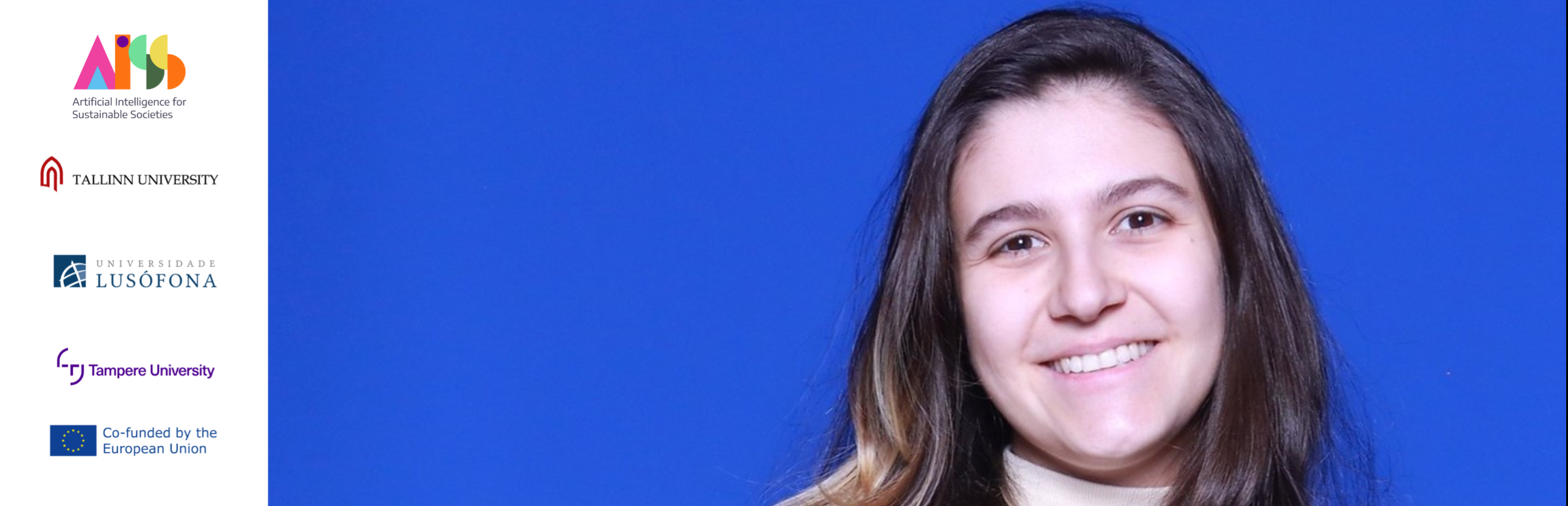
Ligia Ribeiro Dos Anjos, current student of The Erasmus Mundus Joint Master’s Programme (EMJM) Artificial Intelligence for Sustainable Societies (AISS), joined AISS to learn how AI can support sustainable and socially meaningful solutions. The programme helped her develop the skills she needed to create projects now acknowledged by UNICEF and invited to COP30.
What motivated you to apply for the AISS programme at Tallinn University?
I was looking for a master’s programme in Europe, and Erasmus Mundus programmes are well known for their quality and international structure.
When I discovered AISS, it immediately caught my attention because it is neither purely technical nor purely conceptual. The programme brings together programming, statistics, and machine learning with courses grounded in the social sciences, such as accessibility and the Sustainable Development Goals.
This horizontal integration was the key factor for me. I believe that future professionals must understand both the technical and societal dimensions of AI, and AISS offers exactly this balance.
Tallinn University also seemed academically strong and aligned with the kind of environment I wanted to study in, which made me genuinely excited to apply. Also, Estonians speak English very well, which made me feel safe to move to the country. The university brings together people from all over the world, which creates a culturally vibrant study environment.
Could you describe your UNICEF Ideathon finalist project and what problem you were trying to solve?
I participated in the UNICEF Global Youth Outcomes Ideathon 2025, a high-energy, 48-hour challenge focused on finding data-driven solutions for reducing NEET rates (Not in Education, Employment, or Training) among young people worldwide. The event is organized by UNICEF’s Generation Unlimited, the ILO’s Global Initiative on Decent Jobs for Youth, and YouthForesight, bringing together youth researchers from all around the world.
My teammate, Nina Petrushkova, invited me to join the competition. Over the weekend, we worked intensively with datasets from the Global Youth Outcomes Observatory and conducted additional research, especially on youth in Brazil. We selected Brazil as our focus because the country provides rich, accessible datasets.
Our findings showed that young women are significantly more likely to become NEET, especially those living in the North and Northeast regions of Brazil. We developed evidence-based recommendations aimed at policymakers to address these structural inequalities.
The judges selected our proposal as one of the finalists, and our work was showcased at the Global Youth NEET Forum in New York and in the global UNICEF/ILO. It was an intense but very meaningful project and I had the opportunity to present the project and discuss it at the UNICEF event.
What was your role in the project and what methods or tools did you use?
Nina and I worked collaboratively throughout the entire process. We applied methods and tools we learned in the AISS programme, especially Python, data science techniques, and statistical analysis. Without the technical preparation from our courses, we wouldn’t have been able to deliver such a robust and data-driven proposal in such a short time.
The AISS programme’s emphasis on project-based learning also helped us a lot, we already had experience working with different stakeholders, structuring ideas, and approaching problems from a design-oriented and solution-focused perspective.
Could you tell us more about your GIS project that will be presented at COP30? How did this idea develop in the GIS course?
During our GIS classes at Lusófona University in Porto, I began developing a project with classmates titled “Mapping Climate-Vulnerable Populations in Pará, Brazil: An Integrated GIS Analysis of Social Vulnerability and Environmental Risk”.
The project investigates how climate change disproportionately affects certain communities, especially in Pará, a region facing increasing deforestation, wildfires, and other environmental risks. By combining GIS tools with indicators such as HDI, land-use data, and environmental layers, we mapped areas where social vulnerability overlaps with climate hazards.
After presenting the project to professors Carlos Velosa and Paulo Vasconcelos Figueiredo, I decided to continue developing it on my own, as my colleagues chose not to proceed. Later, I connected with Swissnex, applied for this project, and it was accepted.
As part of the Planetary Embassy in Belém during the UN Climate Summit COP30, Swissnex presented the exhibition Imagining Planetary Diplomacy at the Goeldi Museum.
This opportunity means a lot to me, not only academically but also personally, because it is a socially relevant project rooted in my home country.
.jpeg)
What has been the most valuable lesson or experience for you during the AISS programme?
The project-based structure has been the most valuable experience for me. Working continuously on real-world problems teaches us how to manage deadlines, collaborate effectively, and connect theory with practice.
Every course gives us the chance to apply what we learn immediately, which makes the learning process faster, deeper, and more meaningful.
How have these projects influenced your academic or career plans?
Because AISS is multidisciplinary, I feel much more confident applying for positions in both industry and research. The projects helped me understand how I can combine my background in design with data science and AI in ways that create social impact.
They also showed me that I enjoy working at the intersection of technology, ethics, design, and public policy, so now I’m exploring career opportunities based on what I like the most.
What advice would you give to future AISS applicants?
Start early! I began preparing a year and a half in advance so I could take the English exam, gather documents, and research the programme properly.
Give yourself time to prepare your application with care, and don’t be afraid to showcase your unique background, AISS values diverse perspectives.