
Add to calendar
iCal calendar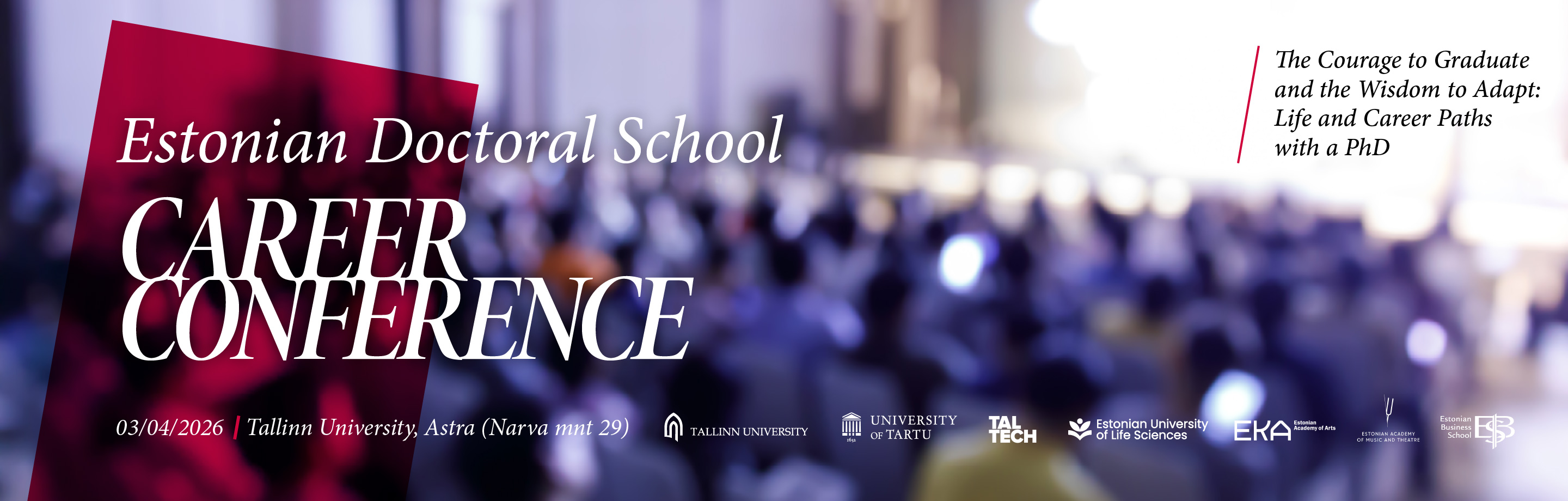
The Courage to Graduate and the Wisdom to Adapt: Life and Career Paths with a PhD
Dear PhD students, Master’s students, supervisors, and partners in doctoral education!
Led by Tallinn University and in cooperation with Estonian partner universities, we are pleased to announce the next Estonian Doctoral School Career Conference. This year’s event focuses on two critical stages: the successful completion of doctoral studies and the subsequent leap into the labor market.
- Time: March 4, 2026
- Location: Tallinn University, Astra Building (Narva mnt 29).
Conference Focus and Panel Discussions
The program is built around two major roundtable discussions:
- Panel I: "The Home Stretch: Final Year Experiences and Successful Defense" We focus on the final year of doctoral studies and its unique challenges. How can you maintain motivation when the defense is in sight but the pressure is peaking?
- Panel II: "Career Paths After the PhD – What’s Next?" This discussion explores choices following the degree defense. We examine whether a PhD is a door that opens equally to the academic world and to high-level positions in the public or private sectors.
Practical Workshops
Between the panel discussions, participants can choose a workshop that best fits their needs. These interactive sessions allow experts and participants to exchange experiences and acquire new skills. Topics range from career design and personal branding for researchers to the use of AI in doctoral studies (see details below).
Confrence is held in Estonian with simultaneous interpretation into English.
Contact:
With questions please turn to Katrin Iisma katrin.iisma@tlu.ee
| 10:30–11:00 | Gathering and morning coffee |
| 11:00–11:15 | Opening remarks |
| 11:15–11:45 |
Presentation: Janika Leoste – “I didn’t stay in one place – and that was a conscious choice” |
| 11:45–12:45 | Roundtable for PhD students and recent graduates: "The Home Stretch: Final Year Experiences and Successful Defense" |
| 12:45–13:30 | Lunch |
| 13:30–14:30 | Workshops (Selection can be made during conference registration) |
| 14:45–16:15 |
Roundtable for PhD holders: "Career Paths After the PhD – What’s Next?" |
| 16:15–16:30 | Closing remarks |
| 16:30–17:00 | We conclude the conference with a social gathering – light refreshments and informal networking. |
Come and shape your future with intention!
Registration HERE! The deadline is 20.02.2026.
| 1 | From research to reach: Using LinkedIn strategically as an early-stage researcher// Ulrike Rohn, Professor of Media Management and Economics (Tallinn University) |
|
This one-hour workshop introduces early-stage researchers to LinkedIn as a powerful tool for visibility, networking, and impact. Participants will learn why social media marketing matters in today’s research ecosystem where discoverability and visibility are key for impactful research and collaboration. The session shows how to translate academic work into engaging posts, build a professional profile that reflects one’s research identity and grow a meaningful network. Practical examples, simple posting strategies, and best practices for consistency and authenticity will be shared. |
|
| 2 | How to become a chance-seeker?// Liis Nimik, TLU Junior Research Fellow |
|
In film editing, everything begins with how we look at images. Do we see them as building blocks for a story, or as moments that move us? This one-hour workshop explores attention as a core editorial skill, focusing on narrativity and authenticity. Drawing on Roland Barthes’ concept of punctum, we first analyze still photographs to identify the small details that affect us, then extend this approach to moving images. Through film excerpts and discussion, we ask: what might punctum be in cinema? The workshop reveals how preconceptions shape our viewing and how openness can transform it. Grounded in a decade of teaching experience, the pedagogy is framed by Gert Biesta’s notion of subjectification and concludes with the concept of “chance-seeking,” a valuable tool for editors, researchers, and scholars. Prior requirements / preparation: Bring along your favourite photograph |
|
| 3 | Translation awareness and multilingualism in research// Katerina Maadla, TLU Junior Research Fellow |
|
Translation and multilingualism are present in many stages of research, from data collection and analysis to writing and publication, yet they often remain unnoticed. This workshop introduces the idea of translation awareness and explores how language choices and translation practices can influence research processes, meaning, and interpretation. Drawing on key concepts from Translation Studies, participants will reflect on methodological, epistemological, and ethical aspects of working across languages. Through a short introduction, an individual reflection task, and group discussion, PhD students will be encouraged to consider how translation affects their own research projects and to develop a more conscious and transparent approach to multilingual research contexts. Prior requirements / preparation: Before the workshop, registered participants will be sent a short set of reflective questions to help them consider their research from the perspectives of multilingualism and translation. |
|
| 4 | Failing Well in Academia: Lessons from Setbacks in Research// Ayan Shamchiyeva, TLU Junior Research Fellow |
| Inspired by the “F*ckup Nights” format, this workshop creates a safe and open space for PhD students to share experiences of setbacks, failures, and challenges in academia. Conferences often focus on success stories, which can reinforce impostor syndrome and unrealistic expectations about academic careers. By openly discussing failed experiments, rejected applications, career doubts, or changes in direction, the workshop aims to normalise failure as part of academic life. This session invites participants to openly discuss failed experiments, rejected papers or grants, career doubts, and changes in direction. Through small-group conversations followed by collective reflection, participants will normalise failure as a common part of research life, learn from one another’s experiences, and gain more realistic and humane perspectives on academic trajectories. No prior knowledge is required. Guiding reflection questions will be sent to registered participants in advance to help them prepare their thoughts and contributions. | |
| 5 | Making or Faking? Exploring Ethical Fabrication in Qualitative Research// Maliheh Keshmiri, TLU Junior Research Fellow |
|
The workshop explores ethical challenges that arise when qualitative researchers work with sensitive narratives and other forms of multimodal data. Using illustrative examples from studies involving vulnerable groups, the workshop examines ethical implications of employing creative strategies such as composite narratives, data construction, and anonymizing transformations of text, images, or videos. Fabrication approaches are highlighted as effective tools for protecting privacy and enhancing confidentiality, especially in digital or public contexts where traditional anonymization may be insufficient. At the same time, the workshop addresses how researchers can balance these protective measures with the need to preserve the integrity and meaning of participants’ stories. Participants will reflect on how to navigate these ethical decisions and will gain practical guidance for making defensible methodological choices across diverse qualitative materials |
|
| 6 | Designing for Uncertainty// Paulo Ferreira, TLU Junior Research Fellow |
| Most commercial Generative AI interfaces function as ready-to-go answer machines (means-end machines), delivering confident, opaque outputs that encourage unwanted cognitive offloading and copy-paste behaviour among students. This workshop - Designing for Uncertainty: Generative AI Interaction interfaces for Critical Engagement - invites participants to explore how interface design choices can shape the way users interact with Generative AI. Building on theories of Distributed Cognition, Desirable Difficulties, and Affordances, participants will engage in a "Wizard of Oz" simulation to experience the friction between performance and learning. Attendees will transition from passive users to active designers, prototyping new interface perceived affordances - specifically, "Cautious Explanations" - that are expected to trigger verification, uncertainty, and critical dialogue, transforming generative AI from an invitation to use it as it is into a partner that requires guiding | |
| WORKSHOPS IN ESTONIAN | |
| 1. |
Does a Researcher Need to Think About Personal Branding?// Aija Sakova, PhD, TLU Head of Business Cooperation and Knowledge Transfer |
| This workshop invites participants to discuss the necessity of personal branding and personal science communication strategies. How should we view the role of various social media tools in building a researcher's image? What should be considered when planning science communication activities? | |
| 2 | PhD Career Opportunities and Challenges// Kadri Pakaste, TLU Career Counselor |
| In this workshop, we map out the role of the PhD in today’s labor market and discuss the obstacles and opportunities along the researcher's path. We share practical advice for career planning and staying focused in an era where there are more choices than ever before. | |
| 3 | AI Applications as a PhD Assistant // Marge Kusmin, PhD |
| This workshop introduces AI tools that support a doctoral student's daily work with research articles (search and analysis: Elicit, Connectedpapers, NotebookLM; translation and writing: ChatGPT; visualization: Napkin, Gamma, Curipod). Participants will create a draft article based on their own research questions, supplement it with visuals, and create an interactive presentation. Note: Participants should create accounts in advance and bring their own devices. | |
| 4 |
Networking for PhD Students: Yesterday, Today, and Tomorrow The Estonian Association of Doctoral Students (Doktorantide Selts) |
| Until recently, Estonia lacked a cross-university organization for PhD students to voice their concerns at the national or European level. Since 2024, the Association has filled this gap. Join us to discuss the necessity of doctoral representation, meet others, and help give the Association more momentum! |
Project "Cooperation between universities to promote doctoral studies" (2021-2027.4.04.24-0003) is co-funded by the European Union