
Translating Digital Transformation: Lessons from Estonia in Dialogue with Sarawak
An article in The Borneo Post highlights Sarawak’s interest in Estonia’s digital transformation model. Drawing on Tallinn University’s experience in international collaboration, this post reframes such interest as a process of translation rather than adoption, where principles, not systems, travel across contexts.
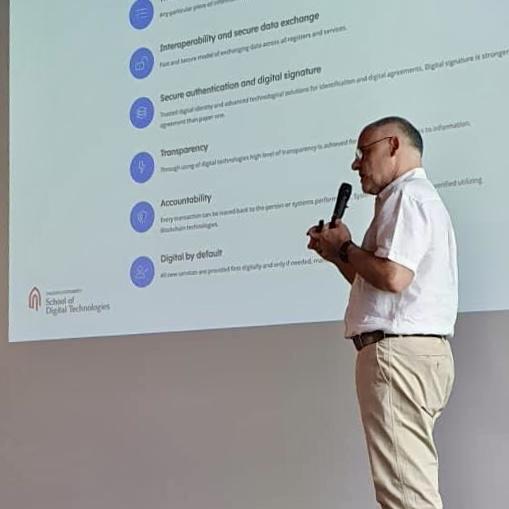
An article in The Borneo Post discusses how Sarawak could look to Estonia as a reference for advancing its digital economy strategy. The proposition reflects a broader and recurring pattern: Estonia is frequently positioned as a model for digital governance and transformation, particularly in regions seeking to accelerate structural change through technology.
From the perspective of the School of Digital Technologies at Tallinn University, such propositions require careful unpacking. Estonia’s digital ecosystem, often summarised through elements such as digital identity, interoperable data infrastructures, and integrated public services, is not a standalone product. It is the outcome of sustained alignment between policy frameworks, institutional arrangements, technical infrastructures, and public trust.
In this sense, the idea of “adopting” Estonia’s model risks oversimplification. Experiences from international collaborations across Africa and Southeast Asia indicate that digital transformation cannot be transferred as a fixed configuration. Each context brings its own institutional logics, infrastructural constraints, and socio-cultural dynamics that shape how digital systems are conceived, implemented, and sustained.
Sarawak’s case, as discussed in the article, is illustrative. Its digital ambitions are closely tied to regional development priorities, including overcoming geographic dispersion and enabling broader economic participation. These conditions differ significantly from Estonia’s, yet they also create opportunities for alternative pathways to digital transformation, ones that are grounded in local realities rather than external templates.
Within this landscape, Estonia’s relevance lies less in replication and more in orientation. It provides a coherent example of how digital infrastructures can be designed as integrated systems, where interoperability, user-centricity, and trust are treated as foundational principles. These principles can inform strategic thinking elsewhere, but they must be reinterpreted and operationalised within each specific context.
Work conducted at Tallinn University increasingly frames such engagements as processes of infrastructural translation. This involves not only transferring knowledge but also co-developing approaches that are institutionally viable and contextually meaningful. It shifts the focus from “how to replicare e-Estonia” to “how to design a locally grounded digital transformation informed by comparable experiences.”
The exchange between Estonia and Sarawak, therefore, should not be understood as a unidirectional transfer of a successful model. Rather, it represents a dialogue in which different contexts explore how digital technologies can be mobilised to support long-term, systemic transformation.