
The Estonian Language in the Wide World
What else is there to do in November if not to set off to Europe for some self-improvement? Erasmus+ gave wings to the lecturers of the Estonian studies track at the University of Tartu Narva College: Ele Arder, Merilin Aruvee, Annika Bauer, Hiie Rüütli, Tiina Rüütmaa and Joosep Susi. Joining them were a total of 28 students from both tracks of the Estonian Language and Literature curriculum.
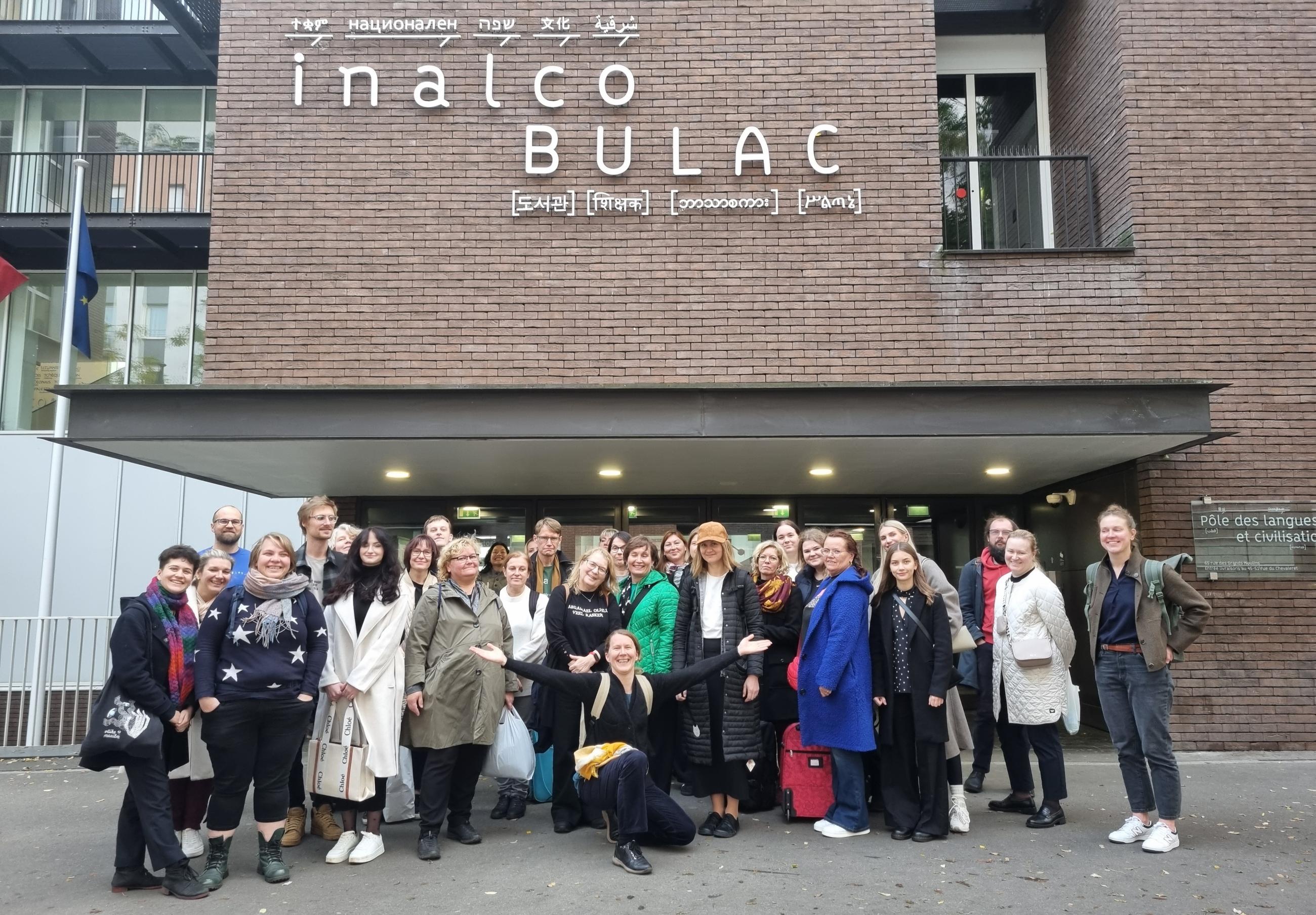
From 13–18 November, we immersed ourselves in discovering what kind of life the Estonian language leads in the wider world. We are happy to state that the language is full of vitality. Both at INALCO in Paris and at the European Schools II and IV in Brussels, the language bug is passed on to adults as well as to students of different ages.
Gerli Klammer:
“For me, it was a great surprise and joy to discover that Estonian is taught at INALCO in Paris. Even more so, there are several students there who have found their way to the Estonian language and are learning it with great enthusiasm. This realization filled me with pride and warmth, because seeing our language and culture reach different corners of the world is truly inspiring.”
Liis Viru:
“I am very grateful for the opportunity to visit INALCO in Paris together with students training to become teachers of Estonian language and literature and teachers of Estonian as a second language. I feel great respect and gratitude toward the students there who have chosen Estonian as their field of study. It was moving to hear how some students recalled their first trip to Estonia, their impressions of our country, and the interest in Estonian that began there. To think that this warmth travelled back home with them and influenced their choice of studies does something profound to the heart.
It was also a special opportunity to teach French students a bit about Estonia’s (historical) minorities, to share with them some of the most vivid moments from song festivals, but also to approach learning colours in a fun and dynamic way, and to tie the tongue into knots with an English–French–Estonian tangle while linking emotions and colours. However, the most unforgettable impression, and perhaps the greatest experience, was meeting the linguist and translator Eva Toulouze. Her wisdom, sensitivity, curiosity and warm humour will continue to inspire me for years to come.
A big thank you, merci and thank you – Erasmus teaches in a way nothing else does.”
Yes, indeed, the students were in Paris as part of a foreign internship, which meant that the trip was not limited to observation and familiarisation. They were responsible for teaching both language and culture. While giving language classes was a familiar format for students specialising in teaching Estonian as a second language, explicit, separate teaching of culture in the way it is done at INALCO was something none of the students had tried before. Both formats proved highly instructive. As can be seen from the reflections, the most striking aspect, however, turned out to be something as simple as learner motivation.
Lily Teppan:
“The motivation and desire of INALCO learners to study Estonian was very uplifting. The same words could describe the meeting with the wonderful Eva [Toulouze], who, despite her multicultural background, seemed more Finno-Ugric than many locals on Estonian soil.”
Karol Ahja:
“Studying at INALCO went on until late hours, and the different ethnic groups acquiring a completely foreign language and culture were astonishing, leaving everyone with the question: why are they doing this? Surely there must be some benefit in it for us. And what benefit do two young French women gain from learning Estonian in Paris? Perhaps we will soon be ready to understand just how uniquely mysterious our small country is, and how it draws in many humanities enthusiasts from around the world. None of them necessarily has to be chasing any particular benefit.”
Alexandra Reinla:
“We had a unique opportunity to meet a group of exceptionally motivated adult learners who had been studying Estonian for only two months, yet whose enthusiastic approach and solid initial knowledge inspired all of us. This vividly demonstrated how strong the interest in Estonian language and culture is even far from Estonia!”
Maria Badjuk:
“Our study trip offered me many new experiences and opened up a different perspective on the subject matter. Most important was the opportunity to see and experience what we otherwise only read about in books or hear about in lectures. Being there in person gave the knowledge a concrete and lively background – people, environment and cultural nuances. It was also very interesting to meet and listen to people whose mother tongue is French but who are learning Estonian. This inspired respect and admiration for their dedication.
Personally, I am used to working more with children, so it was a special experience for me to see how adults learn. Their approach and motivation are entirely different. They make conscious choices, often study late in the evening after a workday, and take language learning very seriously. This experience gave me new ideas for my own teaching practice as well.”
Kätlin Aron:
“As part of the Erasmus project, we had the opportunity to visit INALCO in Paris, where we were able to give a language and culture class. Already upon entering the school building, it was clear that this was an environment where multilingualism is not an exception but the norm. Our goal was to introduce Estonian language and culture to a small group of learners, and although the group was small, the experience itself was very meaningful. I was impressed by their sincere interest – even though their Estonian proficiency was mostly at beginner level, their willingness to think along and speak was clearly present.
INALCO left me with a very warm and inspiring impression. This experience reminded me that language teaching is never just about transmitting words or grammatical forms. It is an encounter with a person at their most vulnerable and at the same time most hopeful point. And at INALCO I met people who reminded me why I want to teach at all. It is about listening, the art of noticing, a small shared step toward where the learner themselves wants to go. Language teaching is a dialogue that happens even when words are still scarce, because understanding sometimes arises even before the sentence is complete.”
We were indeed warmly welcomed at INALCO, and it was interesting to discuss local language teaching principles and approaches, as well as cultural context and needs, with Estonian language lecturer Riina Roasto and Professor Eva Toulouze.
Inga Kaup:
“It was a very interesting experience, because INALCO is the only university in France where Estonian can be studied, and therefore some learners attend via Zoom, as they do not live in Paris. Interestingly, many learners do not have a direct connection to Estonia; they started learning Estonian because they liked how the language sounded when they heard it, or because they became interested in Estonian culture and wanted to learn more. To learn Estonian, they create each course themselves. They have a textbook as a basis, compiled by Riina Roasto, Merit Kuldkepp and Antoine Chalvin. We also became acquainted with Eva Toulouze and had more in-depth discussions with Riina Roasto about how Estonian language teaching works there, as Riina is the teacher of the learners for whom we conducted the lesson. Riina has taught Estonian in Ukraine, Germany and now in France. Eva Toulouze is also an interesting person: she has Italian, Portuguese and French roots, but became interested in Finno-Ugric languages and thus arrived at Estonian. She has also worked at the University of Tartu and still spends every free moment she can in Estonia.”
Of course, travelling together also brings added value.
Lisanna Lajal:
“The trip was both educational and bonding with course mates. I learned a lot about my fellow students’ backgrounds and future plans, and now feel that group work is more enjoyable, as I relate to them also on a personal level. The trip also taught me how to organise accommodation, transport and scheduling. A useful experience in every sense.”
Our self-improvement journey then took us onward to Brussels, where we visited two schools where Estonian can be heard. At the European School IV, we were welcomed by Kerttu Maripuu, thanks to whom we were able to observe various lessons of the Estonian section – that is, to follow instruction in Estonian not only in language and literature classes but also in environmental studies, mathematics and biology. At the European School II, we were greeted by Edward Kess, who demonstrated one literature lesson and one Estonian language lesson for us. It must be admitted that real contact with cross-border colleagues tends to be inspiring in nature, and it is more than likely that, in a larger or smaller group, we will find ourselves again somewhere learning, doing an internship, observing, following and studying.