
APAIE 2026: Asia is shifting from a source of international students to a global magnet for talent
At the end of February, the Asia-Pacific higher education conference APAIE 2026 (Asia-Pacific Association for International Education) took place in Hong Kong, where Tallinn University was represented by Head of Strategy Mikk Kasesalk and Senior Specialist of International Cooperation Anete Elken. Bringing together more than 3,300 delegates, the conference confirmed that Asia’s role in global higher education is changing rapidly: whereas the region was once seen primarily as a source of students, it is now increasingly becoming an attractive destination for international talent.
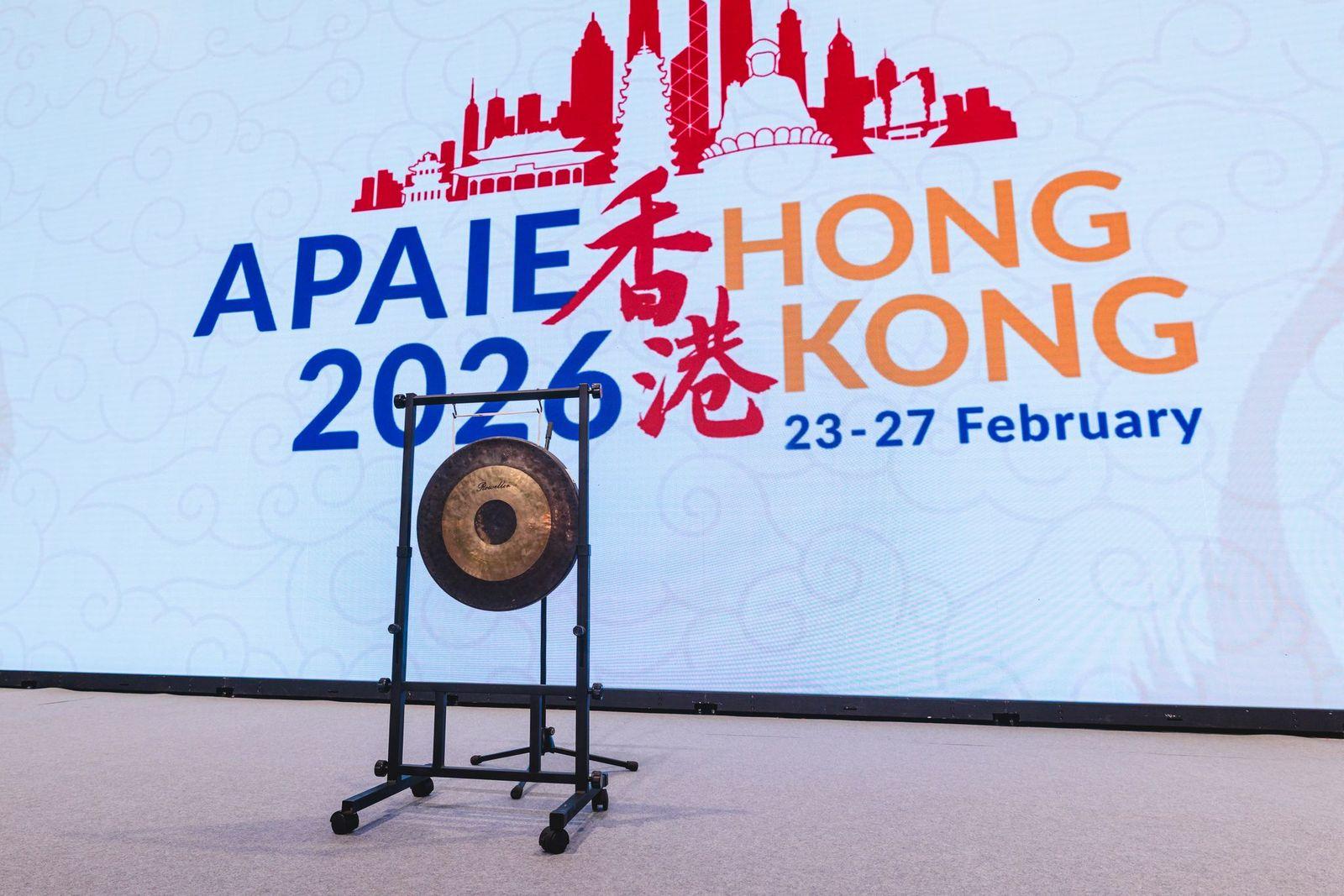
In Asian countries, higher education is closely linked to economic growth, technological development, and labor policy. These countries are no longer focused only on sending students abroad, but are deliberately creating conditions to attract international learners and specialists. The significance of these ongoing changes, and the desire to better understand the processes behind them, was clearly reflected in the fact that nearly half of the APAIE conference delegates were representatives of European countries.
Asia is linking higher education ever more closely with the labor market
A clear message from the conference was that the strategic direction of Asian countries is to connect education more consciously with the labor market, economic development, and society. The so-called career-first approach stood out, in which the value of higher education is measured by how quickly and smoothly it helps graduates enter the labor market. To support this, curricula are being made increasingly flexible, and AI skills and data analytics are no longer limited to technology-related fields but are spreading across all disciplines.
This direction is also supported by national talent policies. For example, Hong Kong has positioned itself as a talent hub and created the Top Talent Pass Scheme (TTPS), which allows graduates of the world’s top universities to enter the country without a prior job offer, even though this is normally required. South Korea has introduced a kind of “fast track to citizenship,” which grants science and technology master’s graduates a residence permit or citizenship in just three years, half the usual time. Japan, meanwhile, has launched the J-Find visa, which allows graduates of top universities to come to the country for up to two years to look for work or start a business. Vietnam is strategically sending students to study at foreign universities, including in Eastern Europe, in fields of strategic importance such as semiconductors and artificial intelligence, in order to support the development of its high-tech industrial base. These examples clearly show that the focus is no longer only on starting studies, but also on how to connect international students with the local labor market and society after graduation.
What does this mean for Tallinn University?
For Tallinn University, the conference highlighted several important strategic questions: are we able to take advantage of emerging recruitment markets, how can we turn the growing demand for short-term mobility to our advantage, and how can we adapt to the shift in competition from the university level to the national level?
One of the most important opportunities lies in emerging recruitment markets, especially India, Vietnam, and Indonesia. In India, the number of learners is growing faster than the local higher education system can accommodate, which is leading more and more young people to seek study opportunities abroad. In Vietnam, families invest a significant share of their income in education, and interest in studying abroad is high, especially at the bachelor’s level. Indonesia’s young population and government scholarship programs also create strong potential for international cooperation. All of these target groups are looking for high-quality and safe European education.
The second important issue concerns the growing importance of short-term mobility. For example, universities in Hong Kong are required to provide at least half of their students with an international learning experience, but shorter and more flexible solutions are often preferred over semester exchanges. While international experience used to be associated mainly with semester-long or year-long study mobility, there is now increasing demand for short intensive programs. This creates a good opportunity for Tallinn University to further develop summer and winter schools and other short-format programs, especially on topics such as artificial intelligence, educational innovation, digital transformation, and the European cultural space.
The third strategic issue is related to the new level of international competition. Competition for international talent is increasingly taking place between countries, not only between universities. If countries such as South Korea and Japan are offering increasingly attractive visa and career opportunities to international students, then Estonia and its universities, including Tallinn University, must also be able to offer not only high-quality education, but also a clear career perspective and an attractive living environment.
The main message of APAIE 2026 was that internationalization no longer means only student exchange, but increasingly global competition for talent. For Tallinn University, this means a need to make its offer more career-oriented, strengthen short-term mobility opportunities, and target more consciously those markets where demand for high-quality and safe European education is growing. Estonia’s image as a digital state, along with its study and living environment, may be clear advantages in this competition.