
Katrin Niglas: science means responsibility – not just to discover but to share, explain and serve
On 28 November 2025 Tallinn University conferred doctoral degrees on 22 new graduates who had defended their dissertations during the past year. The Vice-Rector for Research Katrin Niglas said in her speech during the conferment ceremony that there is a lack of clarity in this world as change is accelerating and information is overflowing. Science brings order and clarity to this chaos and it is the duty of scientists to ask what is the evidence, what is the context, what are the prerequisites and whether the conclusion matches the data.
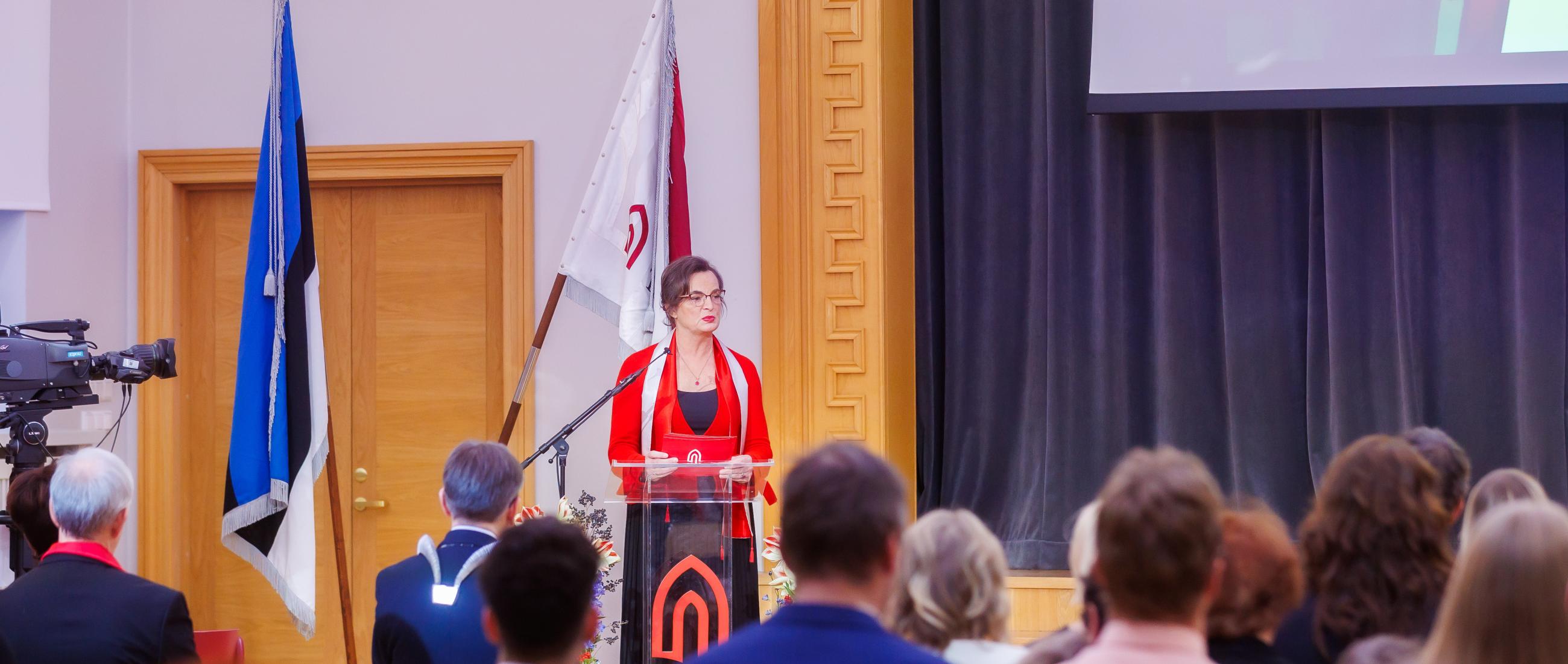
Dear Doctors, esteemed supervisors, dear companions!
I am joyful that we can congratulate 22 bright young people who, some years ago, set their sights on earning a doctoral degree. This journey and dedication to research may seem un-reachable or even frightening to many.
That is why it feels especially apt to recall words spoken hundred years ago by Marie Skłodowska-Curie: “Nothing in life is to be feared; it is only to be understood. Now is the time to understand more, so that we may fear less.”
Dear newly graduated doctors, I am sincerely grateful that you possess such abundant grit to walk this path toward greater understanding — and to share the knowledge gathered along the way. Fear constrains; understanding, by contrast, liberates and enriches!
When the parliament was preparing to decide on the founding of Tallinn University some 20 years ago there were only a few questions in the main hall. The substantive question concerned the research capability of the new Tallinn University and its potential to grow. This question, mixed with doubt, raised another: does the new university deserve the name Tallinn University or should we be more humble and take perhaps another name, such as Tallinn Municipal University?
It's true that up to that point the number of defended doctoral dissertations was under 40 in barely five years. As one of the lecturers who had just received a doctoral degree at our home university, I followed these discussions anxiously. Proposing the status of Tallinn University seemed like a stimulating and ambitious act of courage. But also a certain amount of trembling came with the responsibility this goal entailed.
Today I am still stimulated by the future of Tallinn University because our ambition has not waned. However, I am free of trembling because we have walked firmly along the road of deeper understanding and have joined the ranks of internationally recognized research universities. In the light of today’s celebration, I counted all the doctoral dissertations defended at our university. Over a quarter of a century, we have given Estonia, and the world, nearly 500 new scholars – 500 creators of top-level understanding.
Why is research important particularly today? Why do I claim that the one hundred years old statement by Marie Skłodowska-Curie is acutely relevant? Because the world is changing and at an ever increasing pace. There is more information now than ever before but clarity is often lacking. Science creates order and comprehension in this complexity. Science, the scientist asks: what is the evidence, what is the context, what are the prerequisites, does the conclusion match the data.
We know that science is not merely a heap of knowledge and facts, but above all a way of thinking. Science is the ability to ask better questions and to remain open and critical toward possible answers and solutions. Science is courage to be critical and to question everything. Science is humility to admit when we do not know and to work with dedication to find out. Science is a responsibility not only to discover, but to share, to explain, and to serve.
Sometimes the road to greater understanding is a straight line but usually it is not. But in this movement on the border where the known and the unknown meet the New emerges. On this road of science, the scientist is ready to reevaluate their knowledge, correct their solutions. Science done in good faith is not afraid of change when the horizon, focus and evidence adjusts and changes.
Surveys show that Estonians are believers in science. But in the whirlwind of politics one gets the image of science as a luxury that we might not be able to afford.
I dare claim that our thinking should be the opposite. Science gives us the foundation upon which the confidence and survival of society can stand. The work of scientists and the fruit it bears is a societal treasure. I know that some may doubt if it really is so.
Indeed, science should never exist only for itself or remain as words closed between the covers of a book on a library shelf. Science means a duty to share – the research community has repeatedly been reminded of this by the president of the Estonian Academy of Sciences Tarmo Soomere. I shall use his words to remind us that "science will never defeat pseudoscience". To move forward with wisdom "science must engage society". We, as scientists, must understand that "a sequence of words is not information, information is born after it is received and when its meaning has been comprehended".
Yesterday’s goal—to complete a dissertation, an article, a project—becomes today’s responsibility: to make new knowledge visible. To shape the complex into a simple image — to be understandable in order to include. Researcher who follows the principles of research integrity and can explain clearly increases trust. Trust is the currency of science: we accumulate it slowly and may lose it quickly. Trust builds the bridge between science and society.
Dear new doctors—what do I wish for you but in reality for every experienced researcher?
Guard your curiosity and do not be afraid to show it; I know it does not wear out when shared.
Guard your courage – the courage to ask is a compass that will not abandon you even when the path disappears from the horizon for a moment.
Guard your faith in science, be exemplars and advocates of an intelligent lifestyle!
One more important thought: let us remember that science is a team sport. No work of research happens in isolation. On its path you find a supervisor, a good colleague, a fellow doctoral candidate, maybe a data technician, a librarian, a project leader, an editor, a reviewer, but most definitely family members, friends and acquaintances.
Thank you all!
Dear doctors! I wish you further enthusiasm, but also moments of Eureka and decisions based on them. Feel joy and be proud, always be ambitious. I will meet you on the roads of science!