
When Swords Sang and Spells Spoke: Old English Literature Translated to Finnish
School of Humanities Lecturer of English Alpo Honkapohja has recently completed a decade-long editorial project: a collection of Old English texts translated into Finnish. In what follows, we take a closer look at the volume and its background. Titled "Kun miekat lauloivat", the book brings together a wide range of Old English texts, many of them translated into Finnish for the first time. Edited by Honkapohja together with Aleksi Mäkilähde and Sara Norja, the volume also includes translations and background chapters by as many as sixteen contributors.
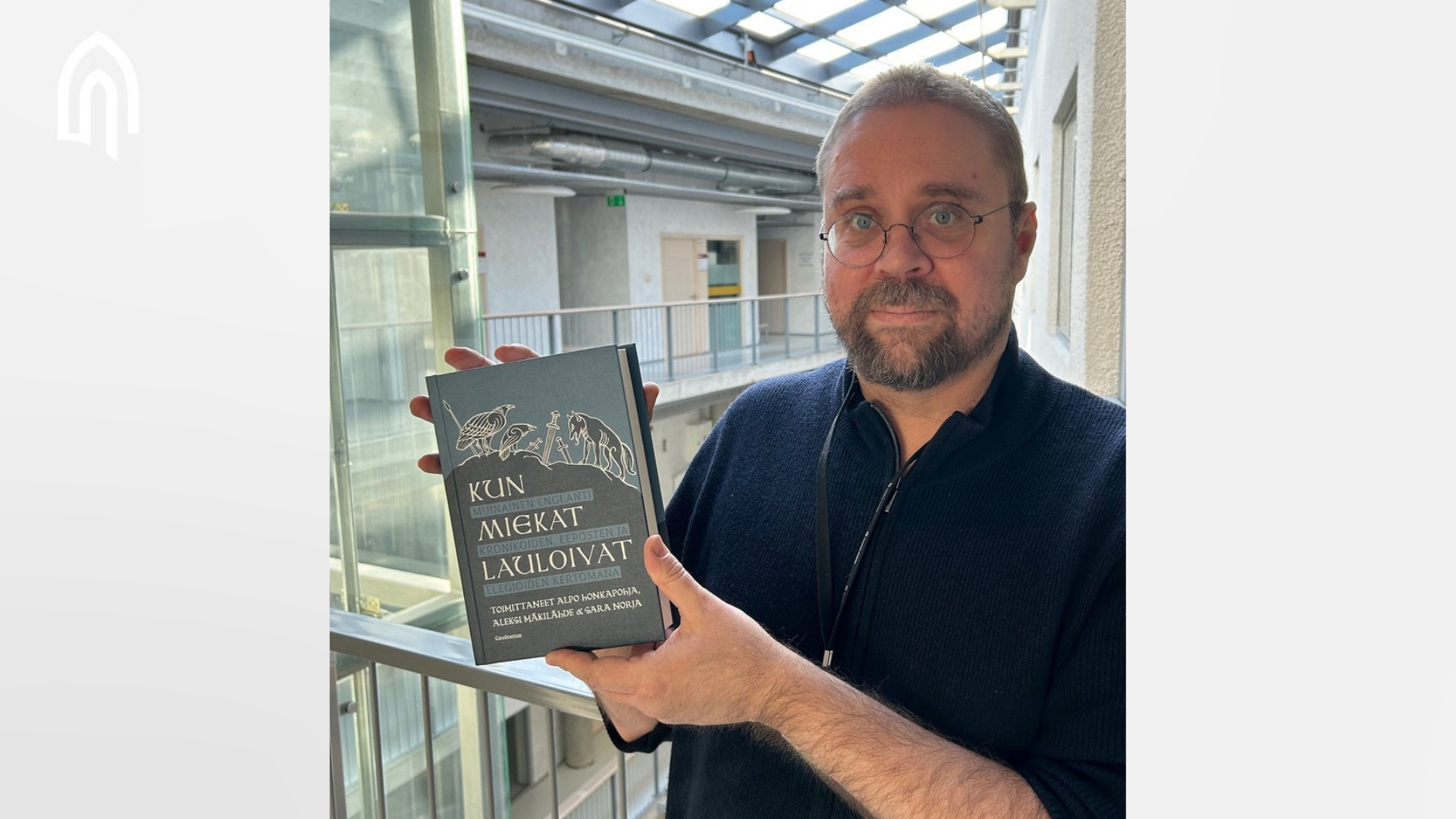
The book contains numerous Anglo-Saxon texts appearing for the first time in Finnish and background chapters, illuminating material that has inspired, for example, J. R. R. Tolkien, the creator of The Lord of the Rings.
Anglo-Saxons ruled Britain from the 5th to the 11th centuries between the collapse of Roman rule and the Norman invasion of 1066. They were the only culture in northern Europe to leave behind a major body of literature in a vernacular language before the year 1000. It is encompassing homesick elegies, religious texts, medicinal recipes, spells, and heroic poems - including the epic poem Beowulf.
What inspired you and your co-authors to compile this volume?
The volume has been a long time in preparation. The initial project meeting took place in the summer of 2015, and the final revised manuscript was delivered to the publisher in early January 2026: more than ten years in total.
It has been a long and, at times, difficult journey, marked by the passing away of Dr Matti Kilpiö during the COVID19 pandemic. The volume is dedicated to his memory; his enthusiasm for Old English inspired several generations of students.
The genesis of the project lay in the realisation how many Old English texts have not yet been translated into Finnish ... as well as conversations between various people involved in teaching and researching Old English. Personally, I had been teaching OE as a part of the History of English module at the University of Zurich, where I did my PhD, and really enjoying it. I have long been fascinated by dead languages and historical linguistics ... I've also learned Latin and Old Norse. Back as an undergraduate student in Helsinki I took a course in Old Norse at the Scandinavian department of University of Helsinki. The final final assignment was a saga translation: mine was a translation of Grímms Saga Loðinkinna (The saga of Grimmr the Hairycheek/Grimmr Karvaposken saaga), which was later published in the anthology Egil yksikätinen (2013).
Similarly, many of the translations included in Kun miekat lauloivat are by then students of English at the University of Helsinki who took a course in Old English poetry taught by Dr Kilpiö in 2016 ... although getting the volume out took such a long time that the contributors had turned into former students.
Why is Anglo-Saxon literature still relevant today?
It is not for nothing that we speak about the 'Anglo-Saxon countries' when referring to England and its former colonies such as the US, Australia, etc.
While the British Isles have seen several waves of invasions and settlement, including the prehistorical settlement by Celts, the Romans, Scandinavian settlers during the Viking Age, and the French-speaking Normans - the English language is a direct descendant of the language of the Old English spoken by Anglo-Saxons - even if these other groups have all left their mark.
As a result, Anglo-Saxon heritage has been influential for the self-conception and culture of these countries. In Victorian England, for example, there was a cult of Alfred the Great. Major anniversaries related to him such as the 1000th anniversary of his birth in 1849 and one for his death in 1899 were celebrated with great pomp and circumstance. The guest lists for these events read like 'who is who' of the cultural elite of the time. Numerous writers like the poet Alfred Lord Tennyson took major influence from Old English... later modernists like Ezra Pound made their own interpretations of Old English elegies (The Seafarer).
In recent years, there's been a renewed surge of interest, with lots of new works set in Anglo-Saxon England. These include Bernard Cornwell's The Saxon Stories about the adventures of Uhtred of Bebbanburg and the tv series inspired by it... as well as Nicola Griffith's novels Hild (2013) and Menewood (2023) about the abbess Hilda of Whitby.
Also, when it comes to fantasy literature, it's difficult to overstate the influence of J.R.R. Tolkien, a professor of Old English at Oxford...
Most recently, I was really surprised to encounter an Old English healing charm - one I had translated into Finnish for Miekat - in the film Hamnet (2025). It is recited by Shakespeare's wife, who was implied to be a kind of folk healer ... or, less politely, a witch! The charm in question is known as Nigon wyrta galdor (the spell of nine herbs/yhdeksän yrtin loitsu) and it is famous since it includes pre-Christian elements such as invocation of the Germanic high god Woden (better known by the Scandinavian form Odin).
How does this material speak to modern readers or students?
Estonians might be interested in knowing that the Old English poem Widsith (also known as the Traveller's Song), which consists largely of a list of kings and peoples across Europe, contains what may be the earliest mention of the name Kalev. The text survives in a manuscript copy from around 970, but on linguistic and historical grounds may date back as early as the 7th century.
The poem includes the line:
Casere weold Creacum ond Cælic Finnum
[Caesar ruled the Greeks, and Cælic the Finns/
Caesar hallitsi kreikkalaisia ja Cælic finnejä]
This is an alliterative line, which juxtaposes Caesar, ruler of the 'Greeks' (that is, the Greek-speaking Eastern Romans of Byzantium) with Cælic, who is said to rule 'the Finns'. The ancient Finns are in rather distinguished company, but maybe the intention is to emphasize the contrast between the famous Greco-Roman world and the Finns who live in the farthest reaches of the earth.
It is tempting to identify Cælic as Kalev - although the final consonant is a bit of problem philologically, as there is no obvious sound change that would explain a Proto-Germanic /k/ matching up with a /v/ - these sounds are articulated in different sides of the mouth...
Also, it's not certain who 'finns' refers to - in Old Norse sagas finnas usually refers to the Sami people of Lapland rather than the ethnic group it refers to today.
What did you personally find most rewarding about working on this project?
I am actually ridiculously proud of the whole thing and especially the way we managed to wrap it up within the last couple of years. This is not really part of my day job, but more of a hobby and it's been a lot of work to make it happen...
The book is available HERE