
Preliminary Results of the Year of the Estonian Book 2025 Reading Study
On 26 November, Marju Lauristin presented the first results of the large-scale research project “Year of the Book Reading Study: Estonians and Books” at Tallinn University. The project focuses on mapping changes in Estonians’ reading habits and book culture. This is a quantitative study examining the reading behaviour of Estonians aged 15–79. The following post summarises the key ideas from Lauristin’s presentation, based on an overview prepared by Merilin Aruvee, lecturer of L1 didactics and applied linguistics.
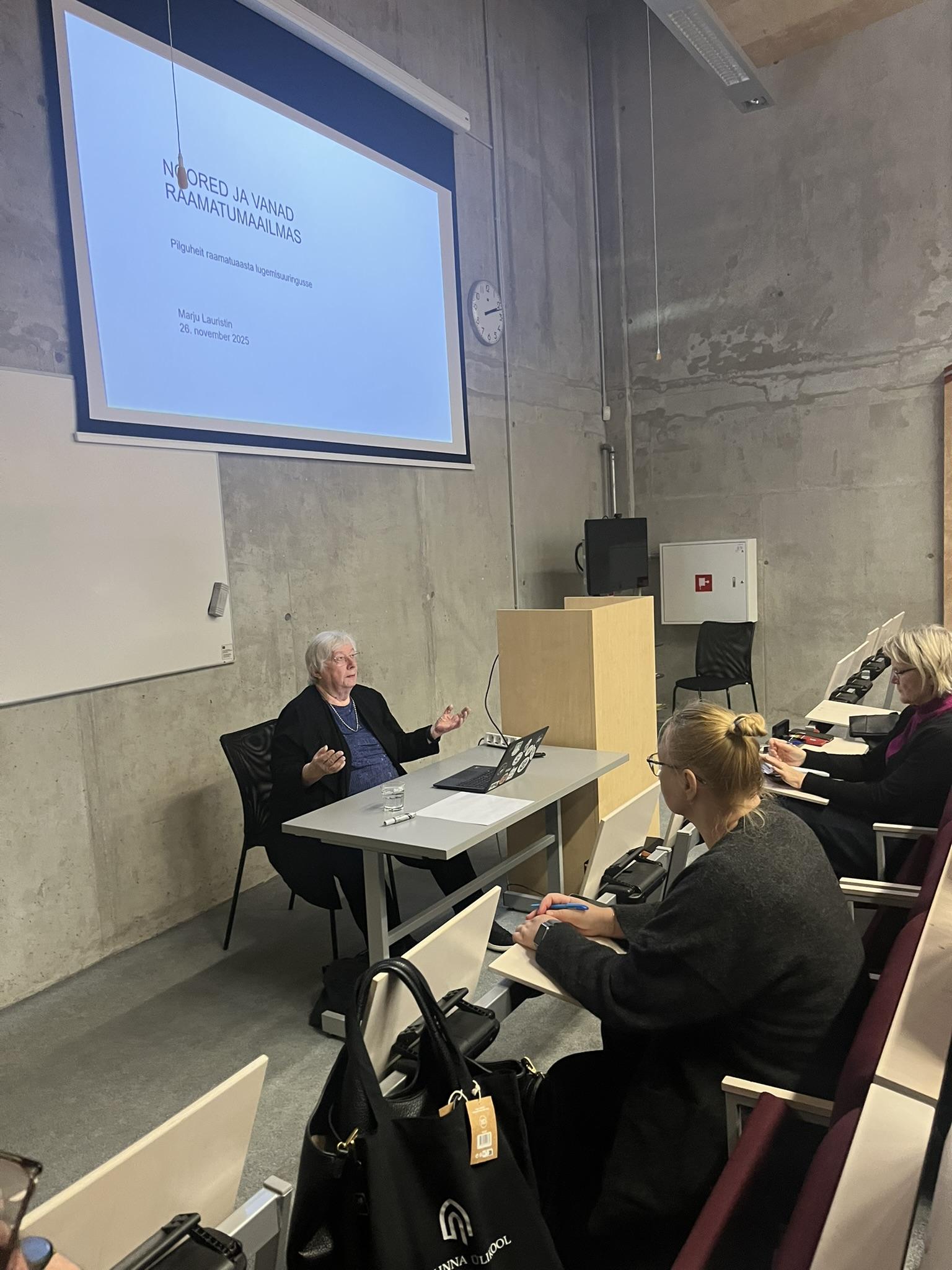
The most important takeaway from Lauristin’s presentation was that young people read just as much as older generations. Overall reading activity in Estonia and the reading activity of young people do not differ significantly. The difference lies in the fact that young people have begun to prefer reading from screens, although 75% of Estonians still read books in print. In addition, the younger generation consumes a great deal of English-language literature, which means that Estonian works are gradually becoming more distant for them.
Another important topic Lauristin discussed was reader clusters. A cluster is a group of respondents with similar characteristics, identified through the analysis of large amounts of data. It emerged that Estonians are most commonly versatile readers, meaning that they read widely and enjoy literature. Nevertheless, there are also many passive readers who read little or only occasionally. The smallest groups are book-averse and digital-centred readers, who essentially do not read at all, as well as those who read only when they are told that a book is good and worth reading. All clusters are represented among the older generation, but among young people some clusters disappear or change in size. For example, the digital-centred cluster has grown among young people, while at the same time reading in English and practical reading have remained prevalent.
The study also revealed other interesting facts. Fiction is read more than other types of literature. Women read more than men. There are similar numbers of readers in urban and rural areas. People with higher education have the strongest reading habits. The better the economic situation, the more people read. Writers from the Estonian SSR period and from the 1960s–1990s are better known by the older generation, whereas young people are more familiar with women writers.
Discussions took place during and at the end of Lauristin’s presentation, focusing mainly on how to guide young people more toward Estonian-language works. It was noted that young people’s cultural consumption tends to revolve more around rap, music, films and more contemporary literature, and that not reading major Estonian works may be linked to limited vocabulary. Instead of reading an entire book, young people often prefer summaries, although Lauristin pointed out that young people do understand that, in addition to watching a film, the book should also be read. However, young people no longer easily understand classical Estonian literature, either because their vocabulary has changed or because Estonian is their second language. This led to a discussion about why Estonian literature should be taught in schools at all and how to do so most effectively. It was concluded that the teacher plays the most crucial role. Teachers must foster reading habits in students and provide guidance. For those who read only English-language books, the world of Estonian literature must also be opened up. The question, however, is how to do this. For literature to reach students, the teacher themselves must have an interest in books—better yet, genuine enthusiasm. Teachers must also know how to work effectively with literary texts. Instead of asking whether a book has been read, one should ask whether what was read has become personally meaningful. At the same time, there are concerns related to the Estonian curriculum. Books should be addressed not only in literature classes but also in other subjects, such as history and environmental studies. The list of compulsory literature also needs review, as the current selection of mandatory books is difficult to justify. Estonian literature must be made meaningful for students so that this door, too, can open for them.
The reading study “Year of the Book Reading Study: Estonians and Books” consists of several components: a quantitative study, a qualitative study (including focus groups, libraries and schools), and an online reading survey. A more comprehensive overview of the project’s research results will be presented at the Year of the Book closing conference, organised by the Estonian Literary Society, the Estonian Literary Museum and the National Library of Estonia, and held at the National Library of Estonia on 13–14 March 2026.