Tallinn University’s role in the HUM Hackathon: From Archive to Insight – Activating Cultural Data
Between April 17–19, 2026 the Estonian Literary Museum hosted the first cultural data hackathon organised by the Estonian Digital Infrastructure for Research and Cultural Data (ETKAD), with the aim of bringing rich cultural heritage datasets into broader and more diverse use.
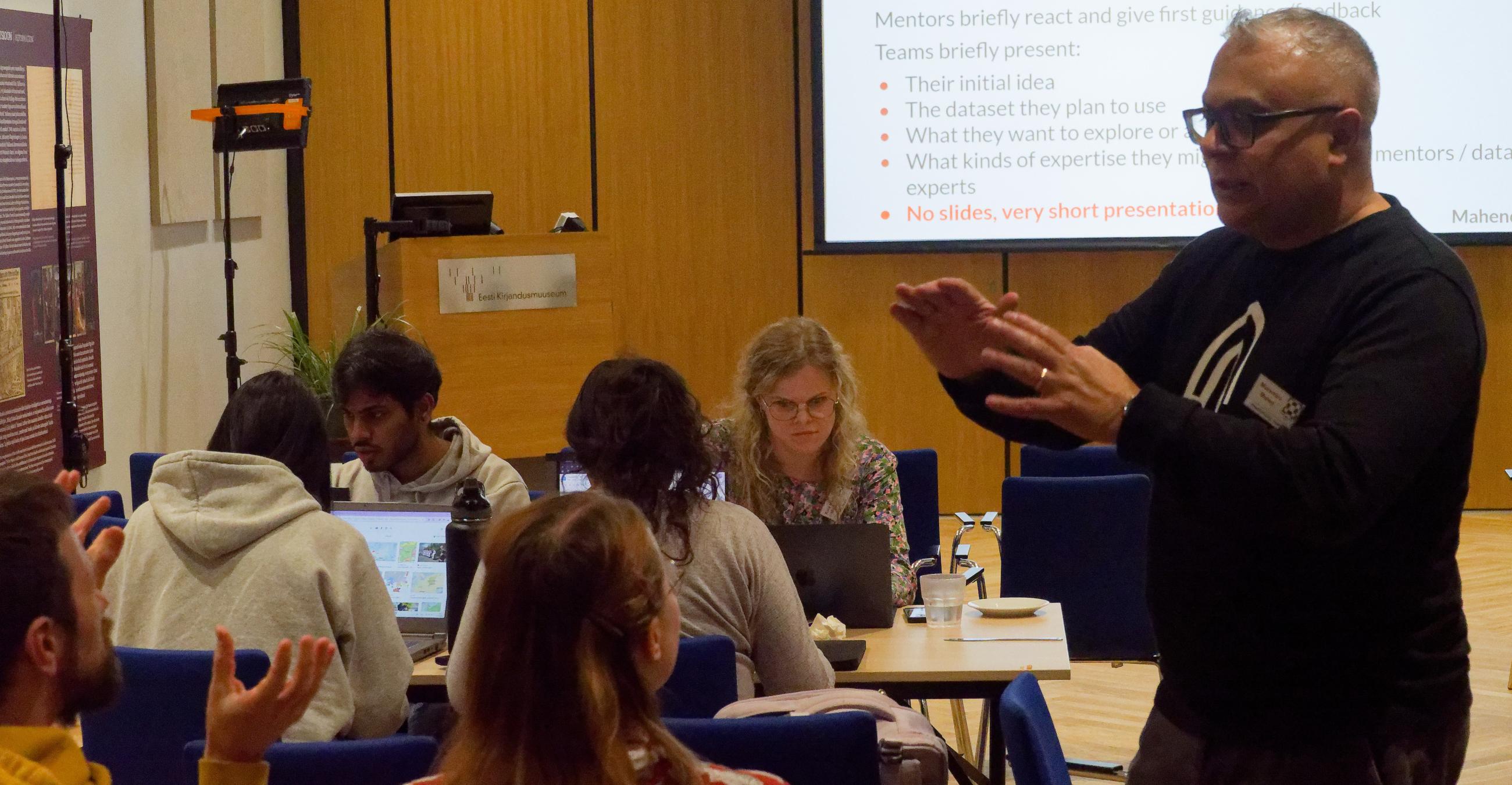
As representatives of one of ETKAD’s partners, Tallinn University staff were part of the hackathon’s organising team and also actively participated in roles such as data curators, evaluators, mentors, and participants.
For example, the team ‘Puzzled Maniacs’, which worked with the Estonian Database of Translated Literature created by Tallinn University, won second place at the hackathon. They were supported by data expert and mentor Daniele Monticelli, Professor of Semiotics and Translation Studies at Tallinn University.
Mahendra Mahey, Research Data Analyst at Tallinn University and one of the organisers said ‘the goal of the hackathon was to bring diverse cultural data, stored in and created by Estonian memory and research institutions, into new, creative, and research-oriented uses’.
Students and other cultural data enthusiasts who participated in the hackathon worked in interdisciplinary teams and developed prototypes of innovative products and services based on datasets made available during the event.
“The hackathon produced new map applications, interactive games, data analysis and database solutions. International teams from various fields worked very creatively with Estonia’s digital cultural heritage. For me, it is very important that the hackathon was culturally diverse, yet focused on Estonian cultural heritage. The fear that not knowing the Estonian language might become an obstacle on this journey proved mostly unfounded as there was plenty of advice and support available from the organisers and mentors. The winning team for example, didn’t speak much Estonian yet worked with an Estonian collection,” said Mahey.
The datasets used included cultural data collections from the Estonian Literary Museum, the National Archives, the National Library of Estonia, the Estonian National Museum, and Tallinn University.
In addition to the database of Estonian translated literature, the hackathon participants were also given access to a collection of historical glass shards created by Monika Reppo, a researcher at the Archaeology Research Collection.
Two students from Tallinn University (Tony Chan and Semjon Fedun) participated in the hackathon. The mentors included Mahendra Mahey, Jaagup Kippar, a distinguished lecturer in software engineering at the Institute of Digital Technologies, Mark Mets and Yan Aschadi, junior researchers at the Institute of Humanities. Maximillian Schich, a professor of cultural data analysis at BFM, served on the jury evaluating the participating teams. Mahendra Mahey organised an online warm up event over a week before the Hackathon. He was then master of ceremonies at the Hack Event, inspiring and passing on his experience of organising over 30 hackathons and running a cultural data lab at the British Library to the hackers.
The hackathon was organised by HUMAL Data Lab: Kaisa Langer (EKM), Mahendra Mahey (TLÜ), Mark Mets (EKM/TLÜ), Kata Maria Metsar (ERM), Aare Tool (EMTA), Olha Petrovych (EKM), and Mari Väina (EKM).
Tallinn University is one of the partners in the Estonian Research and Cultural Data Digital Infrastructure. The infrastructure is included in the list of state-funded infrastructures in the Estonian Research Infrastructure Roadmap. Tallinn University is represented on the ETKAD Council by Aija Sakova, Head of the Research Department.