
Lisa kalendrisse
iCal calendar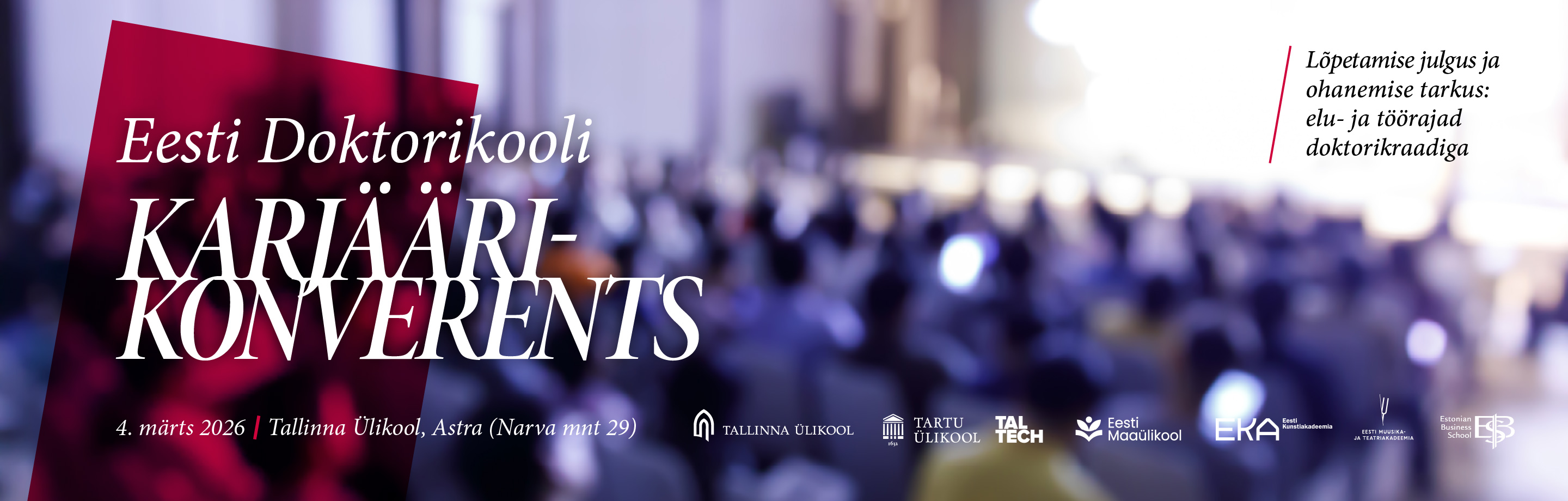
Eesti doktorikooli kolmas karjäärikonverents
Lõpetamise julgus ja kohanemise tarkus: elu- ja töörajad doktorikraadiga
Hea doktorant, magistrant, juhendaja ja doktoriõppe edendaja!
Tallinna Ülikooli eestvedamisel ja Eesti ülikoolide koostöös toimub järjekordne Eesti doktorikooli karjäärikonverents, mis toob kokku Eesti doktorandid. Sel aastal keskendume kahele kriitilisele etapile: doktoriõppe edukale lõpetamisele ning sellele järgnevale hüppele tööturule.
- Aeg: 4. märts 2026
- Koht: Tallinna Ülikool, Astra (Narva mnt 27)
Päeva juhib ja vestlusi suunab Joonas Hellerma.
Konverentsi fookusteemad ja vestluspaneelid
Konverentsi programm on üles ehitatud kahele suurele vestlusringile:
I paneel: "Lõpusirge: viimase aasta kogemused ja edukas kaitsmine"
Keskendume doktoriõppe viimasele aastale ja sellega kaasnevatele väljakutsetele. Kuidas hoida motivatsiooni kui kaitsmine on silme ees, kuid pinge kasvab?
Paneelis osalevad:
Katrin Kabun – Eesti Kunstiakadeemia doktorant ja tekstiilidisainer, kes on ka ettevõtja ja õppejõud. Tema uurimistöö keskendub lambavilla väärindamisele.
Elli Valla – TalTechi teadur, kes kaitses doktorikraadi 2025. aastal IT valdkonnas, uurides Parkinsoni tõbe. Ta töötab ühtlasi Tallinna Tervishoiu Kõrgkoolis juhtivlektorina.
Mikk Granström – Tallinna Ülikooli õpianalüütika teadur, kes kaitses doktoritöö 2024. aastal. Ta on PÖFF-i tegevjuht ning pälvis 2026. aastal Valgetähe V klassi teenetemärgi.
Valle-Rasmus Roots – Eesti Muusika- ja Teatriakadeemia nooremteadur ja tšellist ning dirigent.
Monika Reppo – Arheoloog ja Tallinna Ülikooli teadur, kes kaitses doktoritöö 2024. aastal Tartu Ülikoolis. Ta on tuntud ka kui teaduse populariseerija sotsiaalmeedias.
II paneel: "Karjäärirada pärast doktorantuuri – kuhu edasi?"
Arutelu keskmes on valikud pärast kraadi kaitsmist. Uurime, kas doktorikraad avab ukse võrdselt nii akadeemilisse maailma kui ka tipptasemel avalikku- või erasektorisse.
Saale Fischer – Klavessiinimängija ja ansambli Floridante asutaja, kes kaitses doktorikraadi 2020. aastal Eesti Teatri- ja Muusikaakadeemias. Praegu töötab ta Eesti Rahvusmeeskoori tegevjuhina.
Teele Paluots – Metsaökoloog, kes kaitses doktorikraadi 2025. aastal Eesti Maaülikoolis. Ta juhib Riigimetsa Majandamise Keskuses metsaökoloogide tiimi.
Imar Yacine Koutchoukali – Välisministeeriumi teadusnõunik, kes kaitses 2023. aastal doktoritöö Tartru Ülikoolis. Ta on tegev ka pärimusmuusikuna.
Sander Paekivi – Teoreetiline füüsik ja Tallinna Ülikooli teadur, kes kaitses kraadi 2020. aastal Tallinna Ülikoolis. Tal on töökogemus järeldoktorantuurist ja IT-sektorist ning ta on aktiivne teaduse populariseerija.
Praktilised töötoad
Kahe paneelarutelu vahel on osalejatel võimalus valida endale sobiv töötuba. Need on interaktiivsed sessioonid, kus eksperdid ja osalejad vahetavad kogemusi ning omandavad uusi oskusi.Töötubade teemad hõlmavad erinevaid teemasid karjääri kujundamisest, enda brändimisest teadlasena kuni tehisintellekti abile doktorantuuris.
| 10.30-11.00 | Kogunemine, hommikukohv |
| 11.00-11.15 | Avasõnad - Katrin Niglas, TLÜ teadusprorektor |
| 11.15-11.45 | “Ma ei jäänud ühte kohta – ja see oli teadlik valik” Janika Leoste, TLÜ tehisintellekti didaktika vanemteadur |
| 11.45-12.45 | Doktorantide ja doktoritöö kaitsnute vestlusring "Lõpusirge: viimase aasta kogemused ja edukas kaitsmine" |
| 12.45-13.30 | Lõuna |
| 13.30-14.30 | Töötoad (Valiku saab teha konverentsile registreerides) |
| 14.45-16.15 | Doktorikraadi omandanute vestlusring "Karjäärirada pärast doktorantuuri – kuhu edasi?” |
| 16.15-16.30 | Lõppsõnad - Aija Sakova, TLU Ettevõtluskoostöö ja teadmussiirde juht |
| 16.30-17.00 | Konverentsi lõpetame mõnusa olemisega – pakume kerget kehakinnitust ning laseme mõtetel vabas vormis lennata. |
Konverents on eesti keeles, soovijatel on võimalus sünkroontõlkeks.
Registreerimine on lõppenud.
| TÖÖTOAD INGLISE KEELES | |
| 1 | From research to reach: Using LinkedIn strategically as an early-stage researcher// Ulrike Rohn, TLU Professor of Media Management and Economics |
| This one-hour workshop introduces early-stage researchers to LinkedIn as a powerful tool for visibility, networking, and impact. Participants will learn why social media marketing matters in today’s research ecosystem where discoverability and visibility are key for impactful research and collaboration. The session shows how to translate academic work into engaging posts, build a professional profile that reflects one’s research identity and grow a meaningful network. Practical examples, simple posting strategies, and best practices for consistency and authenticity will be shared. | |
| 2 | How to become a chance-seeker?// Liis Nimik, TLU Junior Research Fellow |
| In film editing, everything begins with how we look at images. Do we see them as building blocks for a story, or as moments that move us? This one-hour workshop explores attention as a core editorial skill, focusing on narrativity and authenticity. Drawing on Roland Barthes’ concept of punctum, we first analyze still photographs to identify the small details that affect us, then extend this approach to moving images. Through film excerpts and discussion, we ask: what might punctum be in cinema? The workshop reveals how preconceptions shape our viewing and how openness can transform it. Grounded in a decade of teaching experience, the pedagogy is framed by Gert Biesta’s notion of subjectification and concludes with the concept of “chance-seeking,” a valuable tool for editors, researchers, and scholars. Prior requirements / preparation: Bring along your favourite photograph |
|
| 3 | Translation awareness and multilingualism in research// Katerina Maadla, TLU Junior Research Fellow |
| Translation and multilingualism are present in many stages of research, from data collection and analysis to writing and publication, yet they often remain unnoticed. This workshop introduces the idea of translation awareness and explores how language choices and translation practices can influence research processes, meaning, and interpretation. Drawing on key concepts from Translation Studies, participants will reflect on methodological, epistemological, and ethical aspects of working across languages. Through a short introduction, an individual reflection task, and group discussion, PhD students will be encouraged to consider how translation affects their own research projects and to develop a more conscious and transparent approach to multilingual research contexts. Prior requirements / preparation: Before the workshop, registered participants will be sent a short set of reflective questions to help them consider their research from the perspectives of multilingualism and translation |
|
| 4 | Failing Well in Academia: Lessons from Setbacks in Research// Ayan Shamchiyeva, TLU Junior Research Fellow |
| Inspired by the “F*ckup Nights” format, this workshop creates a safe and open space for PhD students to share experiences of setbacks, failures, and challenges in academia. Conferences often focus on success stories, which can reinforce impostor syndrome and unrealistic expectations about academic careers. By openly discussing failed experiments, rejected applications, career doubts, or changes in direction, the workshop aims to normalise failure as part of academic life. This session invites participants to openly discuss failed experiments, rejected papers or grants, career doubts, and changes in direction. Through small-group conversations followed by collective reflection, participants will normalise failure as a common part of research life, learn from one another’s experiences, and gain more realistic and humane perspectives on academic trajectories. No prior knowledge is required. Guiding reflection questions will be sent to registered participants in advance to help them prepare their thoughts and contributions. | |
| 5 | Making or Faking? Exploring Ethical Fabrication in Qualitative Research// Maliheh Keshmiri, TLU Junior Research Fellow |
| The workshop explores ethical challenges that arise when qualitative researchers work with sensitive narratives and other forms of multimodal data. Using illustrative examples from studies involving vulnerable groups, the workshop examines ethical implications of employing creative strategies such as composite narratives, data construction, and anonymizing transformations of text, images, or videos. Fabrication approaches are highlighted as effective tools for protecting privacy and enhancing confidentiality, especially in digital or public contexts where traditional anonymization may be insufficient. At the same time, the workshop addresses how researchers can balance these protective measures with the need to preserve the integrity and meaning of participants’ stories. Participants will reflect on how to navigate these ethical decisions and will gain practical guidance for making defensible methodological choices across diverse qualitative materials | |
| 6 | Designing for Uncertainty// Paulo Ferreira, TLU Junior Research Fellow |
| Most commercial Generative AI interfaces function as ready-to-go answer machines (means-end machines), delivering confident, opaque outputs that encourage unwanted cognitive offloading and copy-paste behaviour among students. This workshop - Designing for Uncertainty: Generative AI Interaction interfaces for Critical Engagement - invites participants to explore how interface design choices can shape the way users interact with Generative AI. Building on theories of Distributed Cognition, Desirable Difficulties, and Affordances, participants will engage in a "Wizard of Oz" simulation to experience the friction between performance and learning. Attendees will transition from passive users to active designers, prototyping new interface perceived affordances - specifically, "Cautious Explanations" - that are expected to trigger verification, uncertainty, and critical dialogue, transforming generative AI from an invitation to use it as it is into a partner that requires guiding | |
| TÖÖTOAD EESTI KEELES | |
| 1 | Kas teadlane peab mõtlema isikubrändile?// Aija Sakova, PhD, TLÜ ettevõtluskoostöö ja teadmussiirde juht |
| Töötoa eesmärk on kutsuda osalejaid arutlema isikubrändi ja isikliku teaduskommunikatsiooni strateegia loomise vajaduse üle. Kuidas võiks mõelda erinevate sotsiaalmeedia vahendite rollist oma teadlase kuvandi loomisel? Mida võtta arvesse oma teaduskommunikatsiooni tegevuse planeerimisel?Loe lisaks: Võtta sõna ja rääkida teadusest – miks ja kuidas? - Sirp | |
| 2 | Doktorandi karjäärivõimalused ja -väljakutsed// Kadri Pakaste, TLÜ karjäärinõustaja |
|
Töötoas kaardistame doktorantuuri rolli tänapäeva tööturul ning arutleme teadlase teega kaasnevate takistuste ja võimaluste üle. Jagame praktilisi nõuandeid karjääri planeerimiseks ja fookuse hoidmiseks olukorras, kus valikuid on rohkem kui kunagi varem. Tule ja saa inspiratsiooni oma potentsiaali maksimaalseks ärakasutamiseks! |
|
| 3 | TI rakendused doktorandi assistendina// Marge Kusmin, PhD |
|
Töötoas tutvustatakse tehisintellekti tööriistu, mis toetavad doktorandi igapäevatööd teadusartiklitega (artiklite otsimine ja analüüs Elicit, Connectedpapers, NotebookLM; tõlkimine, kirjutamine, õigekirjakontroll: ChatGPT; teksti visualiseerimine ja esitlemine: Napkin, Gamma, Curipod). Praktiliste tegevuste käigus vaatame samm-sammult eelpool nimetatud rakenduste võimalusi ning osalejad saavad luua enda püstitatud küsimuse või märksõnade põhjal leitud teadusartiklitele tuginedes: artikli mustandi, täiendada seda visuaalidega ning luua teemat tutvustava interaktiivse esitluse.Lisaks praktilistee tegevustele selgitatakse töötoas TI kasutamisega tekkida võivaid probleeme ja ohte. |
|
| 4 | Doktorantide võrgustumine eile, täna, homme// Doktorantide Selts |
| Eestis polnud ühtegi ülikoolide ülest doktorante koondavat organisatsiooni, mis võimaldaks kaasa rääkida nii riigi kui ka Euroopa tasandil. Alates 2024. aastast on Doktorantide Selts üritanud seda lünka täita ja aktiivselt kaasanud liikmeid igast Eesti ülikoolist. Selts ei ole klassikaline ametiühing, vaid ühendab alustavaid ja juba tegutsevaid teadlasi nii seminaride kui ka meelelahutuslike üritustega, sest koos tegutsedes on mured väiksemad ja rõõmud suuremad. Tule töötuppa, räägime doktorantide esindatuse vajalikkusest, tutvu teistega ja seltsi tegevusega ning anna Doktorantide Seltsile hoogu juurde! |
Projekti "Ülikoolide koostöö doktoriõppe edendamisel“ (2021-2027.4.04.24-0003) kaasrahastab Euroopa Liit.
Lisainfo
Ursula Haava
TLÜ doktoriõppe talituse juht
ursula.haava@tlu.ee
5620 4482