
From Mexico to Tallinn: Ileana Domínguez Reflects on Her EduInno Journey
What is it like to move across continents to study educational innovation in Estonia? In this student interview, EduInno master’s student Ileana Domínguez shares her reflections on choosing Tallinn University, discovering the Estonian education system, and adapting to a new academic and cultural environment. From initial expectations to surprising discoveries, she talks about how the programme has shaped her learning habits, broadened her perspective on education, and offered a truly multicultural and challenging experience.
What did you know about Estonia and Tallinn University before you came here?
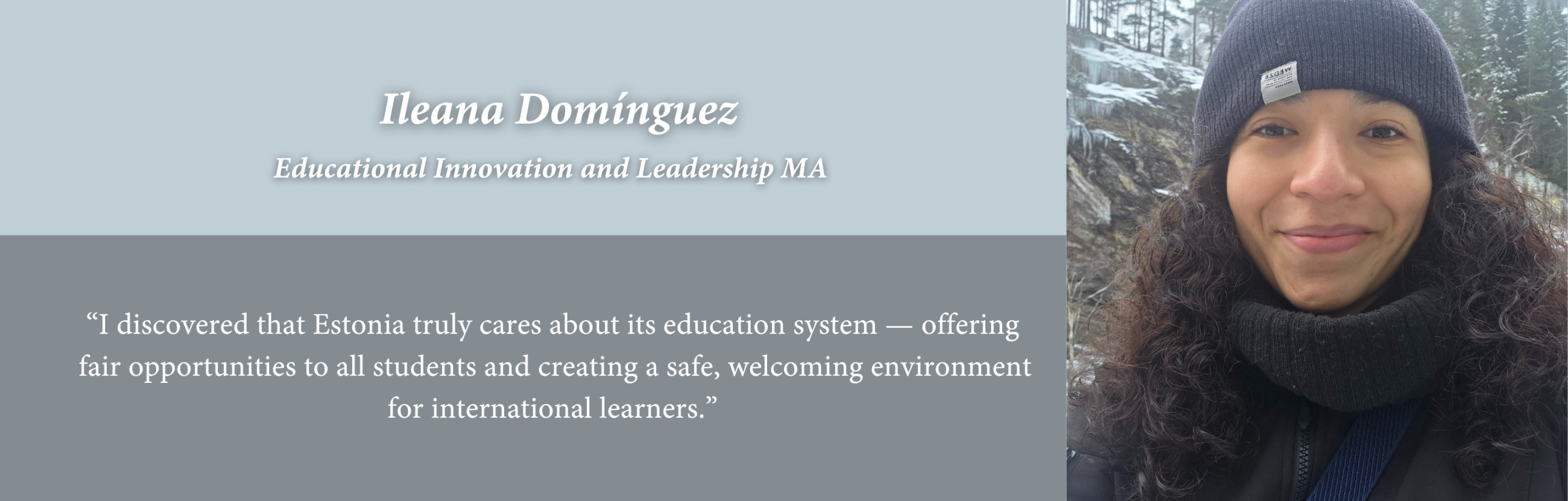
To be honest, I didn’t know anything about Estonia before making the decision to study here. Once I became interested, I looked for information about the master’s program, life in Tallinn, and the pros and cons of such a step in my life. Fortunately, apart from searching on the internet, I received valuable insights from the program coordinator, Salome Khurtsidze, as well as from a couple of alumni. I found out that Estonia cares about its education system, particularly about teachers’ laboral conditions and about providing fair opportunities to all students regardless of their economic background, which has led to success in international standardized tests such as PISA. At the same time, I discovered that Tallinn is a safe city, and welcoming to immigrants. I found myself drawn to the master’s program because, apart from offering solid theoretical foundations, it also provides opportunities to carry out practical projects in addition to the master’s thesis, and, importantly for me as a Physics bachelor’s graduate, it was inviting for those who didn’t have formal training in Education, but who possessed interest and concern about the subject. All of those reasons contributed positively to my decision.
How did you hear about Tallinn University and EduInno programme?
I searched on the internet, while looking for master’s programs on innovation in Education. It was useful to attend the seminars that were offered during the admission process.
What was your perception of the Estonian educational system before you arrived?
My perception was mostly based on the text “Aim high and work hard. Building a world-class learning system in Estonia”, written by Eve Eisenschmid and other authors. In particular, the aspects that I found most inspiring were the effective practice of equity, which is reflected in family-friendly policies, the same standards for private and public schools, free healthcare and school materials, etcetera; as well as the concept of lifelong learning, which I hadn’t encountered before. Both of these are valuable and deeply interesting concepts to me, as Mexico, my country of origin, is a contrasting nation where family economy plays a decisive role in a child’s education future, and, additionally, I think of learning as a beneficial and almost vital process in everyone’s life, one that starts commonly in schools but shouldn’t be limited to them. Overall, I was, and I still am, excited to see the educational practices that have brought success in Estonia.
What is the most surprising thing you have encountered here (culturally or otherwise)?
Personally, I didn’t know that language is deeply tied to my culture and personality. Even though I practice English daily and it is hopefully improving, I still feel that there’s a part of me that only arises when speaking my mother tongue. At group level, it has been fantastic to meet people from various countries and learn from them; surprisingly, although having been raised in contracting scenarios and coming from diverse academic backgrounds, we have a lot in common. Finally, at the city-country level, I was amazed by the quality of Estonian schools, especially when we had the opportunity to visit public educational establishments; they definitely raise the bar for themselves and set an excellent example for us, international students.
Was there anything you thought about Estonia or the educational system here that completely changed after you started your studies?
Something that has changed is how I approach my studies. I used to be more passive and teacher-dependent, but I now work to become more self-directed and independent. As we don’t attend classes from Monday to Friday, we are given the opportunity to do autonomous reading on some days (which has been interesting, because I get to know what habits work best for me to develop lasting learning and, at the same time, it is possible to get deeper into those topics that are more meaningful to me). Simultaneously, some of our teachers practice the flipped classroom approach; therefore, we are expected to gain some understanding of the class topic before the class takes place. I consider these changes to be important gains in my learning path.
If you could describe your studies in Estonia in just three words, what would they be?
Multicultural, opportunity-rich, challenging